

by Bogdan Munteanu
It’s not seldom that we are amazed with the news that high-achieving professionals often enjoy themselves by practicing their talents in arts. A world class diplomat like Condoleezza Rice has been mastering the piano since childhood. Actor Bruce Willis plays the harmonica. Google co-founder Sergey Brin hired Eric Clapton and Keith Richards from the Rolling Stones to be his blues guitar teachers. And examples could go on. Many people who reach top levels in their fields of activity – top-noch surgeons, lawyers, bankers, economists and others who are rarely known to the general public – contantly engage in artistic activities. Some do it as if their beloved form of artistic expression were their ‘second nature’. There is a high likelihood that they could have been as good artists as they are respected professionals in their current positions. Others are merely ‘fooling around’ – yet the fact that they are not very talented doesn’t prevent anyone from having a good time. It is pointless to quantify the usefulness of fine arts in terms of palpable outcomes and profit. However, this doesn’t mean that dedicating oneself to a passion can’t be somehow… economically viable.
Here’s an excellently put example in support of this view, offered by Chip Fournier, Senior Vice President at NBC Universal. Despite not being endowed with a remarkable talent, he regularly plays in an amateur band playing covers of great rock bands. This is “a way of dealing with a midlife crisis, it’s cheaper than a Ferrari and less distruptive to family life than a mistress”, Fournier said, quoted by The Wall Street Journal. Some would argue that any of these successful people can, due to their comfortable financial status, afford the luxury of moonlightning as artists. Actually, numerous researches carried out by various universities around the world support the opposite view: these enviable people owe their success to their passion for arts, whether or not they took formal art classes or learned by themselves.
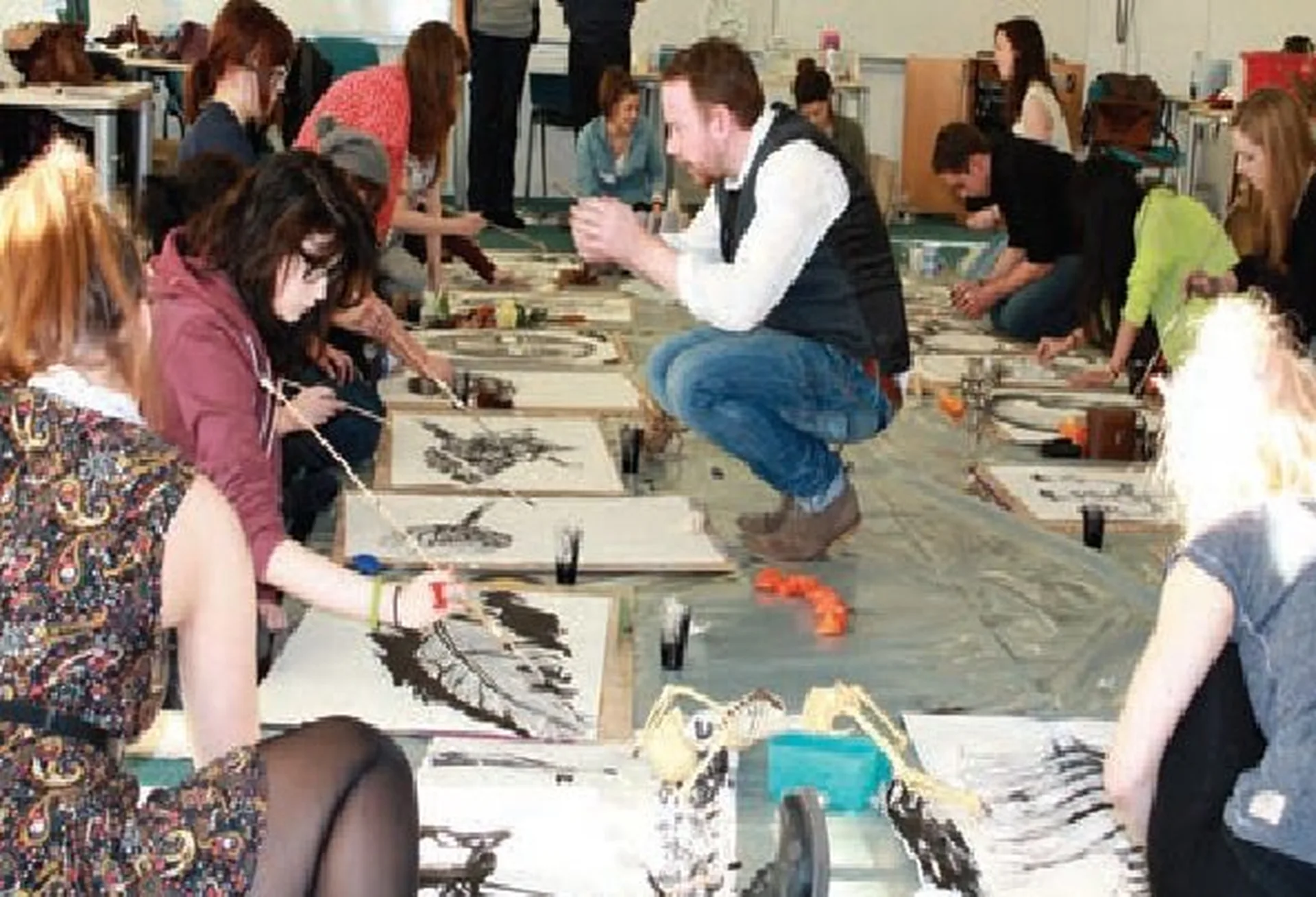
Art classes improve a child’s chances of a successful life
It’s been a decade since the think-tank Rand Corporation published a report called “A Portrait of the Visual Arts” (2005) asserting the social benefits of art classes. Students from lower income families, who otherwise got very little or no exposure to art at home, had better prospects in life if art education was part of the school curriculum. Similarly, a study of the New York Solomn R. Guggenheim Museum (2006) measured the performance of children involved in a pilot program that placed artists in schools. Kids who had been taught how to create their own artworks performed better on six categories of literacy and critical thinking skills than their counterparts not part in the program. In 2010, the second edition of a study issued by an American NGO advocating a strong presence of art in schools (Art Education Partnership – AEP) compiled the results of almost a hundred different researchers. AEP drew the conclusion that there is a direct link between the number of art classes students took and their performance on standardized tests on all other subjects. Also, these children expressed more developed social skills. Other researches showed that children whose artistic inclinations are stimulated have a more satisfying life – and so confirmed their teachers from other subjects, not related to art! – and are less exposed to the risk of school dropout. Involvement in art has been associated with better performances in mathematics, reading, cognitive ability, critical thinking and verbal skills. Art education also improves motivation, concentration, confidence and teamwork.
Art is good for business and good for the brain
A bold claim was made, in 2013, when the findings of a research done at the Michigan State University (MSU) were presented: “A young Picasso or Beethoven could be the next Thomas Edison” – the latter, known as the inventor of the light bulb, being regarded as an archetype of both a brilliant scientist and visionary entrepreneur. The MSU team found that a sustained participation in art activities since childhood and continuing into adult life means that “you are more likely to be an inventor as measured by the number of patents generated, businesses formed or articles published.” This can be explained by the fact that art encourages out-of-the-box thinking. Using artistic skills (such as analogies, playing, intuition and imagination) in order to solve problems is very similar to the process of inventing a new product, improving another or finding solutions to attract customers, the MSU researchers said. Ultimately, art education was endorsed even by a team of neurologists from the Johns Hopkins University (JHU) of Baltimore in a 2009 study: “Neuroeducation: Learning. Arts and the Brain.” They witnessed that those whose brain was trained to achieve better motor control, attention and motivation while practicing a form of art (especially playing an instrument) would eventually transfer these improved capabilities to their entire brain. Their concentration and efficiency in any activity, along with their socalled fluid IQ (the capacity to solve new problems, under new circumstances) were all improved. And so were their overall academic and social abilities.
An abundance of ignored evidence in favour of arts
The JHU teams appears to have just reinvented the wheel, since 2,400 years ago Greek philosopher Plato said the same thing: “Music is a more potent instrument than any other for education, because rhythm and harmony find their way into the inward places of the soul.”
Over the centuries, many scholars and statesmen spoke in favour of introducing art classes in education, so there is no wonder that today’s world famous entrepreneurs think alike. Let’s stop to just a couple of examples: “The arts have a crucial impact on our economy and are an important catalyst for learning, discovery, and achievement in our country”, believes Paul Allen, Co-founder of Microsoft and a passionate guitar player. “A broad education in the arts helps give children a better understanding of their world... We need students who are culturally literate as well as math and science literate”, said Paul Ostergard, Vice President, Citicorp. Unfortunately, in spite the abundance of scientific evidence about the benefits of artistic activities in education – presented in hundreds of
researches – art remains the ‘black sheep’ in many education systems. The most common excuse is the lack of financial resources, but could the root cause be a sort of intentional neglect?
Among other aspects, art education improves language development, decision making, visual-spatial skills, inventiveness and cultural awareness. All these can lead to the emergence of independent, responsible and assertive citizens who may pose a threat to the political statu quo in any country, be it an economically developed democracy.

In 2013, a bold statement was made when a study conducted by Michigan State University (MSU) was presented: "A young Picasso or Beethoven could be the next Thomas Edison" - this one from the next inventor of the light bulb, I consider the archetype of the brilliant scientist but also of the visionary entrepreneur.