Interview by Bogdan Munteanu, Photo Mihaela Matei
How hard was it to get to the current professional recognition?
I avoid clichés like the one that it was very hard and I had days and nights working. It might be too much. I had a few major chances throughout my professional path. The first was to pass the exam at the University of Law in 1989, a second chance – to grow up in the military service with an exceptional group of friends and a third – to be a member of the first generation that started right after the fall of communism. We were the first students who witnessed the making of the new legal system in Romania. Fourth, we had a great chance to start law in a time when it was virgin territory. In 1993, when I started, very few people knew what business law was. I counted on my fingers the people who knew where the profession was heading to and these were rather visionaries. A fifth chance was to start my career near one of those visionaries: Gheorghe Muşat. Then, in a chronological order, I had the chance to take the decision to start my own company in 2005 with a team of highly competent people. Our decision coincided with a very good state of the economy. Regarding my income, it saddens me that it ends up being subject of gossip. I declare how much I earn, but do not want to dwell on this subject.
About anyone who achieved remarkable results we presume that they do something different than their competitors. What have you done different from other law firms?
Above all, we are a team that shares the values of the same generation. All my partners are people under 43 years. I am, as they call me Tetea, the old man, being 44. It’s a young team, but I wouldn’t emphasize youth but rather the fact that we are formed at the same school. Secondly, we tried to cultivate the spirit of real partnership.Then we focused to bring something new and spectacular in our industry. What did we bring new in the industry? For example, I evoke the latest thing we’ve done. Recently we realized that we have reached a point where we are very focused on laws, regulations, ontracts, clients, money, business; I said maybe it’s time to talk about something else. This is why, I recently started within the company a series of conferences or chats different than so-called team building, seminars, conferences and internal training sessions. We invited every two weeks a personality from the cultural elite to be our moderator. Horia Patapievici was the first; in the second session it was director Cristian
Mungiu, then Emil Hurezeanu, and this evening (31th October) – Andrei Pleşu. The idea was very popular with my teammates and the audience is very good. The public consists of our colleagues, our customers and our friends. It is an informal meeting which involves enjoying a pint with someone who challenges us. Professional success was probably also the result of life lessons. Which of these might be of use to anyone, in
any field other than law? I do not know if I can offer life lessons, but I recall two examples which are probably illustrative of the differences between my generation and the generation now. I in the bin. It might be conservative, but if this is the candidate’s interest in his profession… The second example relates with the time when I was an intern and I had a football accident. I was in the hospital, after having a surgery, and I found out that we had a new foreign client. I said „I want that client” and when I went out of the hospital, the taxi dropped me off in front of the office, which was on the eighth floor in Piaţa Victoriei. The elevator was out of order and I had climb eight floors with crutches. I reached the office exhausted and I said „I will solve the case of the new client” Today the answer is: “work-life balance”. No blame, but there are some major differences. The main concern of the young lawyer today is to have the best of both worlds. They want a good job, money and weekends starting Friday morning.
How do you reconcile professional life with your duties as a father and your passion for sport?
I must be very honest. I had difficult years in 2005- 2010 and I dedicated them solely to building a successful business. It was a hard takeoff, but I’d be lying to say that now there is the same pressure. We reached 10,000 feet, the plane can be put on autopilot and we can have a cup of coffee on board. I have time for life. In my case, it means concern for the career and the future of my children. I also write from time to time and I would like to return to the University to teach and to do more sport. Regarding my skills as a tennis player, I run like crazy, but I have no talent.
Decades ago, great lawyers were also political and cultural personalities. Is there any hope that nowadays a successful lawyer will have something to say in society, to change things for the better?
I fear that his chances are minimal. I am not referring to a particular political orientation, but the whole political system is affected by a crisis, almost everywhere in the world. I think we need to restore the law to the place it deserves. The law system in Romania is very mistreated in all places: in the courts, the parliament, in public debates or TV studios, everyone is competent in law. Once a competent lawyer tries to explain something, he is already accused of using tricks. The law is in a state of unconsciousness and is not really taken seriously. A first solution to heal the system would be granting the law system more than a pompous title like the state of law. You have to prove that you care about the rules of the state of law. Secondly, I believe that the remedy does not lie in the effort of an individual lawyer even if competent, but in a competent effort of the elite. I don’t know who should gather this elite. But for the good of this country there would need to be a time and a place for the expression of an elitist, collective, resonant and firm voice.
How does a renowned lawyer perceive the label applied to Romania: ‘‘corrupt country, corrupt justice?”
Romania is not a pathological case. It does not sit well in terms of image of the honesty of the government, magistrates and authorities, but we are not at the top. There are real, legitimate charges, but there are also many preconceptions born out of the pursuit of sensationalism by the media. I often saw speculations like „this judge has a house in Snagov so he is obviously corrupt”. The rush for the sensational is understandable up to a point. Beyond that point it drives you crazy. When you say that a politician or a judge is honest, there’s no story for the media. Returning to the question, yes, I think the level of corruption in Romania is higher than in Sweden and is lower than Ukraine, but the idea that others are bigger thieves than us is not a delight for me.
Any idea how to bring art and authentic values in public space and replace superficiality and trivia?
Florentin Țuca: Your question is very interesting because it puts on the table a glass half full, half empty. The empty half is more visible and it is the invasion of the hamburger, commercial film, cheap broadcast entertainment not to evoke the vulgarity of tabloids. However, the bright side is that we have a chance. There are still, in the cultural space and public space voices of good quality and real impact. A recent example: the Cannes Film Festival in Bucharest was a great success which is encouraging.
Would you consider yourself a Mecena? What should an artist do, to convince you to help him ?
Our company decided to develop a program, within the limits of a budget, to support three directions. The first direction is the charitable, the second is the support for elite and third – support for education and culture. I do not want to talk about charity, I want to ensure their anonymity. Most often there are medical cases. In segment two, I can evoke the support we give to the national mathematics team participating in international contests. I think we, Romanians, are brilliant in mathematics, music and IT. In segment three is culture and education: we sponsored the Enescu Festival, Celibidache Foundation and the recent Cannes Festival à Bucarest .
Are you happy Mr. Ţuca?
No. For several reasons. First, I constantly raise the bar higher and higher and until the moment I pass it, I am in a state of unhappiness. Secondly, I’m pretty strict in interpreting happiness. If happiness means to be the leader of a prosperous law company – yes, I’m happy. If happiness means to have two wonderful children – yes, I’m happy. If it means that you can play tennis at 44, you can read a book and understand it – yes. But if someone told me they are happy, I would become very suspicious. Maybe I’m pessimistic, but I find it hard to say loudly “yes”. I like to think that I can taste various forms of happiness and be marked by different types of unhappiness.

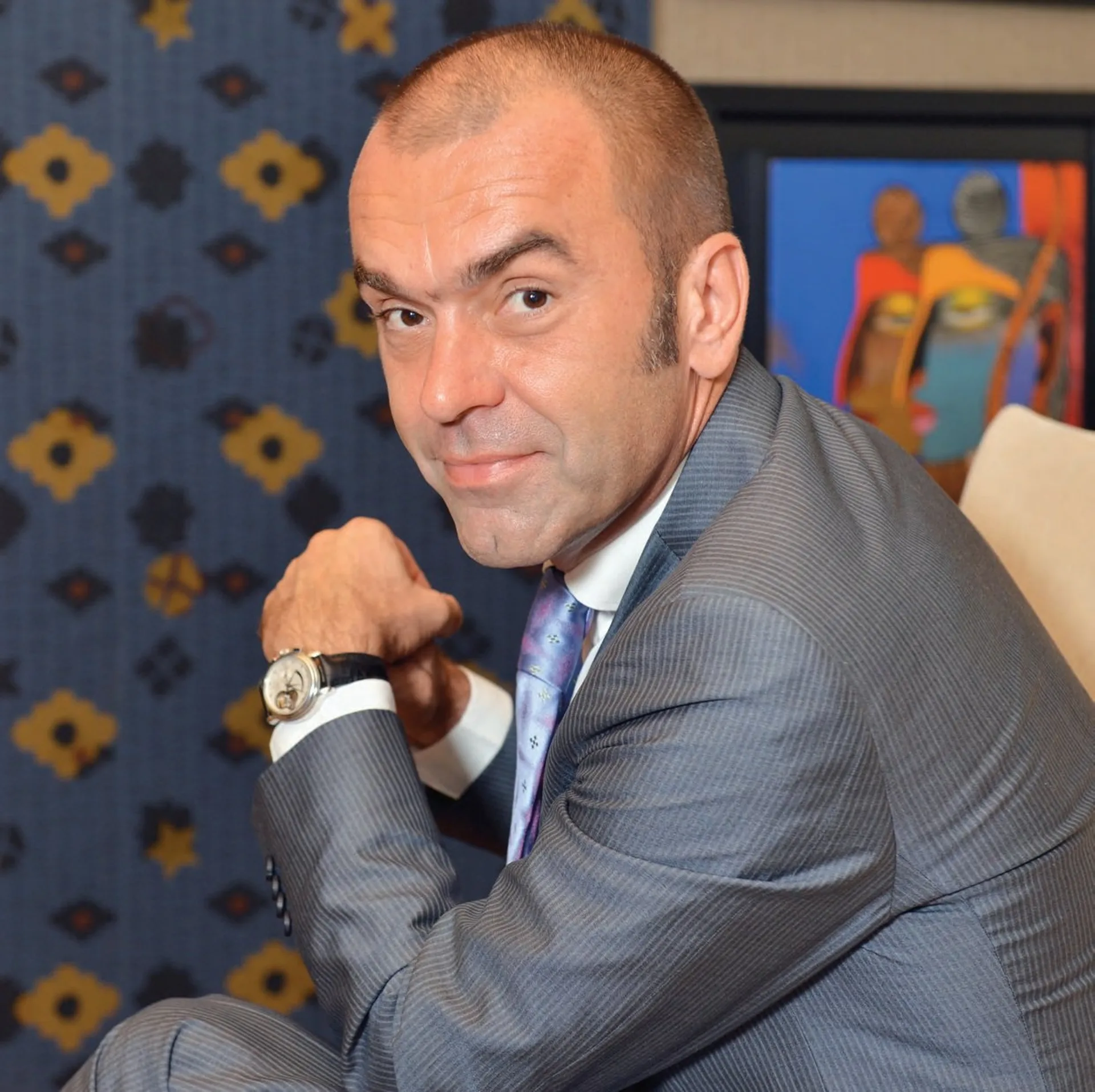
“The young lawyers today want a good job, money and weekends starting Friday morning.”