by Alice-Claudia Gherman, photo archive Florentina Vinica Barbu
A few flowers and branches, a kenzan (the traditional needle-point holder used to secure flowers upright), cold water, a simple yet elegant container, and a touch of aesthetic sensibility—these are, at first glance, the essential ingredients for creating an ikebana arrangement. And yet, this is not the true spirit of ikebana.
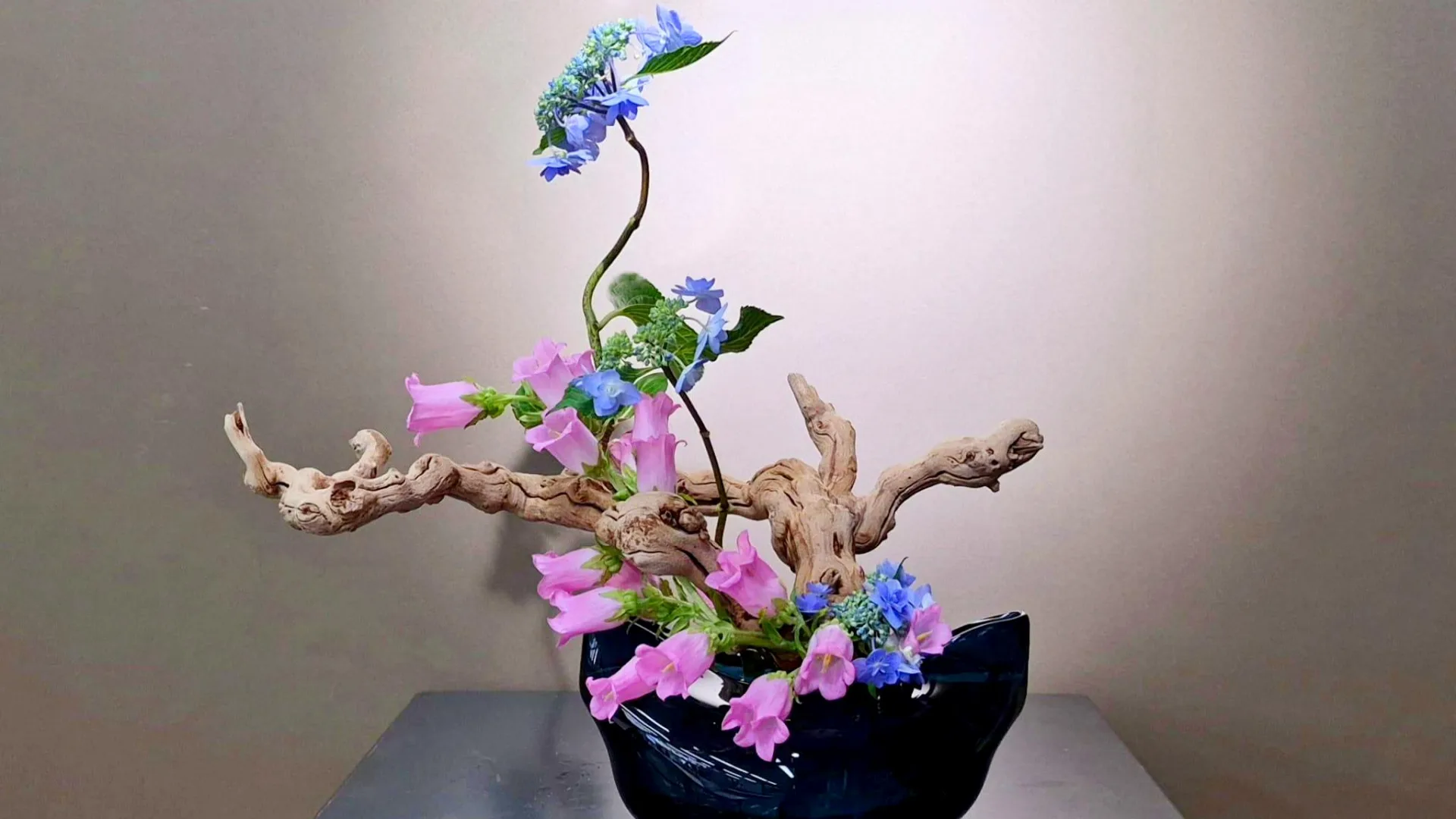
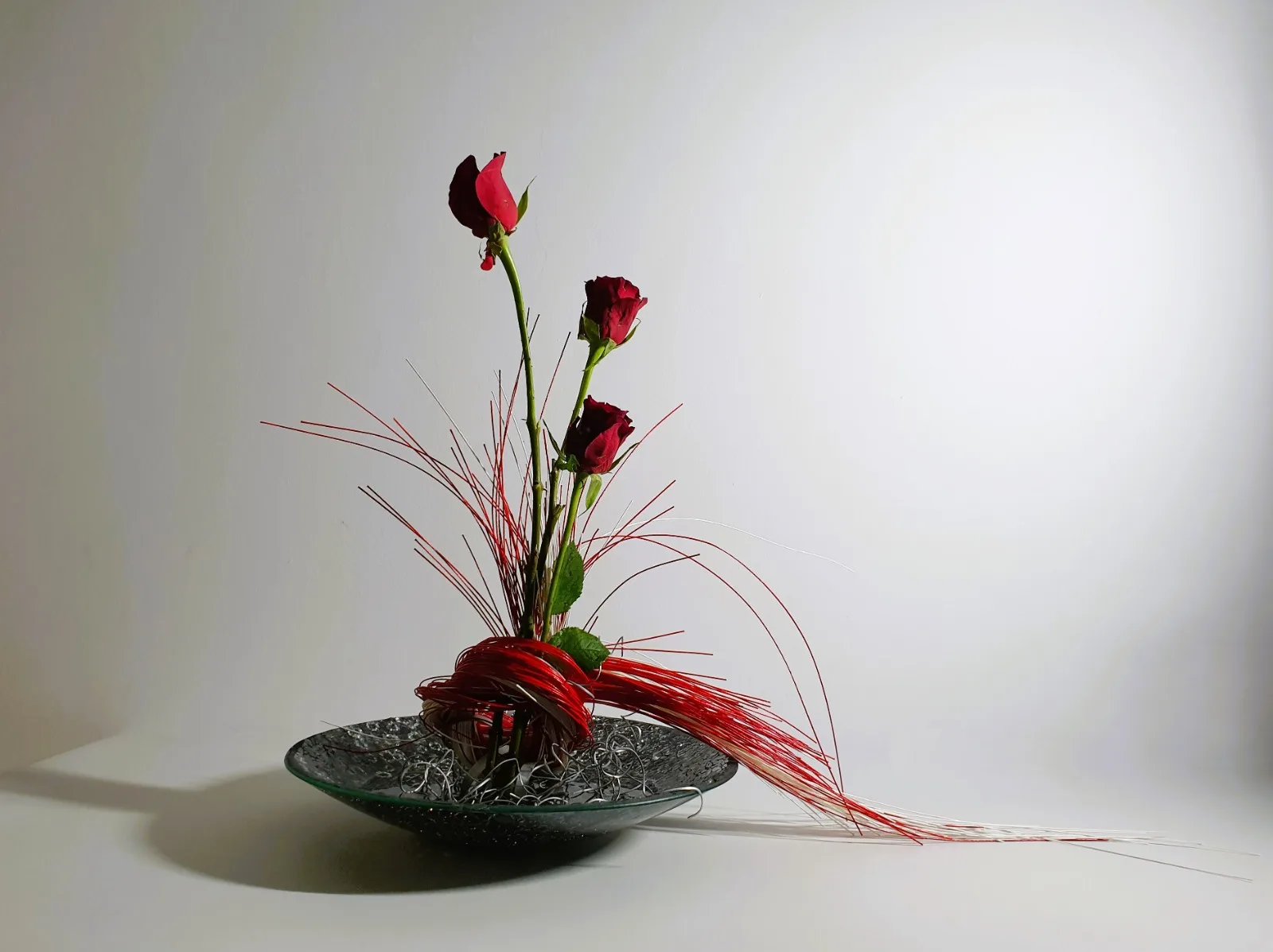
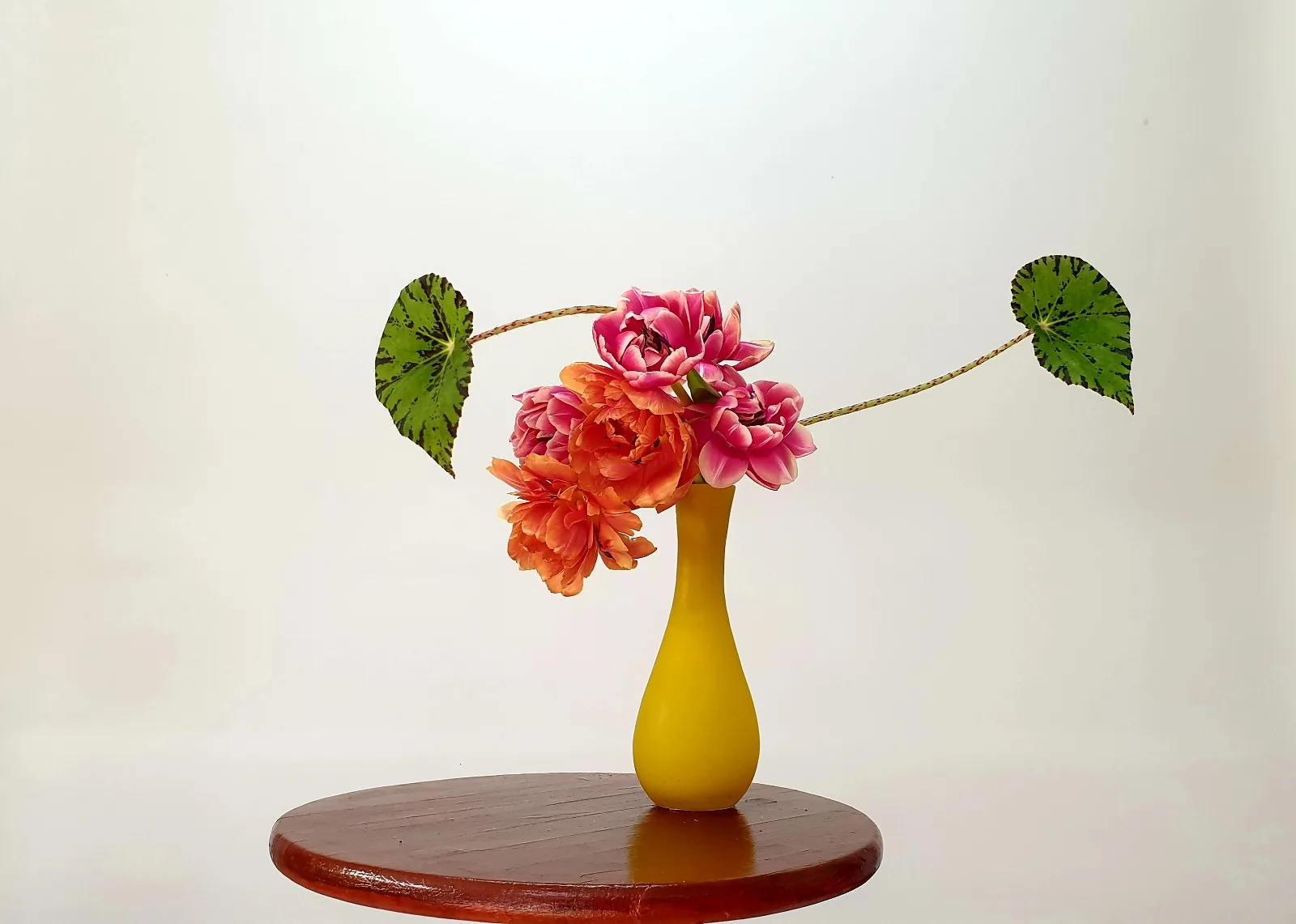
Not every floral composition inspired by Japanese aesthetics can be called ikebana. Certainly, ikebana is grounded in a set of principles: line (the contours created by flowers and branches), volume, focal point or emphasis (using a single element—such as a flower—to draw the viewer's eye), space (the Japanese concept of Ma (間), the intentional use of empty or negative space within and around the arrangement), and materials (branches, living or dried leaves, roots, as well as other botanical or even non-botanical elements. The Sogetsu School, for example, embraces unconventional materials such as wire and even plastic). It is also defined by techniques, from mizukiri—cutting stems under water to preserve freshness—to carefully twisting stems in order to achieve a desired visual effect, among many others.
Yet ikebana is far more than a collection of principles and techniques. Strange as it may sound, ikebana is ultimately about philosophy and spirituality, about Zen and the inner self. It is the Way of Flowers—a path we explored with Florentina Vinica Barbu, who described the art of flower arranging as a profound form of active meditation. It is an exercise in introspection, one that teaches us that imperfection and impermanence exist both within ourselves and throughout the natural world. And, contrary to what modern society so often encourages us to believe, these qualities are not flaws to be rejected. Instead, they are to be embraced and cherished as an inseparable part of the great mystery of the universe.
Kadō, the Way of Flowers: A Path to Wisdom and Humility
“If you want to practise ikebana, you must understand that ikebana cannot exist without kadō (花道), the Way of Flowers, and kadō cannot exist outside Zen,” Florentina explains. “Virtually every major current of Japanese spirituality—and even some beyond Japan—has, in one way or another, shaped the birth of ikebana. Confucianism played a part, as did Shinto, with its reverence for the sacredness of plants, and Taoism. In fact, Zen philosophy itself was profoundly influenced by Taoism, and together these traditions gave rise to what ikebana is today. The word itself comes from the Japanese ikeru—meaning ‘to arrange,’ ‘to live,’ or ‘to give life’—and hana, meaning ‘flower.’”
For Florentina, ikebana is nothing less than a symbolic expression of the universe. Every element within an arrangement carries meaning.
“Ikebana teaches us a simple truth: nature simply is. The sun is. The flowers are. Nothing more, nothing less. We human beings are ephemeral creatures inhabiting a universe filled with other transient beings—and even transient non-beings. Yet we all belong to an eternal universe. That realization makes us humbler while also offering hope that what we truly are is never lost. This is one of the most moving aspects of Japanese aesthetics.”
Ikebana as a Form of Meditation
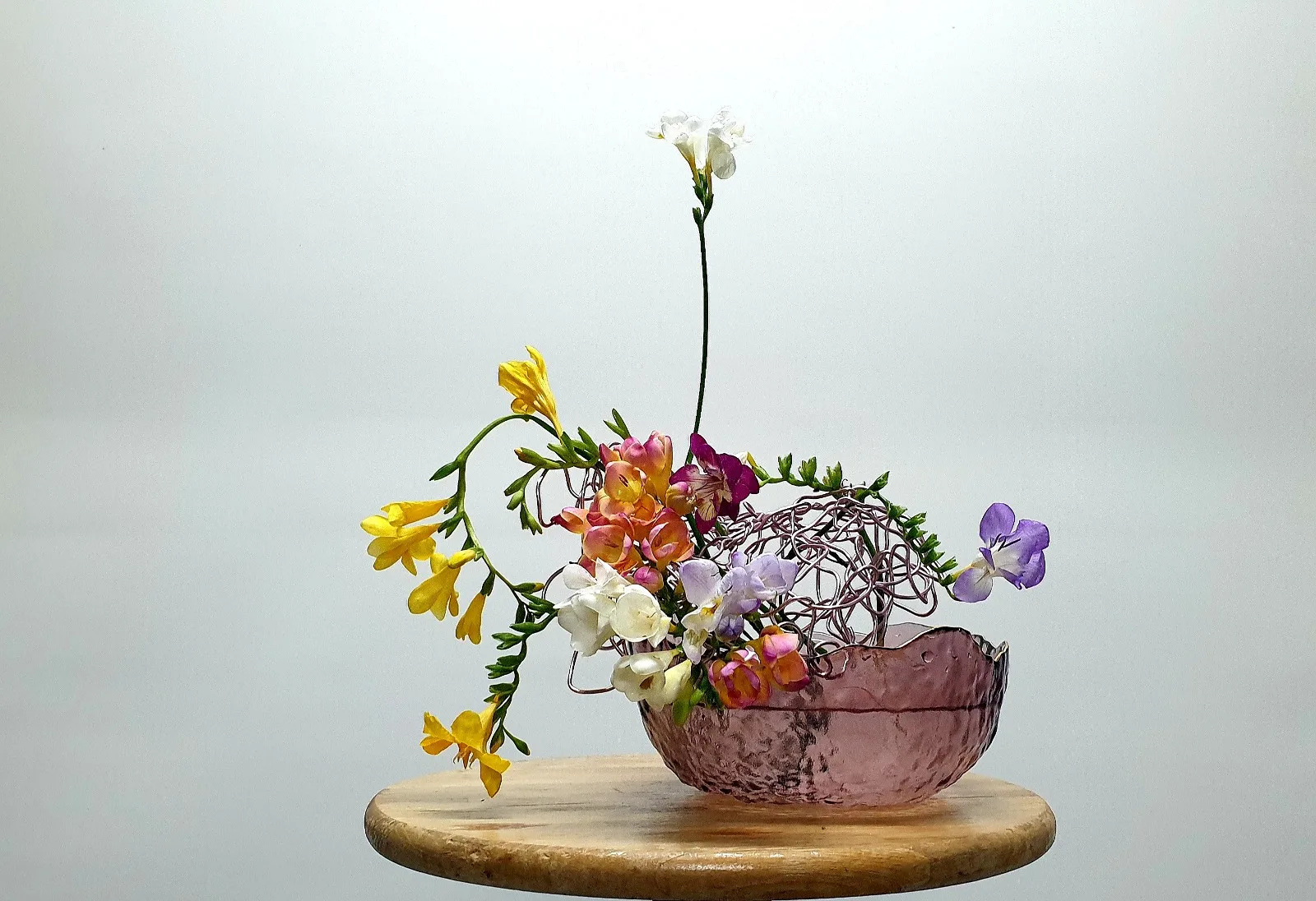
In ikebana, the container represents the universe itself, while the arrangement is built around three primordial elements: Heaven, Earth, and Humanity. Human beings exist between heaven and earth, and together they create balance—harmony.
“When you create that harmony within a vessel, it is transferred into your own soul. The arrangement becomes a space onto which I can project my inner world. Personally, it was through ikebana that I learned to understand other people,” Florentina says.
“From the way someone constructs an ikebana arrangement, I can often sense what lies within their heart. Perhaps that comes from years of practice, or perhaps it is because, as I said, ikebana is about far more than plants and their symbolism. When you reach the essence—what the Japanese call shusshō (出所 / 素性), the vital force that animates those plants—you arrive at the very core of existence: life and death. The moment we cut a plant, we might say it dies. Yet through ikebana, we give it another life. That is precisely the meaning of ikebana: from ikeru, to give life, and hana, the flower.”
Ikebana brings us closer to nature because it reminds us that we are not separate from it—we belong to it.
“When you create an ikebana arrangement, you are fully present within it. There is no ikebana without you. You become the flower that withers. You become the dried branch. In the end, you are everything you have placed within that composition. Through it, you experience every stage of life, from beginning to end, and in doing so you come to understand life itself more deeply. That is why the most important part of ikebana is not the finished arrangement but the process of creating it—the stillness, the preparation, the state of mind you cultivate before you even begin.”
“Ikebana is a form of meditation. And when the arrangement is complete, what remains is an inner sense of peace. Of course, your work also brings joy to those who admire it, but above all, ikebana is an intensely personal art. It is about you,” Florentina says.
Seen in this light, it becomes clear why authentic ikebana cannot truly be turned into a business in the sense of creating arrangements to sell.
“Someone once asked me why I don't sell the arrangements I make. How could I? Ikebana is not about making money—it is about peace, introspection, and meditation. Money has nothing to do with it. I simply couldn't think that way. That isn't what practising ikebana means.”
Hana no Kokoro: From the Soul of the Flower to Your Own
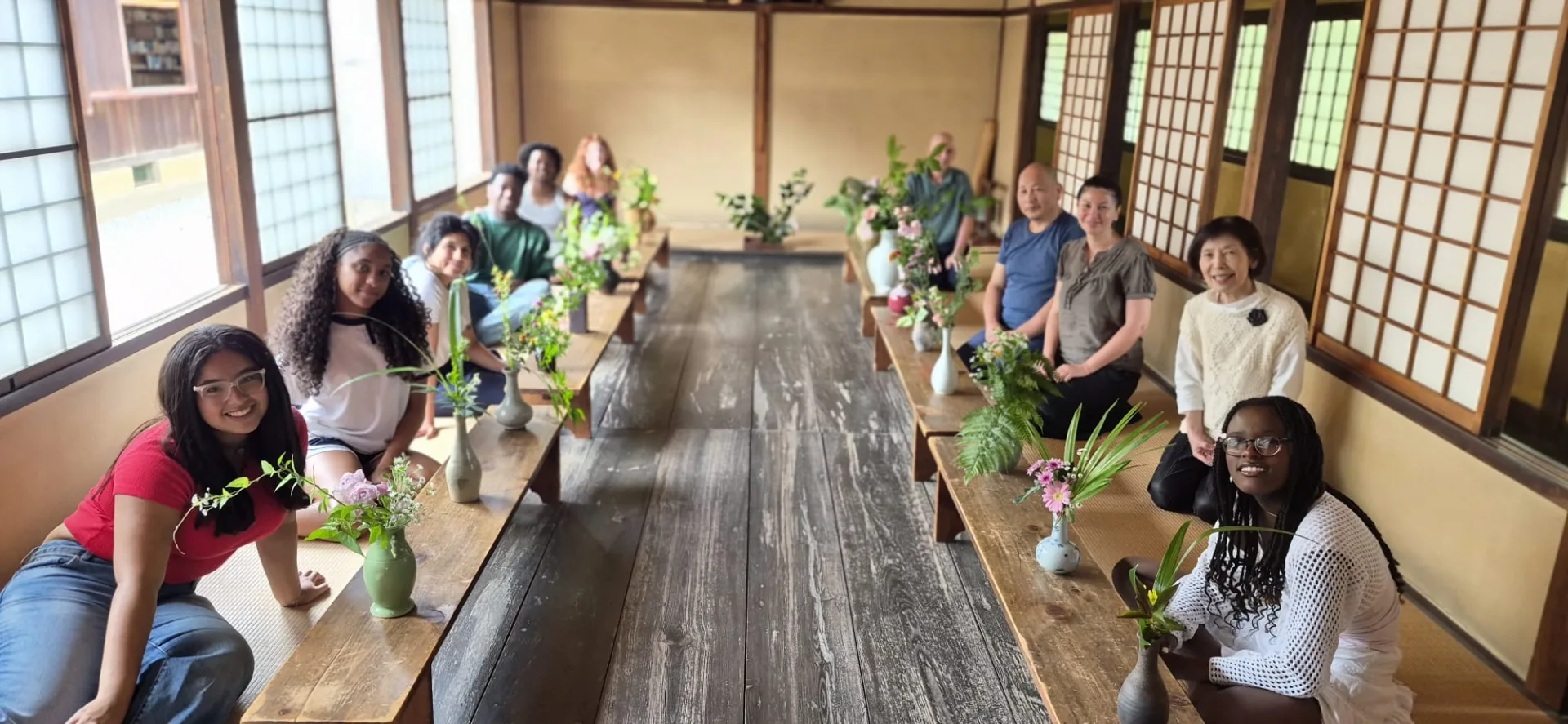
Ikebana is inseparable from the changing seasons, whose rhythms lie at the heart of Japanese aesthetics. This is why Florentina organizes her Sogetsu School workshops and exhibitions in harmony with the seasons, allowing students to explore the ever-changing dialogue between nature and artistic expression.
Naturally, ikebana also follows a set of aesthetic principles: proportion, line, focal point—where the eye is drawn—how energy flows throughout the composition, whether the arrangement creates harmony or tension, how the texture of the plant material interacts with the vessel, as well as the role of shadow, reflection, and water.
“You can even create ikebana with water alone. The founder of the Sogetsu school and the school’s first iemoto, Sofu Teshigahara, used to say that anyone can create ikebana, anywhere, at any time, using any material. If you find yourself in the desert, then you create ikebana with sand. Ikebana is an outlet for our creativity. It is a spiritual path of flowers that speaks to us about the purity of plants and their connection with our own soul, because through ikebana we seek a correspondence between what exists within us and the soul—the heart—of the flower, Hana no kokoro (花の心).”
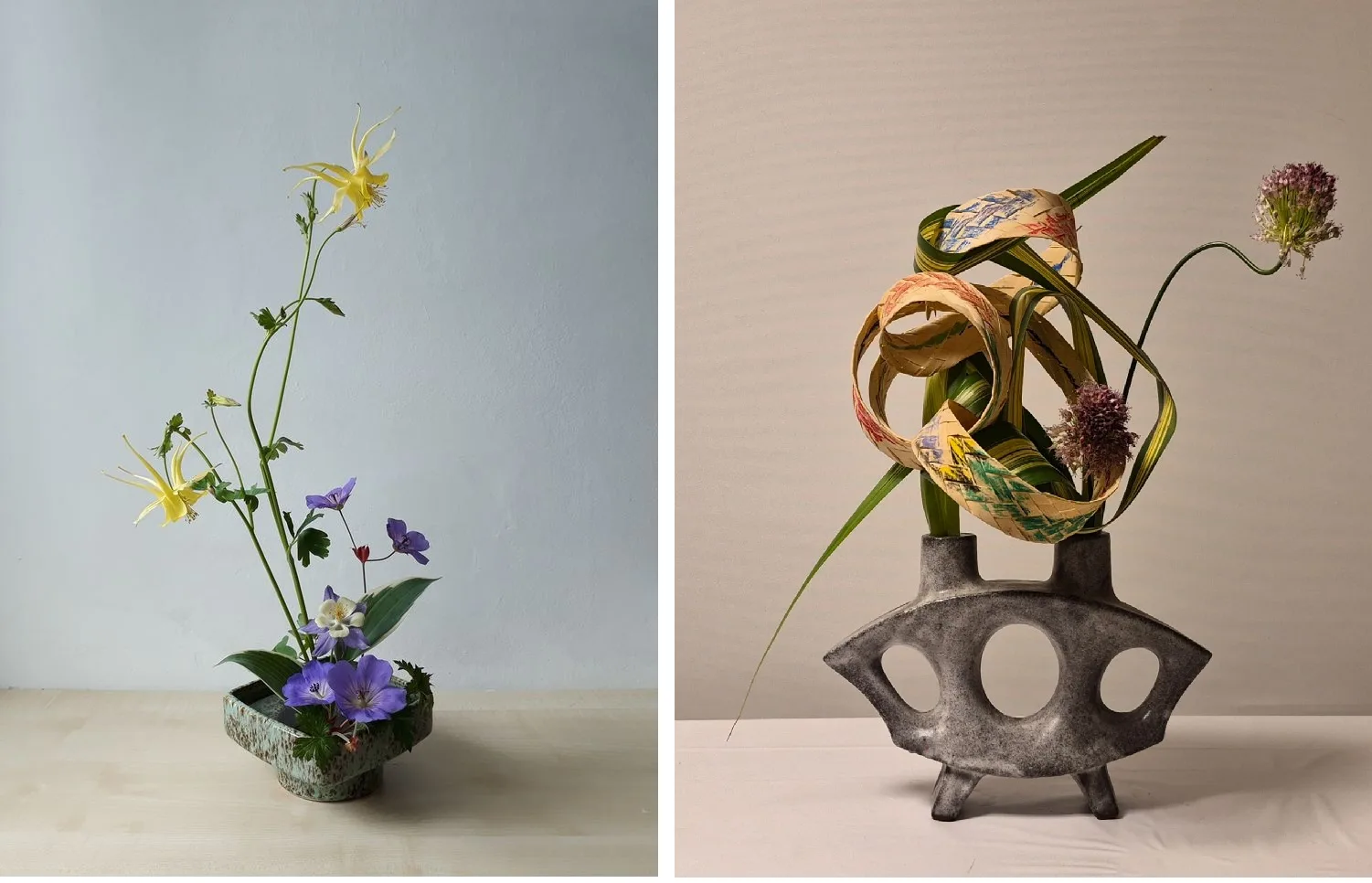
Ikebana may be practised within established forms, or it may embrace complete creative freedom.
“I've noticed that some of my students are afraid of freedom and prefer fixed forms, while others seek nothing but freedom and never want to be constrained by rules. Interestingly, beginners—precisely because they don't yet know the rules or their limitations—are sometimes more creative than students who have begun studying the formal structures and start feeling restricted by them,” Florentina Vinica Barbu observes.
The Beauty of Imperfection
Ikebana is also about discovering the beauty of imperfection, Florentina reminds us.
“In Western society—or perhaps we should simply say in modern society—we have become captive to the idea of perfection. In many ways, we are crushed by it. We're never good enough, beautiful enough, or intelligent enough. Nothing ever seems sufficient. Women struggle with countless insecurities, men have their own, and we are constantly driven to want more and more.
Through ikebana, however, we learn that nature is beautiful exactly as it is. Nature has never aspired to perfection. There is beauty in twisted branches and gnarled forms. Nature is beautiful in its very essence. It grows according to its own rhythm, following its eternal cycle: it is born, it lives, it dies, and it is reborn, only to die once more. That is precisely what ikebana teaches us when it incorporates withered leaves or seemingly ordinary twigs—elements that can nevertheless breathe life into an arrangement.
Ikebana teaches us that we, too, are beautiful just as we are. And if we can accept that nature derives its beauty from its imperfections, perhaps we can learn to accept ourselves without placing such relentless pressure upon ourselves.”
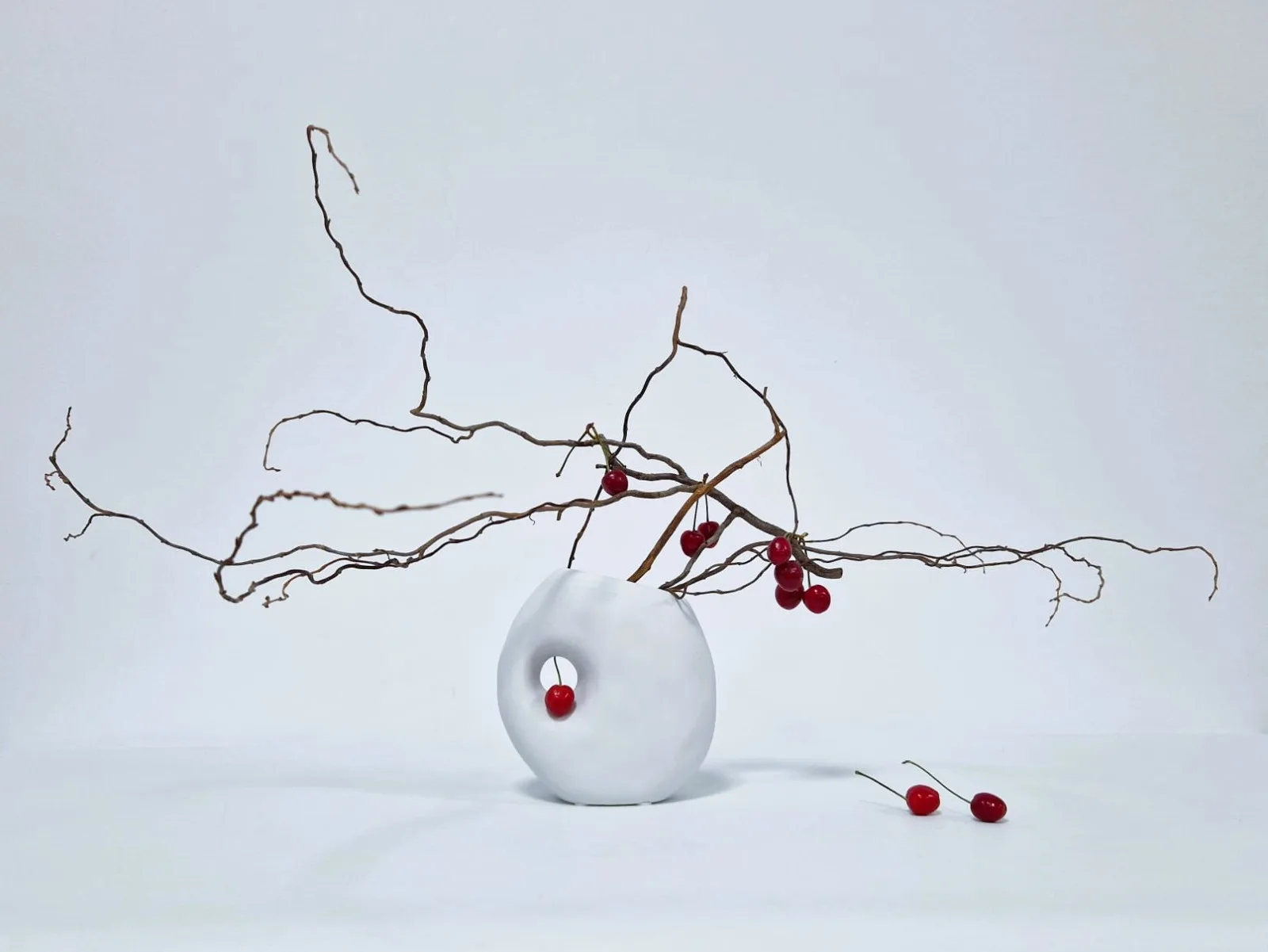
In Japanese culture, every flower blooms in its own time, without competing with the others.
Ikebana and the Awareness of Sacrifice
Creating beauty in ikebana often requires cutting away what is unnecessary. To many, this may seem like an act of cruelty toward plants and flowers. Florentina, however, sees it differently.
“Don't we prune shrubs and trim the branches of trees every spring and autumn? When we harvest fruit, don't those actions also appear rather harsh? This is simply part of horticulture; there is no other way. So why should it be considered cruelty here?
Someone once suggested that instead of cutting flowers, we could simply place a potted plant in a corner of the house and bring nature indoors. That's certainly one way of looking at it. But a potted plant can never carry the symbolic meaning of an ikebana arrangement. And if we continue along the same line of reasoning, why keep a plant confined indoors at all, when it would thrive much better outside?
Those who truly practise kadō (花道)—they are called kadoka—develop a profound awareness of the sacrifice made by the plants they use. In the traditional schools, this sacrifice is not only acknowledged but honoured. Plants are treated with respect; once they have withered, they are not simply thrown away but are buried.
Earlier this year I spent three weeks in Japan, visiting Nara, Tokyo and Kyoto. At the headquarters of the Saga Goryū School in Kyoto, I even saw a monument dedicated to the plants that had been sacrificed in the practice of ikebana.”
There is another fascinating aspect to this philosophy. In Japan, practitioners of kadō are very often gardeners as well, reflecting the belief that one should not only take life, but also nurture and create it. In this way, a balance is maintained between life and death. Many kadoka also practise tōgeidō—the Way of Pottery—crafting the very vessels that will hold their arrangements. The creation of both the container and the composition reflects the same pursuit of harmony: a balance between the plants and the vessel that gives them a temporary home
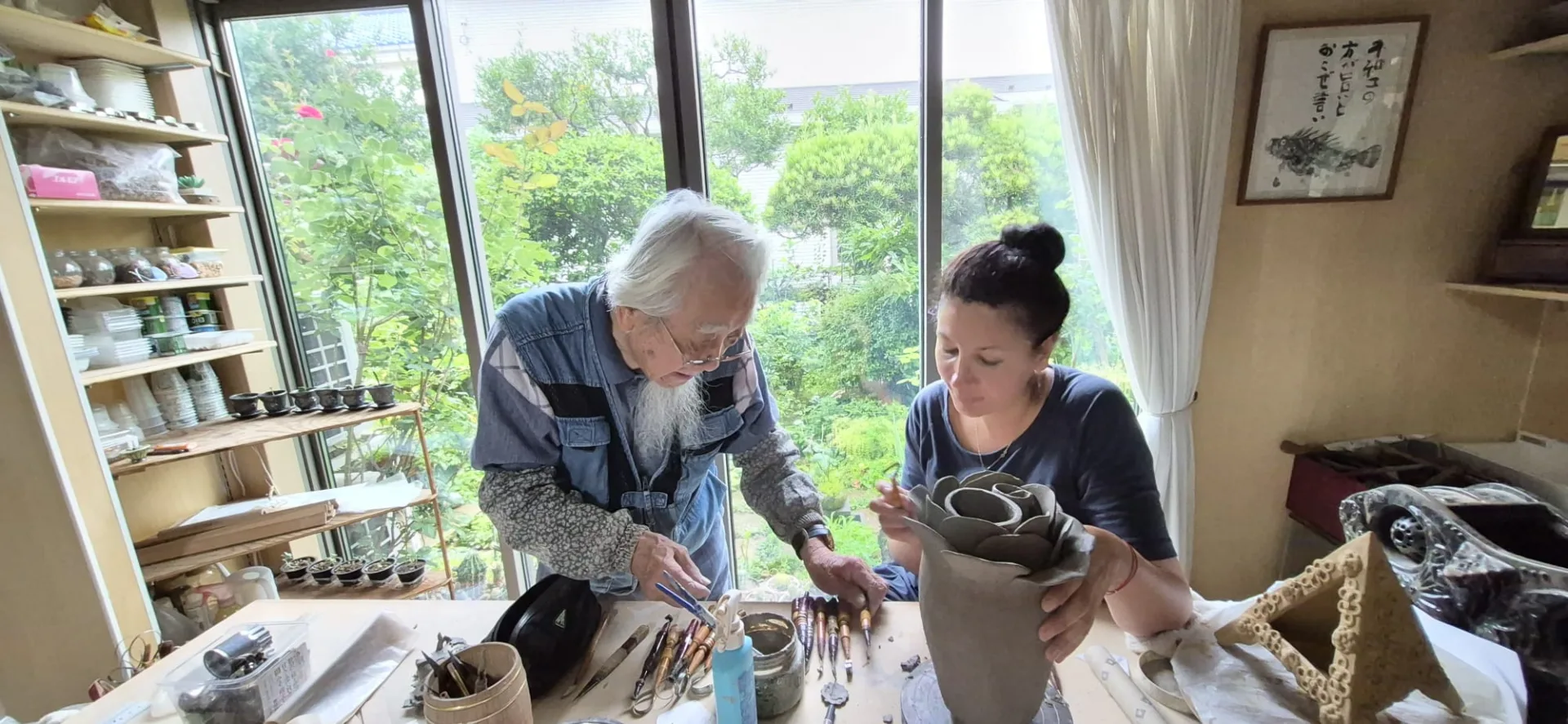
Florentina Vinica Barbu at a Japanese pottery workshop, together with Harashima Shigemoto one of the most important contemporary ceramic artists in Japan.
So deeply rooted in spirituality, ikebana should never be regarded merely as a way of creating floral arrangements. Rather, it is a form of sculpture—or even painting—with living plants, an art that speaks of the inner self and of human nature. It communicates emotion, invites contemplation, and creates new layers of meaning for those who experience it.
Florentina Vinica Barbu – The Teacher with a Flower's Name: Aika (愛花), “Flower of Love”
Florentina Vinica Barbu has loved flowers for as long as she can remember. Her fascination with plants began in childhood, when she discovered a book on ikebana by Laura Sigarteu Petrina in her grandparents' home. She read it with complete absorption and eventually knew it by heart.
Although she later sang with the Choir of the Romanian Radio Broadcasting Company and prepared to audition for the National Conservatory, Florentina ultimately chose to study horticulture instead. In hindsight, the decision seems almost predestined. Her life has always been inextricably linked with flowers, and even her surname, Vinica, evokes vines, growth, and life itself. It is tempting to see her professional journey as the work of fate, gently guiding her toward the extraordinary world of plants—a path that would ultimately lead her to ikebana.
Three remarkable women played a defining role in her education as an ikebana artist.
The first was Rumiko Matsumura Sensei, a Riji (Executive Master) of the Sogetsu School. The second was Nadia El Borai Yamamura Sensei, a Grand Master of the Ohara School, Florentina's mentor, who introduced her to Ikebana International and encouraged her to establish the Ikebana International Bucharest Chapter.
The third was Yukiko Tanaka Sensei, without whose support the association could not have been founded, as the regulations required representation from at least two different schools of ikebana. An ikebana practitioner of the Saga Goryū School, a Japanese language teacher, and a tea ceremony instructor, Mrs. Yukiko Tanaka brought the traditional lineage that made the initiative possible.
Another key figure in Florentina's journey was Professor Osamu Inoue of the Saga University of Arts in Kyoto, who invited her to become one of the directors of the International Society of Ikebana Research (ISIR)—a recognition of her growing contribution to the international ikebana community.
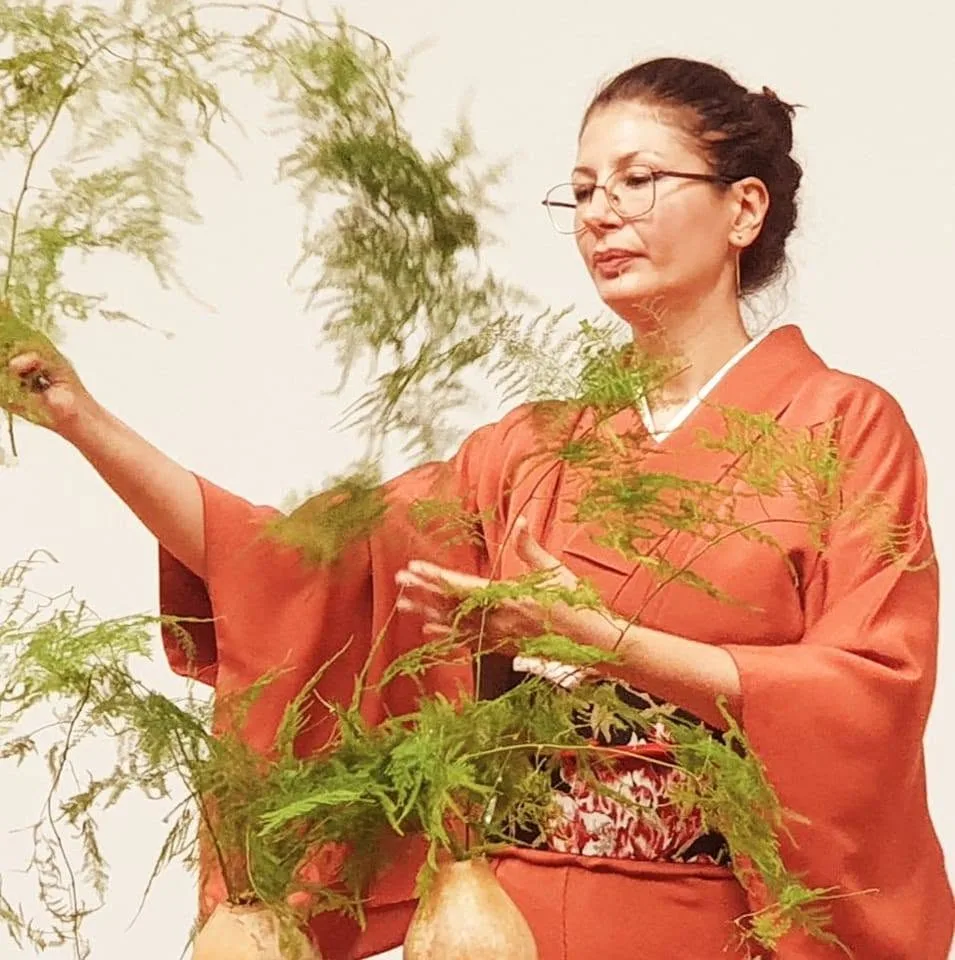
Today, Florentina, a PhD candidate in horticulture and a member of the Sogetsu Teachers Association and ISIR (International Society of Ikebana Research), shares the knowledge and secrets of ikebana with all those who wish to approach flowers in a different way, beyond simply creating beautiful floral arrangements. Her teacher, Rumiko Matsumura Sensei from the Sogetsu School, during her studies, followed Florentina’s journey and, recognizing her connection with flowers, gave her the Japanese flower name 愛花 Aika (meaning ‘Flower of Love’), because Florentina approaches flowers with delicacy and love.