by Petruș Costea
Arnold Josef Rosenblum was born in 1863, at Iaşi, in a Jewish family. At 10 years old, he left to study at the Wien Conservatory that he graduated in 1879 and, at 18 years old he became a first violin at the Wien State Opera. The following years, from 1882 until 1938, he was employed as a first violin of the Vienna Philharmonic. Due to the anti-Semitism of the Austro-Hungarian Empire and in order for him to occupy his position, he was forced to convert to Christianity (just like Mahler or Bruno Walter) and to change his name to Rosé. In 1882, he had also set up the Rosé Quartet, that will be active for half of century and was considered one of the most important chamber music bands of that time, playing mostly Beethoven`s music. The Quartet had several concerts in Bucharest, at the end of the ’20s, part of a Beethoven cycle. In 1893, he was appointed professor of the Wien Conservatory, and he taught there until 1924; between 1888 and 1896 he was also the first violin of the Bayreuth Festival`s Orchestra.
He became friends with Brahms, who had often conducted the Philharmonics, and had played as a first audition some of his works, with him by his side playing the piano (Trio op. 8 or the Clarinet Quartet). His friendship with Mahler had a strong impact especially during the three seasons (1898 – 1901) when Mahler was the main conductor of the orchestra. In 1902 he married Justine, Mahler `s sister (his brother Arnold, cello player Eduard Rosé, had already married Emma, Mahler`s youngest sister) and their daughter, born in 1904, was named after the composer` wife, Alma. Another important moment is the meeting with Arnold Schoenberg, to whom he presented – as a first audition – the two quartets (1907 and 1908) and Transfigured Night (1902). Besides the great classics, he had played several works signed by contemporary composers such as Max Reger, Karl Goldmark or Sir Alexander Mackenzie. For fifteen years he was accompanied during the soanata sessions by Bruno Walter - the famous conductor – at the piano.
The cello player enjoyed the appreciation of musicians – conductor Sir Adrian Boult considered him Europe`s best first violin and cello player. Carl Flesch thinks of him as being „the most perfect and versatile type of Viennese player”. He was particularly known for his clean technique and the purity of his intonation, a fact that he admitted himself: “My fingers are built in such a way that they press exactly where the notes are”. He had a rare scientific approach with regards to the vibrato and did not allow any exaggeration in this respect - although this was something fashionable in those days - either by himself or by the other famous conductors that were leading the orchestra.
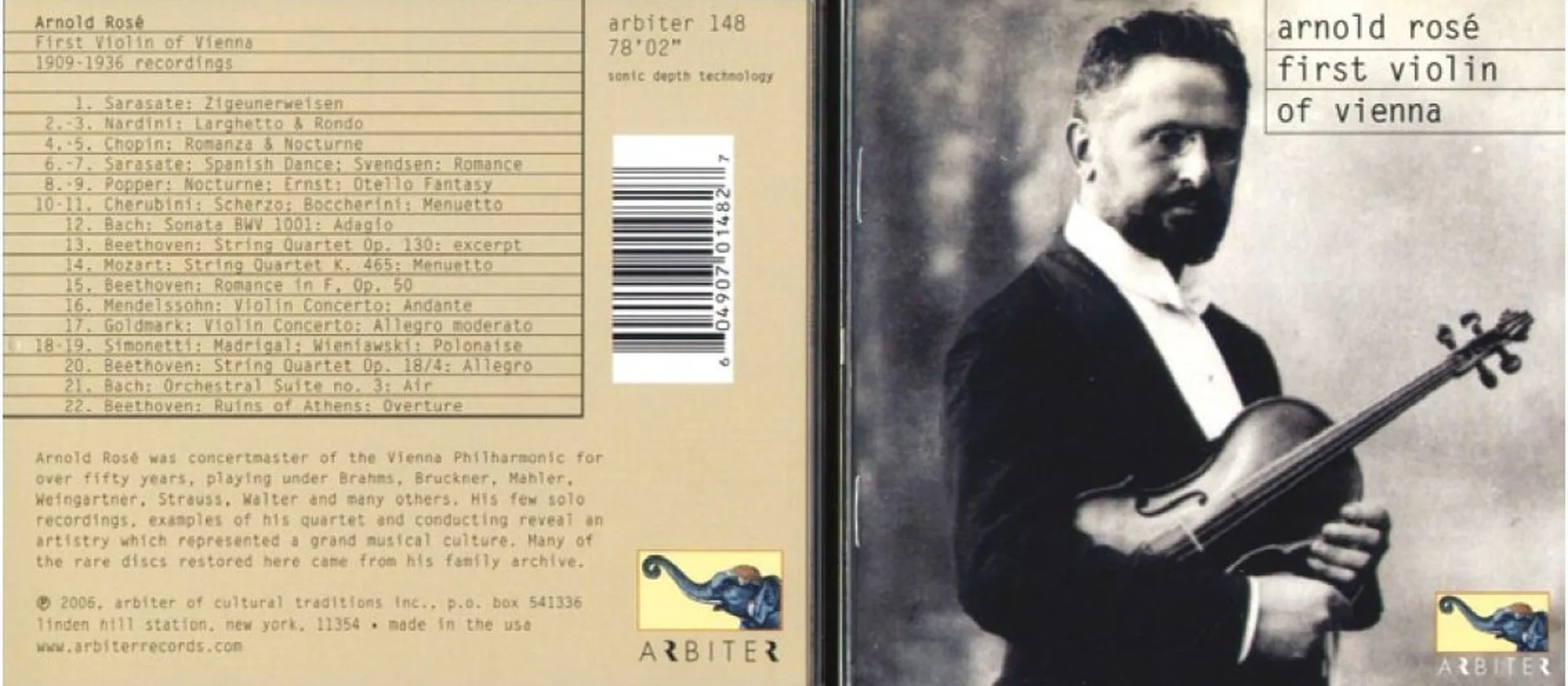
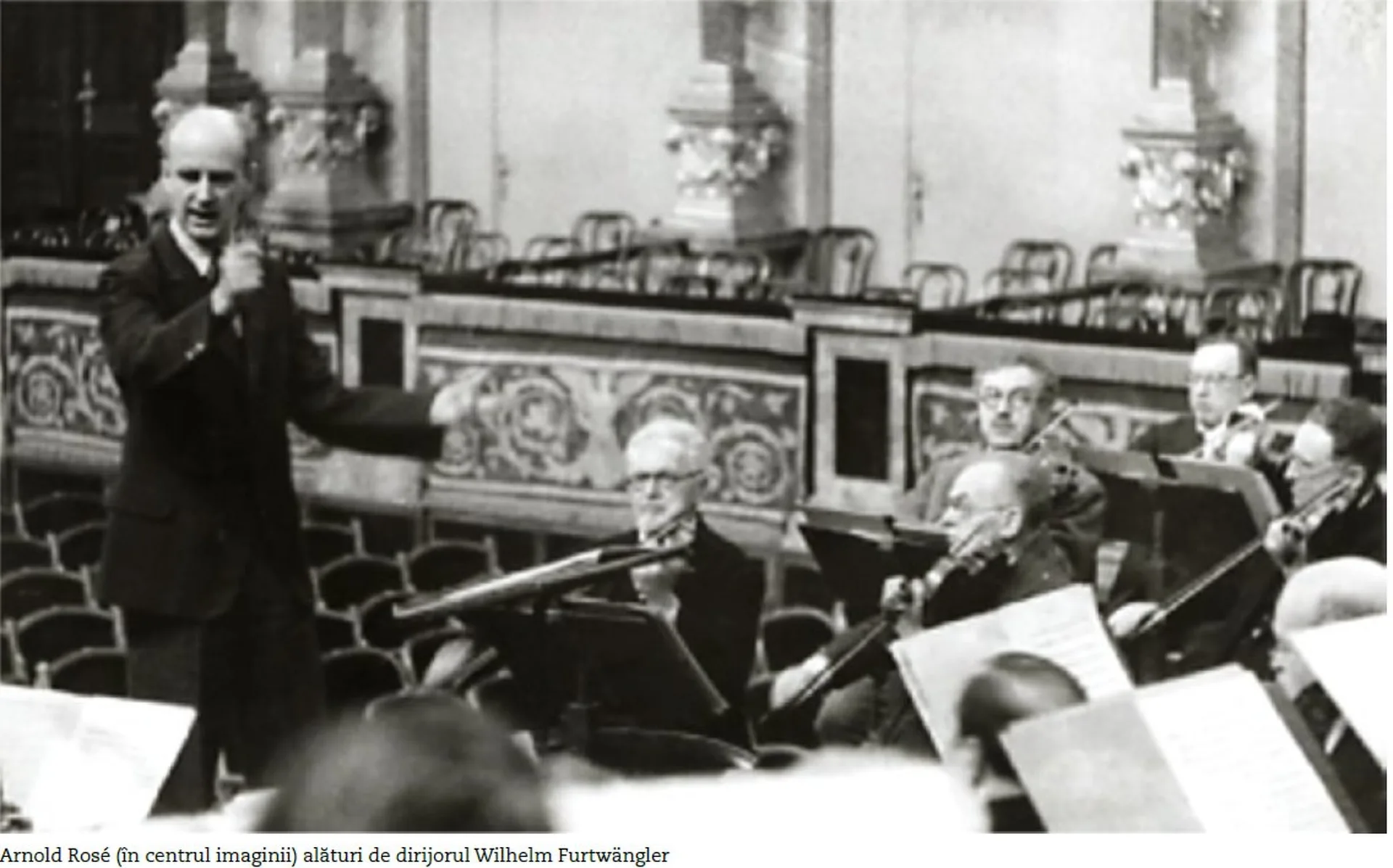
All the Vienna Philharmonic recordings produced before 1938 have Arnold Rosé as the first violin: symphonies by Beethoven with Felix Weingartner, works by Beethoven, Brahms, Haydn, Mozart or Wagner or Bruno Walter or works belonging to the Strauss family and conducted by Clemens Krauss. Some of the pictures taken at the concerts show him by Wilhelm Furtwängler or Bruno Walter`s side.
His last concert as a first violin of the Vienna Philharmonic Orchestra was on the 16th of January 1938, conducted by Bruno Walter and playing the Ninth Symphony by Mahler; a live recording of this event was published by His Master Voice, a short while after the concert. After Anschluss, he is disposed by the Nazis and, in the fall of 1938, he managed - due to a funds collection initiated by Carl Flesch – to settle in London. He had less and less appearances on the scene but he was invited by Myra Hess to play at the National Gallery’s famous concerts, carried out every day during the war. In January 1946, the Vienner Philharmonic invited him to take over the first violin position, but he turned the offer down. He died on the 25th of August 1946, shortly after he received the official confirmation that Alma was exterminated at Auschwitz, in 1944.
Most of Arnold Rosé`s recordings are easily available on YouTube, from Quartets by
Beethoven – especially Quartet No. 10 for which Arnold had a soft spot – to solo recordings or the Concert for two violins by Bach, recorded in 1929 together with Alma Rosé.