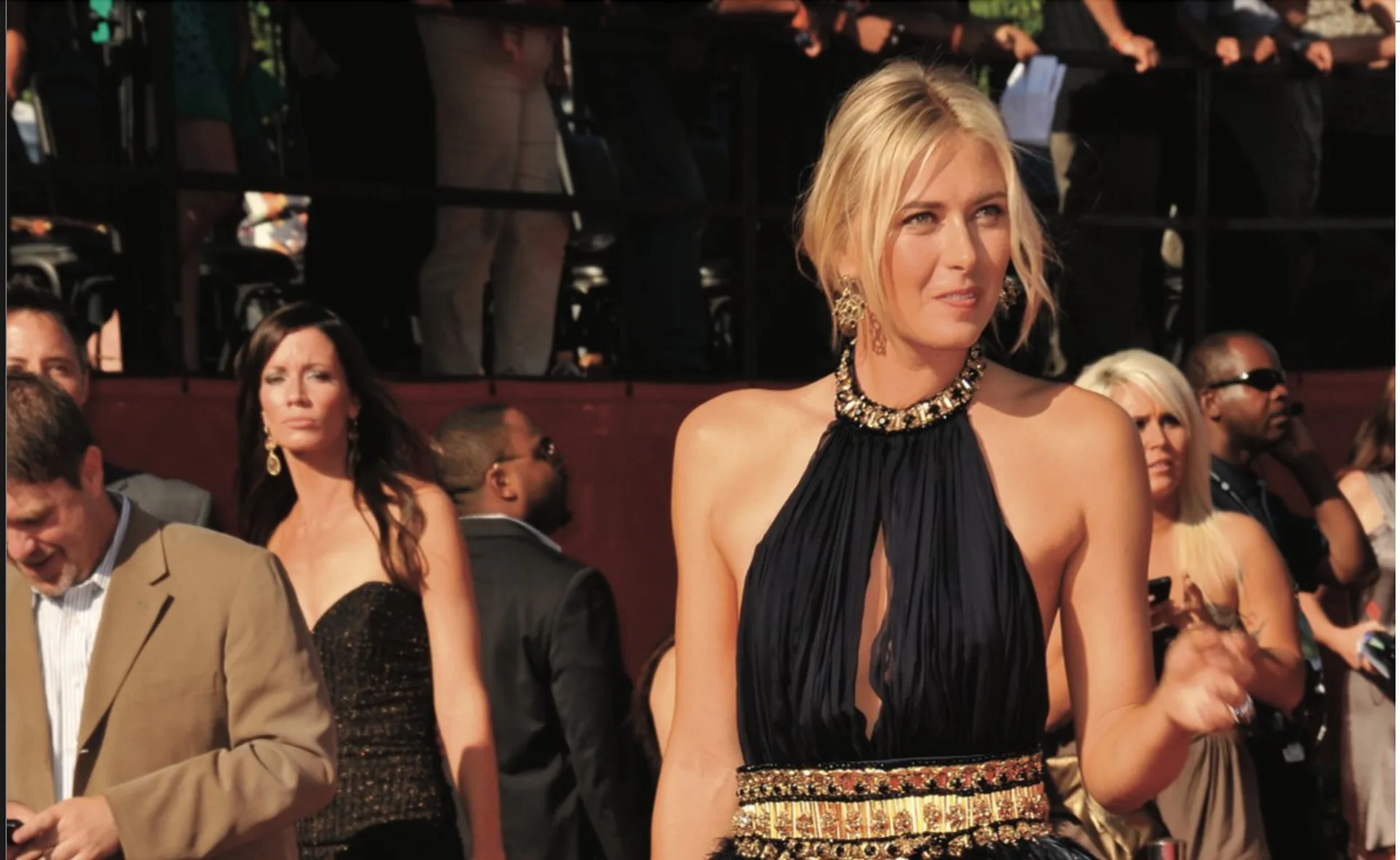
Every tennis generation had a golden haired prodigy. No previous generation, however, had someone who scored so many points in their favour like Maria Sharapova: sporting prowess, beauty, wealth and personality.
by Luminița Paul
The ball leaves the racket with a sharp whack, like the popping of a champagne cork released in a fraction of a second. It arrives in the opponent’s court leaving what seems to be a burnt spot where it scorches the surface. The grunt barely fades away as it melts with the sound of the yellow sphere forming a distinctive, yet familiar sound. unmistakable, it is Maria Sharapova.
Once the point is over, she turns her back to the net, tilts her head slightly and examines the strings of her racket with such care as if she saw them for the first time. With a slight hop, she gathers momentum and returns to the game. Mighty and determined, with an alert gaze, the same sequence is repeated time and again.
Advantage point or not, there is defiance with a ritualistic precision. It is as if, for her, a game contains hundreds of beginnings and she is always ready to start anew, over and over again. This probably explains why she was able to accomplish so much in such little time, not knowing what it’s like to give in, to retreat, to falter.
She didn’t know it when she was a 6 year old little girl who used to hit the tennis ball against a small brick wall in Sochi, she certainly doesn’t know it now, when she has completed a career Grand Slam. At 25 she has eyes only for what lies ahead of her and yet at only 25 she leaves behind her a lifetime of tennis.
Like with many modern stories, we will start with the end, a happy ending that Maria lived until June when Roland Garros, the French Open, ended. One major tournament title that was missing from her track record was won in thrilling fashion on the red clay Parisian court.
All the other tournaments were crossed off her wish list a pretty long time ago. In 2004 when she was just 17 she won Wimbledon after a final beating Serena Williams, who was at the time almost invincible on grass.
Two years later, in 2006, she won the US Open with her black rhinestone dress memorably shinning mysteriously in all the static and motion pictures. In 2008, after another 2 years, at what seemed the peak of her physical condition, she won the Australian Open.
Paris should have followed in 2010, but sometimes symmetries and coincidences suffer memory lapses, or perhaps only delays. In this case it was a 2 year delay before she got her final important victory. Did anyone take notice of this, I wonder, because the Russian girl certainly didn’t. She did what, in strictly sport terms, is called the Grand Slam of her career.
She reached a zenith that not many other female players have reached over time, and in doing so, she added another jewel to her crown. Along with this Parisian triumph, came her return to number one in the world rankings, where she hadn’t been since the summer of 2008, the year over which a big question mark hovered.
Everything in its own time though. Maria Sharapova of 2012 is a live portrait of success, a nonlinear yet still round success, if something as such is even possible. Yet, it hasn’t always been this way. Like with many classic stories, we will start with the beginning, or even before it, like Laurence Sterne in ’The Life and Opinions of Tristram Shandy’.
It was April 1986 and Maria’s father, Yuri, had just met her mother, Elena. They were married very soon after in Gomel, Belarus, Yuri’s native town. Neither knew what their lives would turn out to be. His family included his mother, Galina who ran a small corner store; and his brother Sasha (the father had passed away when the boys were still young).
Yuri had satisfied his military service and was working in constructions. Then came the event that would change their lives forever. On the 26th of April there was an explosion in one of the reactors at Chernobyl, only 100 miles away.
Elena found out she was pregnant 3 months later and Yuri Sharapov’s young family were forced to move, initially to the city of Nyagan in Western Siberia where they settled into a small studio flat sharing with Elena’s parents while Yuri found work in the oil extraction industry. Maria, their precious child, their prodigious little girl, their unique baby, was born here.
Two years later they moved from Nyagan to the friendlier Black Sea coast resort town of Sochi. It is here, in the city of Evgheni Kafelnikov, the first Russian to become world number one in 1999, that Maria was introduced to tennis.
But there’s still more of this story to tell until we get to the crucial point when somewhere in the stars above everything was decided: it shall be tennis for the little Sharapova, tennis all the way. The workout routine was simple, repetitive and tiring. The kid hit the ball against a brick wall in the local park.
There was no money to rent an indoor or outdoor tennis court and the 30 minutes walk to the tennis centre made the park the only real option. When the harsh and barely humane winter comes, Yuri wrapped Masha up in a synthetic fur coat and took her to the brick wall. There was no one else in the park but them and the wall.
Something happened soon after that both father and daughter will remember for the rest of their lives. Maria was 6 and while running to catch the bus to the tennis centre, she slipped, the slip cutting her hand open.Her fingers bled and her nails were broken.
The pain, greater than anything she could have ever imagined, made her burst into tears. Her father was unshaken and told her ”Don’t cry Masha!”. She pleads with him to return home. “Don’t cry Masha!’’, his voice sounded louder and harsher. “Stop crying! We’re going to practice!”
This was how Sharapova was taught to live, defeating everything that stood in her way be it a cut finger, a net or an opponent. The story flows towards its target and its heroes don’t even know it. Yuri took Maria to Moscow for an open tennis lesson held by the great Czecho-American champion Martina Navratilova.
There was something in this little ambitious blonde girl’s still rudimentary and childish way of playing that attracted Navratilova and even shocked her. She noticed her one way system of always pushing forward, never stepping back.
But, added Navratilova, she needed a skilled trainer to work with the unpolished precious stone. This meant Yuri Yudkin, her Sochi trainer until then, was of no good use anymore. He remembered his admiration: “It amazed me from the beginning how intelligent she was, even at her age of 4 and a half. She absorbed everything I said or did.
And she would invent new moves that cannot be explained yet. It is difficult to believe that in normal life she is a polite smiling girl because when she gets her hand on that racket she becomes a beast! She is not afraid of anyone and I have never heard her say she is tired!”
So Yuri started to save up money for tickets and visas as well an extra 700 dollars to survive off when they got to the United States. They wanted to get to Bradenton, Florida, to Nick Bollettieri’s Academy, academy made famous by the likes of Andre Agassi, Tommy Haas, Mary Pierce and such like.
Elena Sharapova was denied the US visa, which saw mother and daughter spending the next 2 years apart. Maria remembers the letters, their only means of communication, they wrote to each other. There were no mobile phones back then and the cost of phone calls was high.
Mother and daughter were able to speak to each other on the phone once every 6 months. Yuri didn’t have it easy either as he was forced to have 3 jobs to pay his daughter’s fees. He would wash dishes, floors and anything else that needed washing.
At Bollentieri Academy, one of the assistant trainers saw Sharapova play and decided she was too young. “Come back with her in two years!” he said, those 2 years that Masha remembers as the most defining years of her career and life. “I didn’t leave my mother (behind) for nothing.
I didn’t spend 6 hours a day training under the Florida sun for nothing. I didn’t sleep in a tiny room for 3 years, eating cornflakes straight out of the box for nothing. All these things helped me build my character and nothing can say more about me than the fact that I always stood on my own two feet''.
Back at Bollentieri Academy, she was placed in a room with older girls who would constantly tease her. “I wanted to go to bed around 9”, Sharapova told the British tabloid the Daily Mail, “and they would leave the light on and would talk until after midnight. They wouldn’t say a word to me. I felt bad, but I couldn’t cry. I couldn’t let them bring me down to want to go back home. I knew the sacrifices my parents had made for me to play tennis and I couldn't let them down.”
Maybe that is why she is so tough on the tennis court, why she doesn’t want to make friends on the circuit and why she spends such little time in the locker room. She might have learnt a lot from the world she left behind, but her world is different nonetheless.
Then slowly, year after year, success came. The word was out about her even before she started playing in the seniors’ league, ever since she won the Eddie Herr junior tournament. It opened her way and the rest is down to work, determination and persistence.
The first circle closed when she was 17, after winning Wimbledon. Then, followed by the US Open, Australian Open and this year, Roland Garros, the French Open. That’s a rounded career for our world number one.
But what is Maria Sharapova like? The young woman, whose annual endorsement income is of approximately 25 million dollars, admits with a disarming nonchalance that, “ I have enough money for my great-grandchildren to live off”. Yet, despite all this, her life is simple. “I live in the States. I bought a house on Manhattan Beach in California and I was able to furnish and decorate it the way I liked. I limit my gadgets to my mobile, my camera and a few iPods.”
We now go back to the father. He was the most visible character throughout these years, sitting in the tribune, with his arms crossed and his highly noticeable biceps; an untamed man always seen absorbed, with a frown on his face and yelling things at his daughter. With recent memories of the Jim Pierce and Damir Dokici cases, the world suspected him too of having aggressive behaviour towards Masha. She offers him a huge slice of the cake of gratefulness though.
“He never missed one of my trainings, no matter how bad he felt, if he didn’t want to be there or I annoyed him with my attitude. He was always there, even if I would tell him to shut up. He gave me so much of his life. He took on the responsibility for my career and he was intelligent in doing so. He knew he was no expert in tennis, so he took me to those who could improve my game. He never claimed to know everything and this was the most precious gift I got from him.”
Yuri has since retreated from the limelight. Sharapova was surprised but sighed with relief when he told her two years ago that he would also like to do something else with his life; he would like to ski, to relax and to watch over the property business he owns. So, the roles have reversed now.
Elena has been travelling with her daughter for a while now, the father stays at home, and the communication between mother and daughter that was so difficult during Maria’s first stage of her American experience improved. The opposite is true of the father.
They talk every day because, no matter what happens, he will always be watching over her from the back seat. Elena Sharapova started to come up more in discussions lately. The world didn’t really know her, but it was enough for Maria to describe her as an Uma Thurman lookalike for Elena to be admired from the word go.
Elena helped her pack her bags when she left for the USA and told her that she wouldn’t need so many Russian books anymore. She painted a picture of her life in one of the most surprising and original ways possible. “When I was about ten, she told me life was like a zebra. There is always a black line followed by a white line followed by another black line”.
It is her that Sharapova tried to call after she won Wimbledon. With all those cameras on her, she pressed unsuccessfully those telephone buttons over and over trying to call her mother. Still, this little mishap landed Masha her first truly important contract with the Motorola mobile phone company.
’’My mother is a very intelligent and quiet person who brings a lot of positive energy to those around her. She prompted me to read and to write my school essays. She would always take me to museums and shows. She always knows where there’s an interesting exhibition.’’ Elena is the balancing force where Yuri would tend to stir things slightly.
There was another man in Maria’s life for a while and he was fiancé Sasha Vujacic, a Slovenian basketball player who had an NBA career playing for Los Angeles Lakers (2004-2010), New Jersey Nets (2010-2011), and who now plays for Anadolu Efes in Turkey.
Sharapova got the engagement ring in October 2010 a year after they started going out and her ring, an 8 carat diamond studded platinum ring, was reported to be worth 250,000 dollars. Their first public event as a couple was a U2 concert, and there was even talk of a wedding, with a date and location announced: 10th November Istanbul, Turkey.
Then suddenly, the break up came without any sign of an argument or scandal. It’s difficult to tell when she finds time for so many things outside tennis. She has so far endorsed brands like Cole Haan (for whom she designed some shoes that sold very well), Nike, Evian, Head, Tiffany & Co, Samsung and Tag Heuer, bringing the total of her annual earnings to 25 million dollars.
Speaking of money, Maria remembers a story: she was 13 and a reporter from an American TV station asked her if she would prefer to win Wimbledon or to make 20 million dollars a year from endorsements. The then little girl looked straight at the camera and answered: ’’I would choose to win Wimbledon because after the millions will follow too’’.
Initially, she complained that Nike dressed all its contracted sportsmen the same way. “We were like clones. I want to be different. If everyone is wearing black, I want to be wearing red”, she told the New York Times.
At first, even if she felt she had a sense of fashion and she knew what was trendy, she approached the famous Anna Wintour, chief editor of the American magazine Vogue, to ask for advice about designing a collection. Wintour warned her: ’’If you fail, you won’t get many more chances’’.
As a result, the collection never saw the light of day. Everything Maria Sharapova does has a purpose. Such maturity for someone who is only 25 makes a huge impression, but Masha has an explanation for this too ’’I understand men better than women because ever since I was little I was surrounded by them. My father, my trainer and my agent. I know how their minds work, maybe even a little bit too well.’’
Then the ball leaves the racket again. A point gained or lost, she does her ritual of always starting over, in her game, in her match, in the tournament and in life.