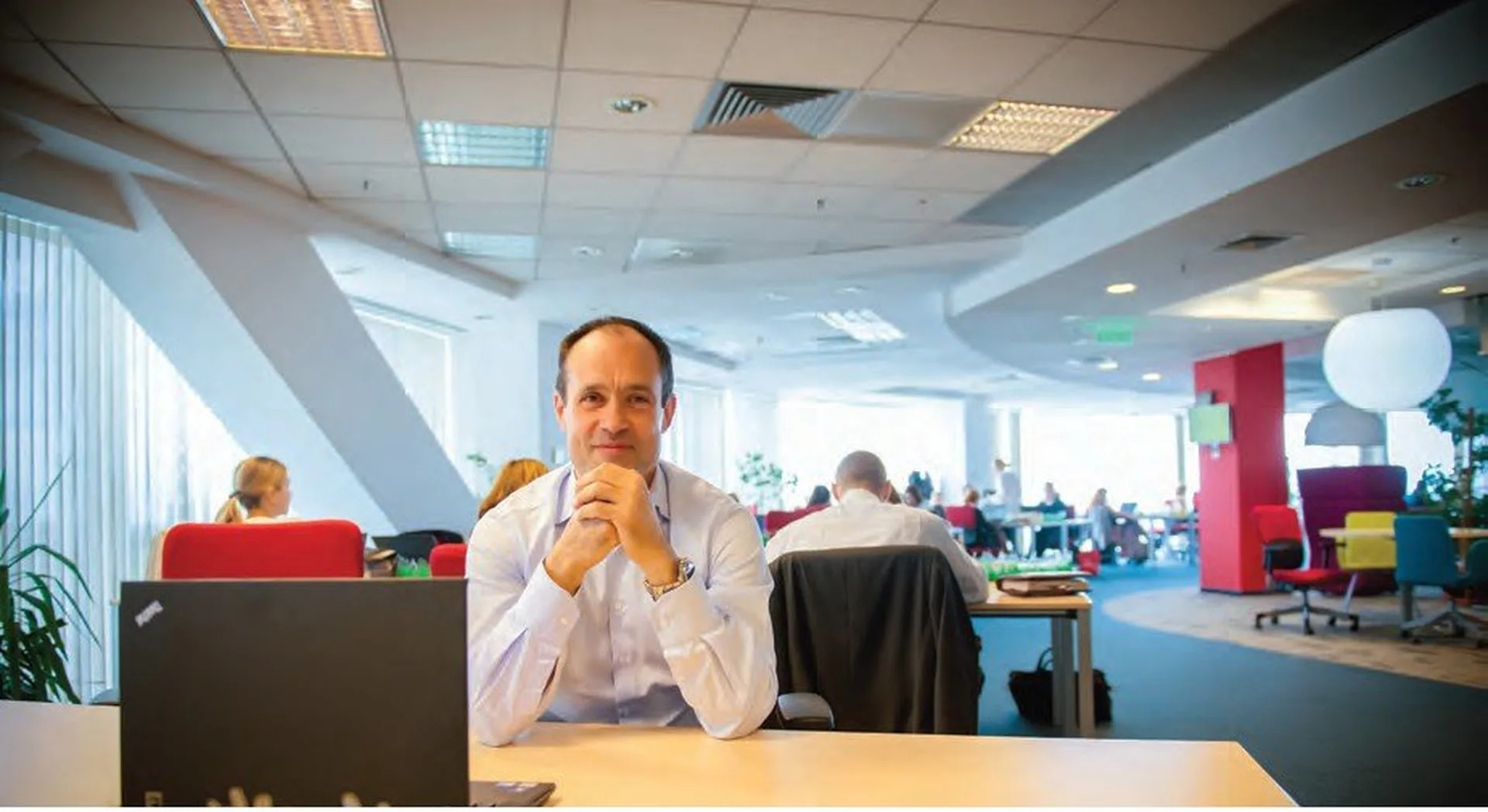
Interview by Vlad Mixich, Photo Cristina Petrescu
What is recommended for a leader: to be loved or to be feared?
To be loved.
Why?
Because it’s better for people to believe in what they do. There is no point in being afraid of anyone and do something they do not believe in.
But it’s so hard to convince someone to believe in something when you are working in the business. A company is not a church ...
Why do you think it’s easier for the church to make you believe? Look at the statistics.
If you give people a mountain of bread, they will follow, but if you give them an idea, they will die for you ...
I think management by fear is not sustainable in any business, in any group of people. It’s not something that works on business on long term. In a business like ours, which offers service to customers, you must have people who believe in what they do. There is a demonization of corporations and perhaps this has to do with what some corporations have done in the past. But I do not know any successful business run by fear. If we look at successful companies today, they had an amazing idea and they to persuade people to say: „I want to be part of it.” Therefore, they are able to attract talented people and make them loyal. Usually, management by fear is a business that attracts a lot of idiots; people who like to be told what to do, rather than being part of a project. If people are more comfortable when working on something in which they believe, why would corporations try to create something different? It would be against the interests of the business.
But you are part of the company which only sells mobile phones. This occupation is simple, clear and honest. Which can be the great idea?
Why would you believe in writing words on paper? Why build a business just printing out things? Although reductive, It’s a way of seeing journalism,... We do not produce mobile phones, we do not manufacture them, we do not make profit from mobile phones. What makes a company like ours is helping people to communicate and this is a human need. In order to be sustainable we must make money which are invested in our infrastructure; the infrastructure that allows people to communicate, to talk to their loved ones; to help them being productive and to be in touch with more people than they had before. We are part of the infrastructure that helps the country to develop. It is not only direct investment, because mobile communication helps all businesses to cooperate. This is what we do. Companies are not created just to make money. This is false. If you build a business to make money, most likely you’ll fail. You have to have a business objective to bring value. If you do this and you do it well, then you will be making money.
When a company grows more and more, doesn’t there come a time, when, because of the significant size, the company forgets the initial idea and making money becomes its primary objective? Is this not evil capitalism?
It’s a political issue.
It’s very discussed in Western society .
Yes , but it’s demagogic . It is demagogic to live well in capitalism, but to say that the companies are capitalist must be avoided. If it would be so, we could not live the way we live. I think we often create some ideals which are not sustainable. We accept ways of life which are convenient to us but we don’t want the other side. And we demonize things that do not exist. I think when increasing the size, many companies lose their creativity. And that goes for universities, political parties, groups of friends. But, to be successful, a company does not have to be bad. It’s exactly the opposite.

„A good manager is one who is able to have the best team”
Andrei Pleşu said that ”we live in a time when we communicate too much to have enough time to stop being alone.” What is the danger of excessive communication?
Do not know . What is different now from what it was before is not so that people talk too much, but the distances we communicate over. Access to information is much higher and therefore we are much more likely to communicate. But, it’s also a choice. You decide how much you want to know , how much you want to read, what you want and what you do not want to read. I do not see how excess information or access to information could be bad. I’d rather be in the situation today than in one where people had limited access to information. It depends on the individual to choose and select how long and how much time he allocates to thinking and how much to communication. It’s a choice. You can read 20 books per week, or you can read one and think about it.
What is better?
I think the important thing is balance. I agree with Andrei Pleşu : no matter how much information you have available, it matters what you do with it.
You said in an interview that when you first came to Romania in 1998 , the country was gray and all the phones were fixed. You are now CEO in a country with one of the best Internet connections in the world. Looking back, it seems to have been an astonishingly rapid development . What has triggered this change?
The most important thing were the people willing to invest in this country. The country created the conditions for these investments. And that made the difference. It would be good for this to continue, not only in communication but also in other sectors. I still see many opportunities in Romania. Those who invested saw a business opportunity. But they did things that helped people. It’s a win-win situation. I would say that Romania has one of the best infrastructures in Europe in telecom. It would be good to transfer this quality in other sectors such as roads.
When you accepted the position of CEO in Romania , you have been warned that is not going to be easy. What made you to accept?
The pleasure of a challenge.
Why do you like challenges?
I love it just like I like running half marathon or climb a mountain. I simply love to prove that I can do certain things. Moreover, I knew the company from 1998 and I was interested by this market and the country. It’s a challenging market. To live as a foreigner in Romania is very easy. But it’s complicated to work in Romania. It’s still much room for improvement in Romania in this respect.
One of the first actions as CEO was to change the Vodafone leaders of that time. Why did you decide to bring a new team?
Some of the people I found here were already at the end of the mandate and seek other challenges. It was a good opportunity to refresh the organization and when you do that, it’s best to start with positions that are closest to you.
I notice that the challenge is a big deal in the world of multinational managers .
I do not think it is limited to managers. I think it’s relevant to anyone.
Do you really believe that?
Yes .
In Romania, there are many people who appreciate stability rather than challenges.
Do not know ...
Challenges have much to do with taking risks.
I think this is a sort of misunderstanding in Romania. Romania always had people who do not like to take risks and like to talk about it. Perhaps this culture comes from recent history, but I do not think that’s true for all Romanians. It is true that there are many people who say “I’m very busy and I have never spoiled anything.” And this is their motto in life. But it’s a pretty sad life. Others like to try things and make mistakes. It’s a different way of life. It’s a matter of choice. People who have been successful in Romania are usually the ones who, in a certain point in their lives decided to take a risk, a challenge to change something. If you do the same thing for too long, you can get bored. But it depends on each individual.
You are a manager in a time of economic crisis, when business was slower than at any other time before ... How do you cope with it?
In fact, the hardest work was between 2008 and 2010. I can not complain too much about this year. The situation is improving in this market. There are still areas that are suffering, we are still under pressure because of the regulations, but besides this, we have the emergence of smartphones due to which we see a better future.
Are there different qualities in a good leader in time of crisis and in time of economic growth?
A good manager is one who is able to have the best team. I do not pay my managers for marketing campaigns. I pay them to create exceptional products. The most important thing for a manager is to be surrounded by the best people. The ability of a company to have good people does not only depend on how they recruit. It is important to recruit good professionals, but it’s more important to be able to develop good professionals. Romanian universities give hundreds of very good young people each year. If they have good managers, these young people will become exceptional professionals. If you have poor managers, these young professionals will be mediocre, even if they were exceptional students. Therefore the team’s management skills are making the difference.
I know that Vodafone has engaged in a project supporting Hospice, Casa Sperantei a palliative care center. Why do you support such a project? Why not something else?
This is not an investment for money , it’s a different type of investment. It is about playing a role in the community you belong to. Vodafone Romania decided 15 years ago to dedicate a part of our funds to initiatives of this kind. We do not have our employees dealing with the palliative care center. But, we take a sum of money and study several social projects that exist in the country. Palliative care is a real problem and I noticed that Hospice, Casa Speranţei has already done a fantastic job and I decided to help. Why? Because we are to some degree responsible for the community we live in. A business grows in a society which develops. We hope that other companies will do the same and then perhaps we will see a different Romania.
Why don’t you talk more often about these projects?
I never liked to advertise our foundation. Because it’s something different , it is not a commercial tool. We do not have a foundation to increase the number of clients. I really believe that everyone has a duty to improve the community in which he lives.
Three final questions that require short answers. First: you’re in front of a group of kindergarten children and you must explain what job you have. What would you tell them?
This is what my daughter asked me last night. I said that I help people in my company to organize and work better so we can provide better service to our customers using mobile phones. I am a facilitator.
Facilitator is a strange word for a Romanian. You are a sort of conductor?
It’s not 100 % accurate. From my point of view, conductor is too straight. Sometimes you have to be a conductor, but sometimes you do not need to impose the rhythm.
You like racing cars.
Right
In a race between a rabbit and a turtle, who would be your favorite ?
This wouldn’t be a very exciting race .
Who would you bet on?
I know the fable of the hare and the tortoise’s lazy perseverance. I love the story, but I do not identify with any of them. Probably a combination of the two is best.
If you would catch a goldfish, what would you wish for as CEO of Vodafone Romania?
Inaki Berroeta (response comes after a period of silence) I would like customers to keep their trust in us and in the future as they did in recent years. And this is because I want to remain relevant to them.