by Bogdan Munteanu
You grow grapevines that we also have in Romania, and olives, that don’t grow here. What business interest takes you to Romania?
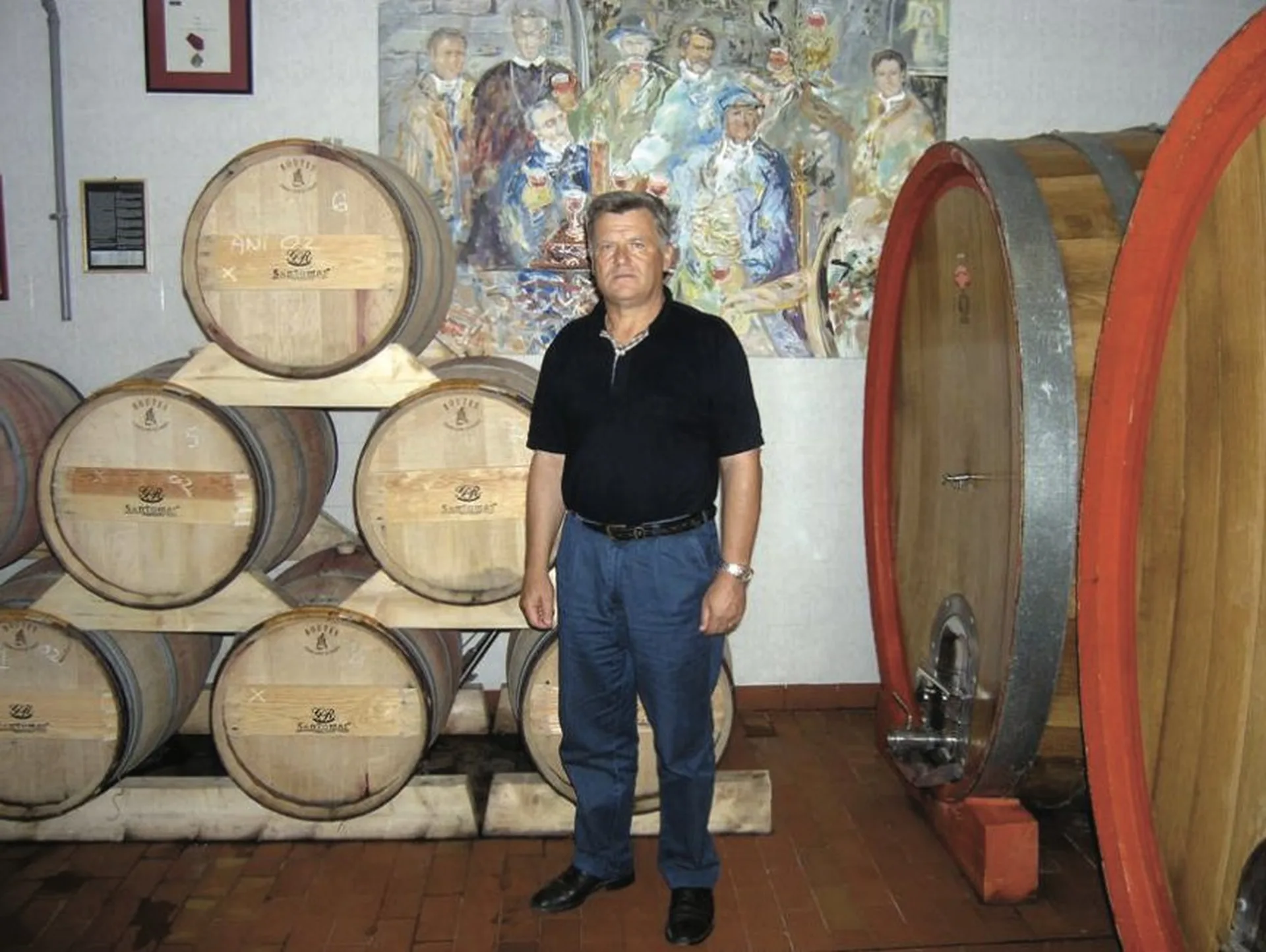
Indeed, the activity dearest to my heart is making wines and olive oil, but I also have a distribution company in Romania, selling veterinary equipment. I have been coming to Romania since 1980, and I first remained here by chance. I came on a delegation from a Yugoslav export company and, as the firm’s representative in Romania got sick and had to return home, I was asked to take his position. I agreed. Then I kept coming not only as a businessman, but as a tourist. I come for friends and I spend here about a month every year.
Premium wines are not ordinary goods to trade. What is the secret of selling them?
Oh, it’s very difficult to sell them… If I knew the secret of selling a good wine, I would be a genius. The secret is that, when you make wine, you engage in a lifelong activity. This is the first and most important secret, that you are tied to the wine with your life and your heart.
The second secret is that the wine must have a certain level of quality. It should be produced in an honest manner and in accordance to the grape variety and to the particularities of the place and the climate where it grows. Each plot of vineyard has a specific taste, a specific message.
The quality of a wine is subjective, it depends on each individual. However, in the global hierarchy of wines, there are opinion makers and one of the most important of these is the American Robert Parker (eRobertParker.com). He tested our Santomas Grand Cuvée 2006 wine and granted it an outstanding result of 94+ points from 100.
Where does the name Santomas come from?
I found it on historic maps from the period of Napoleon Bonaparte. In his travels through Europe, including to present-day Slovenia, he ordered a census of all wine growing regions. Napoleon also came to Koper (formerly Capodistria in Italian) and he wrote that he had found a very good wine named Santomas nearby the city. I liked the name and the history behind it.
Do you sell your wines in Romania?
My wine is a niche product, a premium wine, whose price is a bit high. So, from this perspective, it is difficult to find a good wine distributor. I’d be delighted to find a wine seller to tell me “I like your wine, I want to drink it with my friends”, but I haven’t found anyone yet.
It’s possible that I haven’t tried hard enough to find the right partner. Or maybe I was somehow disappointed with some failed attempts to find one… I found a better response on other markets, so I worked with them. Our most important market is the local Slovenian one. But we also export to America, China and Russia to well established markets for premium wines, selling wines worth of €300,000 every year.
What are the opportunities that Slovenian companies find in our country?
Economically speaking, Romania is a country with a great perspective. Every time I talk to young entrepreneurs, I tell them to come and work here. Romania has hard-working, intelligent and educated people. The country is also a big market of some 20 million people and a very important aspect is that Romania is part of the EU.
Other investors complain about many things, including corruption. Have you found something that you don’t like here?
I think that, very often, people complain without serious arguments. When you enter any market, in any country, it is expected that you encounter problems. Complaining about it is senseless, but this is how some people are; they can’t see the forest for the trees… Doing business in Romania is by no means harder than in other countries. On the contrary, I consider it’s easier to work here than to enter other markets.
As for corruption, I don’t understand the big fuss made about it. It’s important for a former Communist country to fight corruption, as it is a dangerous phenomenon for the state. But I don’t think that corruption is as big as the discussion around it. I hear many words about it, but I don’t personally face it.
Prayer. And the meeting between truth and love. In Slovenia people are not religious anymore. In order for a little nation like ours to confront globalization, we need more spiritual life. This is something we lack.
Did Slovenia get rid of its Communist past? Will it take long until Eastern Europe will be truly healed?
I think democracy is a first step of escaping the past, but it is such an important step that we can already say that “We’re now over Communism.” Afterwards, in a democracy, there are many social layers sharing different opinions that were brought to us along history. One of this ideas is Communism; it’s an idea that has always been with us and will always find support among a certain segment of the population. In a democratic mechanism, this idea enriches us as a society. But putting it into practice exclusively has been a disaster.
Despite being a small country, Slovenia is very successful economically. Is there a lesson that Romanians could learn?
There is no particular lesson to be learned, as Romania has its own success experience. I remember where the country was 25 years ago and I can see it now. It is a joy for me to see big developments every time I come here.
On the other hand, economic development isn’t everything; it’s just a part of life and this is how it should be considered. If there’s too much of a focus on economic progress, we forget the meaning of life. Romania still has a big rural population and it has a richness of tradition. This is what makes me happy when I come here, not only the economic development. We now live in an age when the economy grows everywhere in the world, but it’s important not to destroy the traditions and identity of any nation. Development doesn’t solve everything, it also brings problems.
As a businessman, you are interested in making a profit. Should business people be involved in civic life and try to address some problems of the society around?
If he works with an open heart, any business man should acknowledge that not only profits are important. Making money is a good motivation, but what matters is to work with, not against, the environment around you, to work with your team, with the city or village you live in…
You should think in perspective. For instance, think about the demographic future, because, if there are no children, there’s no joy in a house. We should turn to religion, because it is the only aspect that can be an anchor against the problems brought by development.
Could you give examples of your social and cultural involvement?
Where I live, I try not to live alone; I think about the necessities of those around me… Also, I am very interested in art, both in my native country and in Romania. I collect paintings and I had the chance to know great artists like Margareta Sterian who was a very special lady.
I have an important collection of contemporary paintings, because I don’t like only a work of art in itself, but I also like to meet the painters, to talk to them. From Romania, I have paintings of Margareta Sterian, Radu Darânga, Marilena Măntescu, Eugeniu Barău, Dragoş Viţelaru. I’ve also got German, Chinese and, of course, Slovenian painters.
What would you recommend to a young entrepreneur, in order to find success in business?
Well, not anybody can be an entrepreneur. Or not anyone graduating an economic school. As there are many gifts people are endowed with, there’ a special gift of being an entrepreneur. This gift will teach the entrepreneur what to do in a certain situation.
Education is welcome, but my father said that you must first understand something very well before telling others. A general piece of advice that could work in any business is what my mother told me: “Be a tough negotiator, but pay promptly.”
In the end, I’d philosophically ask: what matters most in life to you?
Prayer. And the meeting between truth and love. In Slovenia people are not religious anymore. In order for a little nation like ours to confront globalization, we need more spiritual life. This is something we lack.