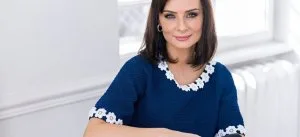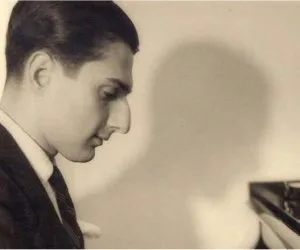
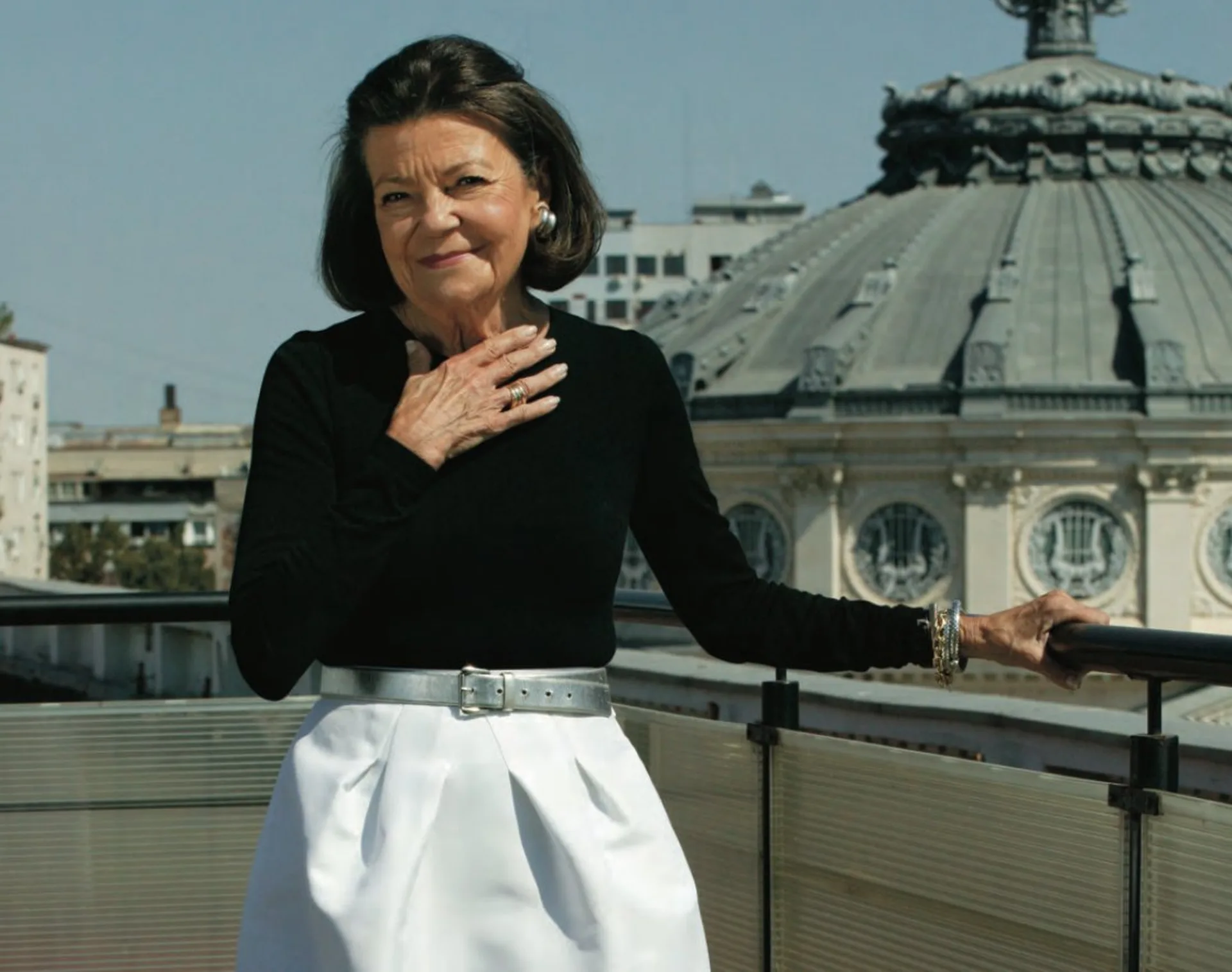
„Sometimes I wonder if perhaps I am a slightly ridiculous person or an anachronism”, Marina Sturdza said to me at the end of a long interview. A question that depicts a curious insecurity for such an accomplished woman - internationally renowned journalist, vice-president of a famous fashion house, UNICEF executive, organizer of major international investment summits, patron and host of charity balls that have raised millions of euros for Romanian children and cancer patients. But Marina Sturdza’s concern is justified by the fact that she has chosen to swim against the tide, in a world where everyone chases money, fame or power. A princess by birth, she has earned respect by virtue of her hard work and discretion, and has earned a reputation that is entirely ridicule proof. Not just princess, but Lady Marina Sturdza.
What would be the definition of a good interview?
Discovering and revealing something that hasn’t already been analyzed a thousand times, allowing the subject to express something that is a personal passion. When, after
the article appears, the subject tells me “That’s accurate that’s me”. I don’t like the type of journalism where you try to trap people; I prefer the exact opposite: to allow my subjects
to express themselves, to try to motivate them to explore new themes.
Any good interviews you remember?
I particularly remember some with Karl Lagerfeld. He is a designer, but a passionate, erudite man in all domains, he has a labyrinthine mind, extremelly well informed, a real
Renassaince man. Sometimes, the best interview is not when we meet for the first time, but the second or third. I often did different interviews with the same person, for different magazines. That’s how we established a more profound dialogue and a level of trust. I always tried to establish a relationship and to show true interest in my subject. I find it incredibly careless when someone comes to interview me and he or she didn’t even bother to look up the topic we are discussing.
So, what did you get from Lagerfeld?
He is a person with a great sense of humor and I got some interesting reactions and emotions. Behind the intellectual armour he wears, he’s a man of tremendous intelligence and sensitivity but whose feelings can be hurt too. It was a particular occasion when he was very upset and refused to talk to anyone else, but accepted to talk to me for an interview. His anger was justified: it had been a kind of Oscar ceremony for fashion had taken place, a complete commercial farce, and he felt ill-used. He was right to feel so.
Another interview I particularly remember also comes from the world of fashion. It was an interview with Giorgio Armani, when his life partner had passed away and I was in Milan with a television crew. It had been scheduled for months, but then his partner died and he refused to give an interviews. I asked his personal assistant if I could speak to him myself. Knowing that I had brought an entire team, at great expense, she said “Yes”. Armani consented to do the program, which surprised everyone. It was very interesting because nobody was talking to him about the single most important thing in his life: the death of his best friend, his life and business partner; they were all completley avoiding the subject. And so he and I talked about it, camera rolling, and I could see the PR in the back saying “Cut! Cut! Cut!”, but he wanted to talk, so we continued the interview that lasted a very long time. A few weeks later they contacted me, asking for the film. I sent them the very short fragment which we had cut for a Canadian television channel, judging that there were many personal issues and that much of it had been a private conversation; I also sent them the entire un-cut film. They thanked me, and that was it. I believe a journalist has the responsibility to respect certain limits and not disclose information that is really confidential.
Isn’t it a violation of the rule that says that the main duty of a journalist is to serve the reader’s interest?
No. Some things are truly personal and they don’t serve anyone’s interest. Being a public person doesn’t mean that absolutely everything about you must be public. You still have the right to some privacy. It may be an old journalistic principle, but it is still useful. It is called “Roosevelt’s wheelchair”. You never saw his atrophied legs. You knew he was paralysed, you had pictures of him in his wheelchair, usually his torso, but you never saw the legs.
You still had the camera running with Giorgio Armani. Was he aware of this?
Of course he knew. He knew perfectly well, but he ignored it.
And he talked?
He did. He was fully aware of what was happening.
You would have been covered if the whole interview had been broadcasted.
Yes, but I would have never done that.
Why not? Wouldn’t it have been a journalistic hit?
No, that wasn’t the purpose of the show. It was a short segment for a specific programme on Canadian Television, CBC, and would have been inappropriate in that context. It may still be possible to use the material one day, now that time has passed, I could ask his permission. At the time he was interested in seeing it, but wasn’t interested in editing it.
Was it your decision?
Yes. It was also about respect for my audience. It was a popular audience and it wasn’t appropriate. There is a politeness, even in journalism. Today, politeness in journalism is a flaw, nerve is seen an asset.
You just said that this politeness brought you the trust of famous fashion designers. You had access everywhere. You got great material and they had something to gain from knowing that their message would not be manipulated but what was the gain for the reader? What is the role of a fashion journalist anyway?
I didn’t write exclusively on fashion. Randomly, it just happens to be examples from the world of fashion, but these two are not just designers, they are global titans, economically speaking. My wish for the reader is to find some precise information, to feel an emotion or to react in a way that reflects precisely what happened. It doesn’t mean that I cannot ask some incisive questions, and I often do, but I try to respect both the intended audience and the subject.
What is the role of the journalist?
The journalist is an intermediary for someone who hasn’t been at the scene. Therefore, he has a duty to respect the truth of the moment. What I disapprove of in current journalism is the lack of differentiation between two very separate functions: reportage journalism versus editorial in which you express your opinion. Like in any other profession, you have a learning period, you have to polish your skills and gain competency and professionalism. I am dismayed when I see young reporters asking frivolous questions about subjects they haven’t even bothered to research, which is part of their job. Each has his/her role, each must know his/her role. There are many people who think journalism is easy, but there have to be highstandards. This is a profession you must respect.
When did you gain access to the personalities you mentioned, and after how many years of experience?
Quite soon. I had some good opportunities. I wrote for some important publications, but if I didn’t write well, I could easily be fired. There were plenty of pleople to take my place. So, before being a journalist, I think I was a good writer, but I don’t like sensationalism.
Still, the famous 5 o’clock news has great audience numbers.
Respectfully, I cannot watch these programmes. Inevitably, television distorts. You have to compress into a 60-second pill an event that happened over a 24 hour or week-long period. That’s if you are lucky; sometimes you only get 30 seconds... Television has a distorting and an exaggerating effect; this is inevitable. The trick is always to select the most pertinent and meaningful information to present a balanced overview. But I’ve seen what others are doing in television, like Alex Dima and Paula Herlo from PRO TV. I have a great admiration for their work. They take on many themes that require extensive and difficult research and they put in all the time an effort that is necessary. I think you always need to be selective even in life. And life is about constantly trying to find that equilibrium, and one probably needs to adjust the balance continuously. There are moments when I realize that work is taking all my time and that my friends are suffering because I’m too involved in some activity. I think you constantly need to readjust the balance.
You worked for many publications, as a journalist.
Yes, I’ve always been a freelancer, but I had contracts with specific magazines and newspapers. And I always kept the copyright.
How did you obtain this privilege?
I don’t know. It just happened. I was not all that well paid, but my articles were always purchased. I didn’t have a fixed salary, but in the end the copyright ownership was a positive aspect for me, because I could keep my freedom of expression.
Why is independence so important to you?
Because it is authentic. You can assign me to write about something, but you cannot tell me how to write. That was important for me, because it is also about credibility. The magazines I worked for respected my view point. Sometimes it is a luxury to say no.
Were you able to afford this luxury?
I did, very often. I probably remained rather poor because of that. (laughs). But I know what’s right for me and I don’t get involved in certain situations because they are not appropriate, not my style. Let them find someone else...
A Chinese proverb says that a good helmsman always sails with the tide. Did you do that?
No. I chose to learn through new opportunities. My career certainly hasn’t taken a very orthodox path, I do not really recommend it, but my entire life has been rather unpredictable: there was no prediction of a communist regime coming, of my family being imprisoned, or under house arrest and that we would be refugees in a number of countries. All these events have added up to the person I am today: I became adaptable, and I seem to have a philosophy of getting over hard stuff. I try to find solutions and make changes, if necessary. My aspiration was to become a diplomat, but was too young for university when I finished highschool at 15. I had a gap year, which changed many things. It wasn’t a very good thing. I skipped three years.
Why?
That’s what my teachers and my parents had decided. I started winning all the prizes at school, I skipped three years and was then catapulted into my incompetence zone. I was quite an isolated child because of my strict education, because of our past history and the fact that we were marked by the refugee experience. It was too early to go to university at 15. I was extremely bright but not nearly mature enough. I learned very fast but I didn’t really know how to study. So I traveled to Europe for a year and I decided to do Beaux Arts on my return to Canada. I had a pleasant little talent, not enough talent to be a true artist, but that’s when I abandoned the dream of becoming a career diplomat. But in the end I think I got the best of several worlds.
You received a very conservative education…
Yes. ... having on the other side the fashion industry, seen as the place of moral excess.
Was your adaptability put on trial?
No, because I was only a spectator. Being in a place where something happens doesn’t mean you’re participating. There were many periods with amazing parties that take place in Paris and you couldn’t watch them in any other way except with wide eyes. That was a completely unknown world to me and I wouldn’t have discovered it if I wasn’t there as a journalist. I was always interested as a journalist–spectator, and even though it wasn’t my world, I had no professional problem as a journalist.
What word would define that world?
Show. Theatre of the extremes. Whose sole purpose is to look at it. I have a sense of humour, so it’s hard to surprise me and I experienced many extremes in my life. I’ve seen very difficult situations working for United Nations. I was motivated and enriched by the people I learned from. When everything becomes routine and I have nothing more to learn, I usually move on.
What did you learn from world of fashion?
Taste. Selection. Subtlety. Nuance. Proportion.
And negative?
Cruelty. It’s a very mean environment. People are eaten alive. But at the same time it is a very creative environment. Every six months you must reinvent yourself. You must foresee what people want, with sales being a constant demand. It’s a very tough job.
You became Vice-President for Oscar de la Renta, in 1988...
We were already friends. I had often interviewed him. Discussions started in 1987.
How are things negotiated at this level?
I didn’t handle it myself. The offer came quite spontaneously. I always went to see Oscar’s collections in New York. I was always welcomed there and I think I wrote about him with precision and credibility. Around that time, I was hosting a big charity event in Canada for a women’s health care foundation. I asked Oscar to come and I told him he must be involved, because he is related directly to his audience. He agreed, so we organized an important event, raising a lot of money for research. In the same year the Australia bi-centennial where I was invited as a journalist took place, on behalf of Canada. Wool being Australia’s principal export, the Wool Bureau, and the Government of Australia invited ten of world’s most famous fashion designers to put on a fashion show to be broadcast globally. As it turned out, I was the only journalist that already knew all the designers and was not intimidated by them, so we did great interviews and got great television footage. Oscar liked what I did there, and then made me a serious offer.
Why did you leave?
I think my age was a deciding factor. I simply wanted to do more than just earn money. I wanted to do something with real social impact, something that would make a real difference.
Did money become irrelevant because you had a very good income?
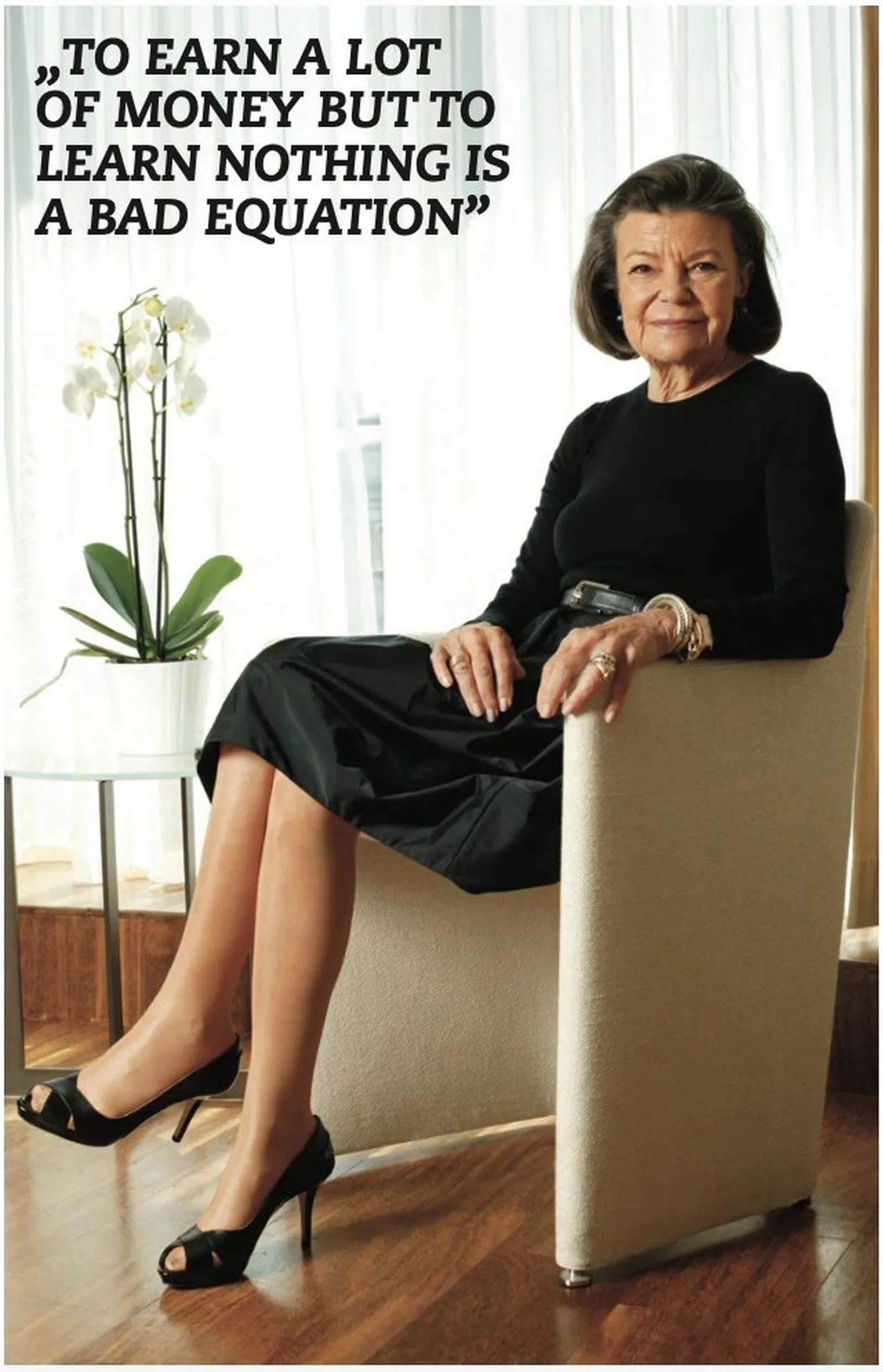
Money is never irrelevant. But money per se has no value if it is not connected with achievement and accomplishment (says someone who was a refugee in Alberta and lived for a long time in a basement in Toronto). Money is essential and it is indeed difficult to have no money. But there are many levels between the essential and luxury. To earn a lot of money and learn nothing is a bad equation. Again, it’s about equilibrium. When I left the luxury goods business to go to the United Nations, there was a big paycut, but there were other benefits. Not necessarily related to money. When I have money, I spend it and we eat very well and drink good wine. When I have no money, we eat spaghetti and drink table wine. It doesn’t change anything very much. I think my friends would agree.
You reached Canada in 1952. What were your parents doing for a living?
We arrived there on a Red Cross program. Canada had already a very enlighten immigration program. My grandmother had been working with the Red Cross for years and with help from Swiss friends of hers we were offered several countries: Greenland, South Africa, New Zealand and Canada, which we obviously chose. We had, like all refugees from the Eastern block, the idea that America is the land of golden opportunity. We left Europe from Genoa, Italy on a Greek ship, the Nea Hellas. And we landed in
Halifax, where we were taken by train to a pig farm in Alberta. The rule was that you had to do one year of farm work. But after 8 or 9 months they set us free because of the
very hard conditions. My mother, my step-father and I went to Toronto. My father was still in Romania.
Your step-father was a well-known patron of industry.
Dumitru Bragadiru... a very elegant, charming and gentle man, rather from another century. Not at all prepared for all these life changes. In Toronto, my mother became a translator and my father did almost everything that refugees do, selling magazines from door to door and many small jobs for which he had no particular qualifications. But gradually they worked their way up. I went to a very good private school and in a few years he became the commercial advisor for the Belgian Embassy. There was a whole community of European immigrants, all the intelligentia and the last vestiges of noble families from Poland, Hungary and Czechoslovakia. Many of us ended up in Canada, mainly in Ontario.
Did you feel that life owes you, that history betrayed you, in your childhood?
Exactly the opposite.
How is that?
I felt that I have a duty to fulfil.
Weren’t there stories about the past at dinner time?
There was never misery or lamentation. Always only the most beautiful memories. We had nostalgia, no revenge, misery, laments, never.
How do you explain that?
Freedom...
Were you free and grateful for that?
We were free. Free, and that was the only thing that mattered. Many ugly things had already happened by the time we left Romania, but we never talked about them. I have never been surrounded by people who whine. On the contrary, they spoke with nostalgia and passion about all the privileges of the past. I was raised with the idea that I have the duty to honor my past, that my behavior is being watched by past generations.
But didn’t you tell the children in school about your family’s story?
No, because I was already was so different. I was always the foreign kid. In the 50’s very few of them even knew where Europe was. Asking them to know about Romania was too exotic for the majority of them. I was “the foreign kid”, strange - my clothes were different, I wasn’t allowed to do things they all did. I was raised in a very restrictive manner. I wasn’t allowed to go to certain parties, to play after school, a more colloquial language would be punished. I didn’t tell my story to anyone there because it was inappropriate and it was a situation when you want to look exactly like the others, to be exactly like them and not isolated. Children like to conform.
Who influenced your teenage years most?
I’m pretty sure that would be my step-father. He was such a charming man. I don’t ever remember him shouting or even raising his voice. He had a visceral politeness and grace. I think he influenced me a lot. Also, a very beloved aunt of mine, Mica Ertegun. But we all started as refugees. She influenced me by always treating me with respect and treating me as an adult and . I very much appreciated that as a child. I was often sent to the farm she had with her first husband, Ştefan Grecianu, an extraordinary man who deeply shaped my views.
Which is the most profound mark that your childhood education left on your personality?
I think it’s autonomy. I really count (and I am not at all a cynical person), only on myself. Of course there was always room for others and I am lucky I have many very close friends, but I generally count on myself. I imagine I'll have to handle every problem. And I have confidence that I can, whatever happens, resolve the situation. In one way or another.
You travelled a lot while working for UNICEF and as a journalist. Does poverty look different in Kathmandu, Chişinău or Bucharest. In what way?
I would not want to romanticize poverty, but Kathmandu is different, in a wonderful way. There isn’t such deep sadness and I suspect that is due to their religious beliefs. I was 3-4 times in Nepal’s poorest places and there was a kind of joyfulness. Nepali people are very elegant, with very beautiful gestures. Similarly in Moldova, the poorest country in Europe, I was struck by the fact that you don’t see dirt, you don’t see beggars, the streets are immaculate. Dignity is a very big thing. You won’t see beggars in Moldova, you won’t see amputee children forced to beg.There are poor people, surely there is material misery, but not much of human misery, there is great dignity.
There is a big difference between misery and poverty?
There is. We were extremely poor, we had nothing to eat, we bought our clothes from charity shops, but I dont’t think we ever lost our dignity.
What happened when you were assaulted and badly wounded by street children in Bucharest? It sounds Kafkaesque...
I live next to the British Embassy, where they are many policemen and it is usually a very safe area. But, that night the roads were closed for resurfacing, and suddenly some children appeared and started to buzz around me. I remember I asked what they were doing at that time at night. That was when they started to burn me with cigarettes. They wanted to steal from me. There were three children and I remember I said, in Romanian “But you are dangerous!” and I started walking faster. I have been mugged before, so this was deja-vu for me. In those moments you realize the extreme danger. Screaming was not helpful, the streets were empty and I needed all my energy to stay on my feet and not fall down. They started to hit my legs with wooden boards, throw stones at me and a little girl was running in front of me with some string, to make me fall. I managed to stay on my feet, I could already fell the blood on my neck and when I reached Magheru Blvd., some policemen apparently saw what was happening, shouted at the children and they ran away. They took me to the emergency hospital with an ambulance. What you see there on a Saturday night is hallucinating. I was very badly cut, they operated on my leg that night because I was quite badly wounded. I stayed in the hospital for two weeks.
Interesting that, despite that experience, you still return to Romania for charitable activities. It didn’t set you off track?
On the contrary. It proved to me more the imense needs. here. That’s why I’m increasingly involved in the destiny of children leaving institutions at the age of 18. Who is going to take care of them? I worry they’ll have the rest of their lives to become delinquents. I have no money, I’m not rich. Sure, I’m richer than some people. What I do have is time and maybe some influence. And I think it’s more useful to take advantage of these things, rather than give 10 lei to one or another. People have illusions, always thinking that somewhere else is better than in Romania. It’s not. Elsewhere there are other problems than those we know here. Many people thought that if we get rid of the communists, everything will be brilliant and now they could dream in colour. No. Democracy is a long-term process and it cannot be accomplished overnight. I choose to be here, but not all the time. If I keep one foot in America, one in Europe and the other in Romania, then I can keep my standards high and can be a better catalyst to raise the standard here, too.
And what happened to those three kids?
This is a real problem in Romania. We have no mechanism for children of that age, who are already well trained criminals. They have no concept of good or bad, wrong or right, no boundaries. They imprisoned those two who attacked me – the third one was more a spectator. We have no correctional schools. That’s why I have a special interest in what is to be done with those who leave institutions. I really forced myself to redo that itinerary alone, with the idea “you need to get up again on the horse that threw you”. I have no lasting problems from this incident, except I change sidewalks if I hear steps very close behind me. That frightens me but that's about all that's left.
Do you have children?
I have two step children. And I have grand-daughters. I was married when I was 22. Very early. Yes. I don’t particularly know why. We were happy for a long time, for 19 years. But there was a very big age difference and we were at different points in our lives. I am the product of Europe, and my husband was very much a Canadian. He wanted to retire just when I was receiving international job offers. But I want to get back to the question about my family history. I realized, even as a child, that the beautiful memorable past my family kept talking about was already history and would never return. Partially, that kept me from coming home to Romania for many years. I knew it was a beautiful fairytale and a world that was already long gone, but I never saw things as lost. I think about all those people I would never have had the chance to meet and how rich I am in this complicated life. I feel 95% at home everywhere. But I never felt 100% at home, anywhere in my life. I’ve always been a bit uprooted. It’s probably the
same for all refugees.
You cannot say where home is for somebody unless you know where they would like to be buried?
Nowhere. I don’t want to be buried. I asked for my ashes to be scattered in several places.