by Alice-Claudia Gherman, photo archive Emanuela Cernea
Could you tell us a little about the importance of Prince Neagoe Basarab in the history of Romanian art and about the role he played in the beginnings of Romanian art?
I dare say that Neagoe Basarab is the historical figure to whom we owe the most valuable artistic legacy. During his short reign of just nine years, he succeeded in turning Wallachia into a veritable cultural capital of Eastern Europe. The most distinguished artists in this part of the world worked at his court; it was also here that one of Europe’s earliest printing presses operated, producing the first edition of the New Testament in Church Slavonic – the liturgical language of the Orthodox East. He was the founder of the most admired church in Romania, whose beauty gave rise to the legend of Master Manole. In addition, without exhausting the list of exceptional achievements associated with his name, I would add one more: he wrote the celebrated book known as The Teachings of Neagoe Basarab to His Son Theodosius, the first major authorial work in Romanian literature.
Beyond his investment in culture, which he pursued with astonishing intuition and consistency, Voivode Neagoe Basarab is also remarkable from a historiographical perspective. He effectively “appropriated” the dynastic name of the Basarabs for his own use, even though his Basarab lineage was disputed. He was the only ruler of Wallachia bold enough to identify himself in official documents simply as IO voivode Basarab, and to be recognised as such without further clarification of his lineage. In addition, he became the quintessential model for the voivodes who followed him.
Neagoe Basarab was a highly cultured ruler. In just 39 years of life, he managed to demonstrate the breadth of his extensive learning.
Could you sketch a portrait of Prince Neagoe Basarab? We know that he was considered the most cultured ruler of Wallachia.
There were, of course, numerous other figures of remarkable erudition who lived or ruled in the Romanian principalities. It is enough to mention Prince Dimitrie Cantemir and his formidable historical and literary output, or the fabulous library of Voivode Nicolae Mavrocordat, which was fiercely contested upon his death by some of the world's most passionate bibliophiles. Thus, it should come as no surprise that a voivode such as Neagoe Basarab, raised in the wealthy Craiovești family and fortunate enough to have been personally educated by a Patriarch of Constantinople who had taken refuge at the Basarab court, was a highly cultivated ruler.
What is truly remarkable, however, is that he managed to demonstrate the breadth of his erudition in just 39 years of life. The disease that ravaged the period – tuberculosis – prevented him from exercising his literary talent and artistic interests for longer, but it also curtailed the diplomatic vocation that had, surprisingly for those times, secured him a peaceful reign without wars.
On the other hand, beyond those long blond curls reminiscent of the heroic Merovingian kings, what draws our attention in the portraits commissioned by Neagoe himself during his lifetime is his insistence on being depicted in the attire of a Byzantine emperor, at a time when the throne of Constantinople had already been occupied by the Sultan and the princes of the Romanian principalities were expected to appear only in the clothing of Ottoman subjects. Thus, the portraits that have survived to this day are not merely faithful records of his physical features, but also narrators of a personality that transcended the conventions of his age – a man who consciously presented himself to his contemporaries as a model of integrity and hope.
Could his donations and his image as a “holy ruler” conceal a political and cultural calculation, or was faith the only motivation behind them?
Although, for us today, whether or not one is religious is simply a matter of personal choice, faith was, for a person of that age, a modus vivendi. Moreover, for a society whose political and cultural model was Byzantium, symbolically represented by the double-headed eagle, it is easy to understand that the head of state and the religious leader were obliged to coexist, and that the ruler therefore had a direct interest in the fate of the Church.
The historical context, however, gave Neagoe Basarab the opportunity to establish himself not merely as a protector of the churches of Wallachia, but of all the Eastern Christian churches within the territory of the former Byzantine Empire, then governed by a political leader of the Muslim faith. Possessing the necessary financial means, Neagoe Basarab transformed this form of patronage into a genuine campaign of personal PR and even a kind of nation branding, avant la lettre, presenting himself as a model of generosity and wisdom among the leaders of his time.
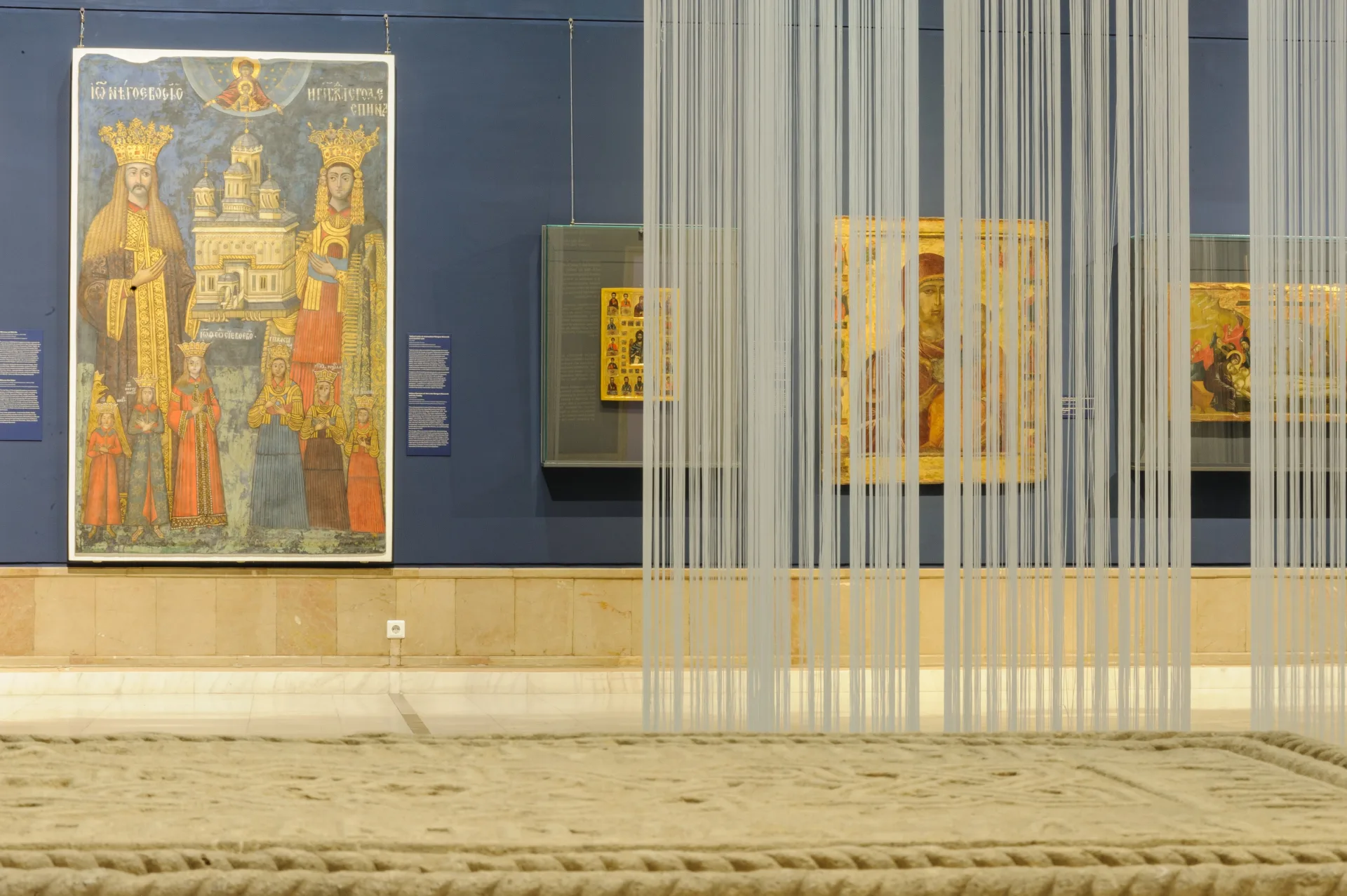
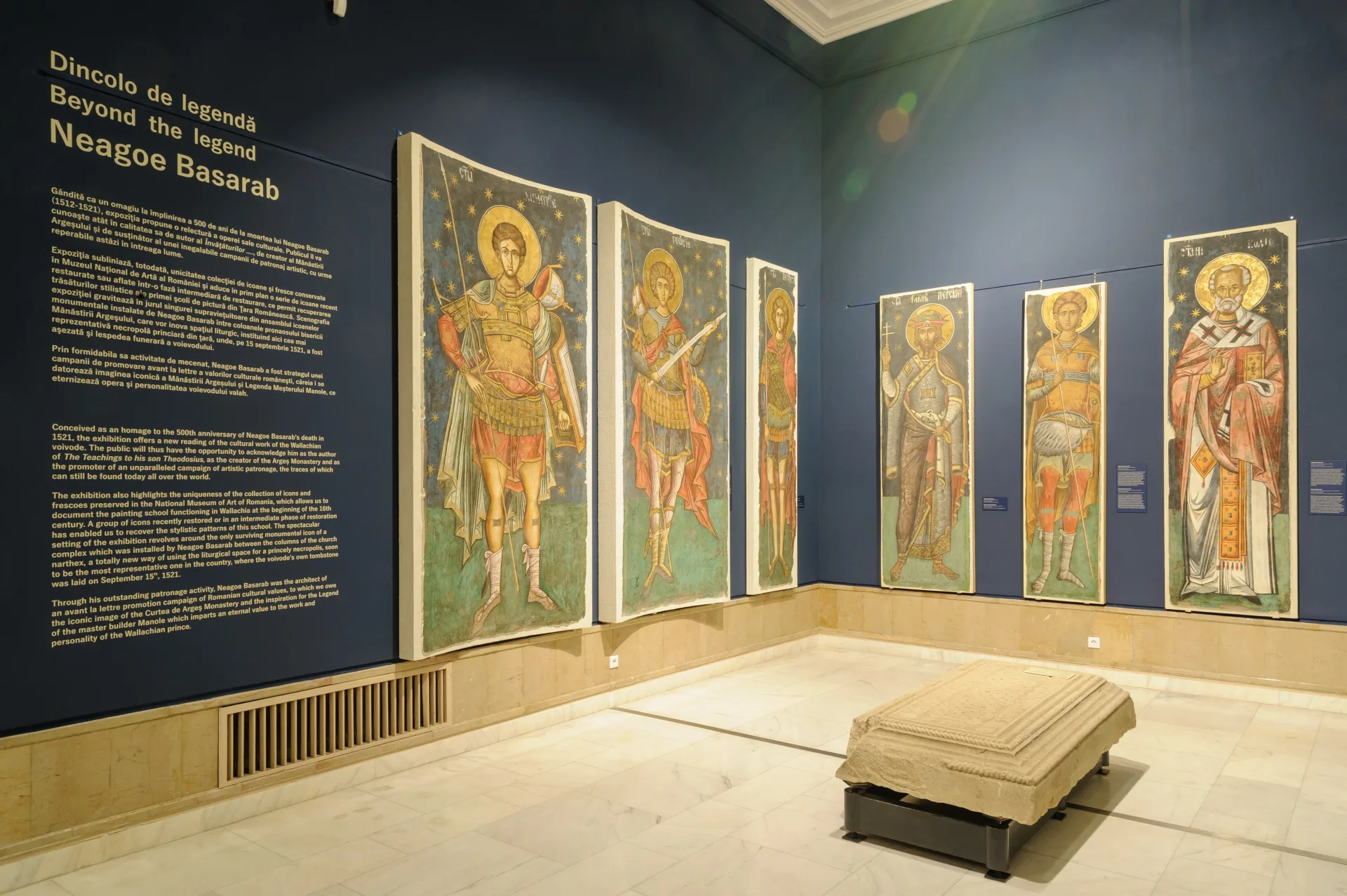
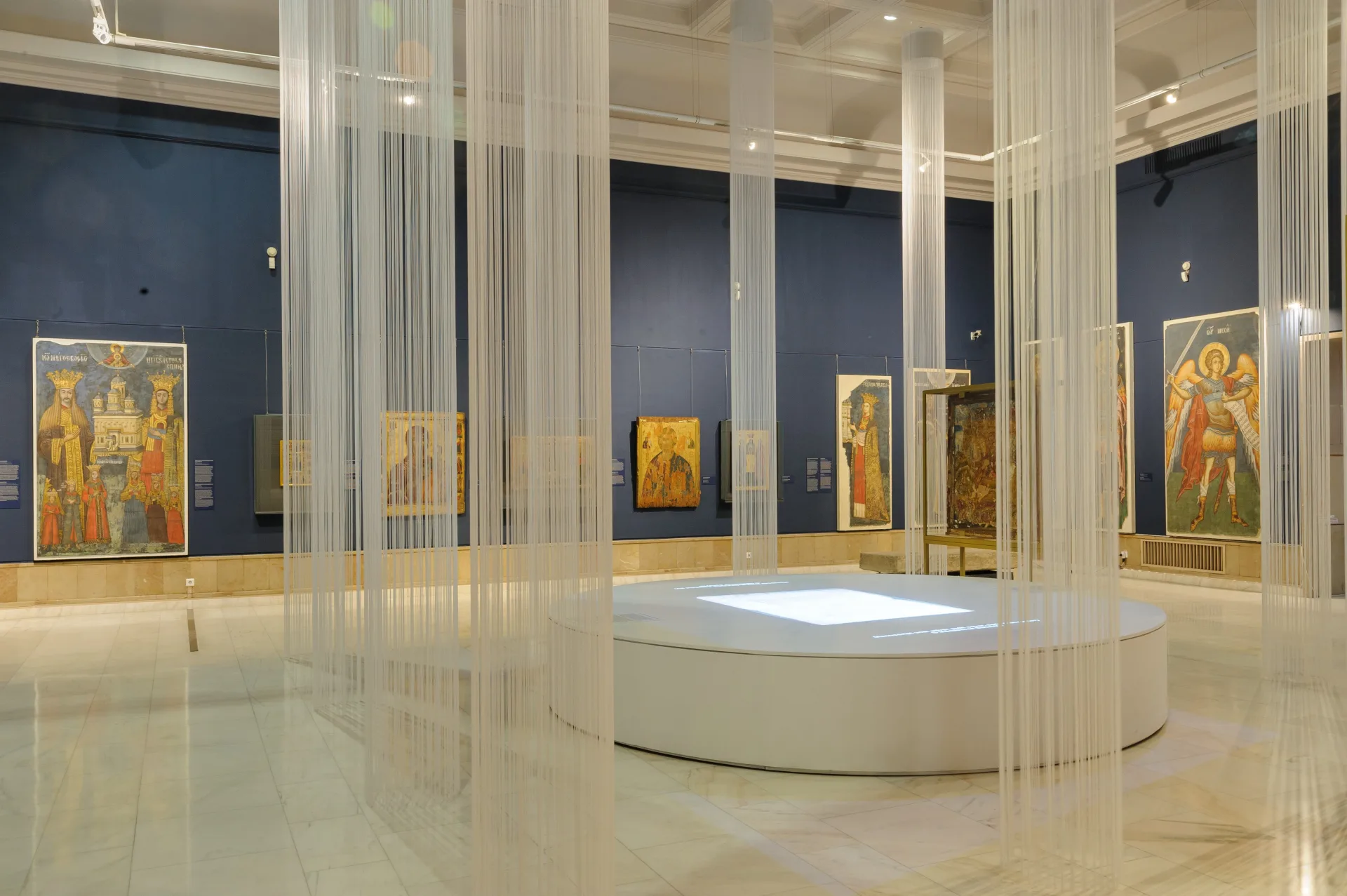
Images from the Gallery of Old Romanian Art, where an entire room is dedicated to the age of Neagoe Basarab.
Neagoe Basarab is often associated in history books with his celebrated treatise, The Teachings of Neagoe Basarab to His Son Theodosius. What is the story behind this work, and could you also emphasise its importance in its own time?
The fact that this book was written during his lifetime, and perhaps even by Neagoe himself – the debates surrounding the authorship of The Teachings have not been definitively settled – remains an exceptional cultural event in Romanian literature and culture. Although we are accustomed to placing our early history on the periphery of the great civilisations, the fact that a “guide” to good practice for a prince was composed at the Wallachian court at the same time as Niccolò Machiavelli was writing Il Principe and Erasmus of Rotterdam his treatise on The Education of a Christian Prince demonstrates just how closely aligned Wallachian cultural policy was with the cultural trends of the period.
In any case, the most authentic validation of the prestige enjoyed by The Teachings and its author in their own time is undoubtedly the plagiarism committed by Ivan the Terrible, who used the work in order to present himself before the Ecumenical Patriarch of Constantinople as a leader with a genuine Christian education. Fortunately, Ivan the Terrible’s copyist, whether intentionally or not, preserved the names of Neagoe Basarab’s children within the text, thereby leaving open the possibility of exposing the fraud and providing posterity with evidence of the success The Teachings enjoyed at the time.
How did Neagoe Basarab manage to support such an ambitious architectural and artistic programme during a period marked by so much political turmoil and Ottoman pressure?
It is indeed astonishing that, in an age of conflicts of all kinds and during a reign of just nine years, Neagoe Basarab managed to leave us such a rich cultural legacy. It is enough to consider that Stephen the Great, his contemporary and the only ruler who could rival him in terms of artistic patronage, reigned five times longer than Neagoe Basarab and yet his generosity did not achieve the same proportionate scale as that of the Wallachian voivode.
In this hypothetical competition, however, Neagoe Basarab was certainly advantaged by the immense wealth of his family, the Craiovești boyars, who were known to be extraordinarily rich. Another factor that facilitated Neagoe Basarab’s remarkable cultural trajectory was the privilege of having grown up under the careful spiritual and cultural guidance of Patriarch Nephon II of Constantinople. Neagoe retained a profound respect for him until his death and, in his memory, commissioned important architectural, artistic and literary works, including The Life of Saint Nephon, written at Neagoe Basarab’s request and which became one of the most evocative chronicles of Wallachia from the beginning of the sixteenth century.
It is also remarkable that Neagoe Basarab directed his generosity predominantly towards beneficiaries outside his own country. He built, restored or endowed more churches and monasteries in Serbia, Bulgaria, Greece, Constantinople, Mount Athos, Mount Sinai and Jerusalem than in Wallachia itself. Historians attribute this apparent imbalance to his need to assert his position in an age of profound political change and tension.
I would add, however, that Neagoe Basarab was not merely fortunate; he also possessed the wisdom to secure a reign free from military conflict. His diplomatic talent is readily apparent in The Teachings, which suggests that the Romanian proverb so controversial today, Capul plecat sabia nu-l taie [The bowed head is not cut by the blade] seems to have been the guiding principle of his reign – evidence of a rare wisdom that helped him choose what would endure over ephemeral victories.
To what extent did the Curtea de Argeș ensemble establish a new aesthetic canon in Wallachia, and how was this connected with the refinement brought by Lady Despina from the Branković milieu?
Together with his cultural policy as a whole, Despina-Milița – the wife of Neagoe Basarab’s wife and a descendant of the family of the last Serbian despots - also made an important contribution to the construction of the Argeș Monastery. Through their connections with the Balkan and Adriatic worlds, Lady Despina encouraged the presence at the Wallachian court of important cultural, artistic and spiritual figures of the period. It is enough to mention Maxim Branković, Metropolitan of Wallachia, who appears to have been her uncle, or the celebrated printer Macarius, also of Serbian origin, whose printing press, established shortly after the invention of printing, produced the earliest printed books in Romanian.
A close examination of Neagoe Basarab’s life and reign reveals initiatives and an intuition that would perhaps arouse the envy of any successful CEO today.
Certainly, all these connections with the Western and Balkan worlds made possible the creation of a genuine artistic school at Curtea de Argeș during the construction of the celebrated monastery. The talent of craftsmen brought in from the most important artistic centres of the time, combined above all with Neagoe Basarab’s desire to erect, in memory of his mother, Neaga, a church without equal in the world, led to the emergence at Curtea de Argeș of the first local artistic school. The monastery built at that time would remain for centuries a model for Romanian architecture and an authentic cultural emblem.
It is no coincidence that this monument also became the protagonist of a famous folk ballad, while its founder was often compared with the legendary Master Manole.
Was there a deliberate political strategy on Neagoe Basarab’s part to transform Wallachia from a frontier territory into a new cultural and religious centre – a “new Constantinople” – through art?
Certainly, yes. But even if we cannot say that Wallachia became a new Constantinople, it is enough to learn from contemporary accounts that the church at Curtea de Argeș was compared with Hagia Sophia in Constantinople.
The iconic status granted to the Argeș Monastery in the Romanian collective imagination allows us to regard it as a genuine example of successful nation branding. A close examination of Neagoe Basarab’s life and reign reveals initiatives and an intuition that would perhaps arouse the envy of any successful CEO today.
He succeeded in creating a genuine national brand in order to secure the internal and external credibility he needed in a historical period marked by so much uncertainty. Through the care with which he appropriated and established the dynastic name of the Basarabs; through the tenacity and attention with which he designed the overall framework of his cultural and political actions; through the way he related to his subjects; and through the pioneering nature of his cultural initiatives, Neagoe Basarab demonstrated that he knew how to operate, within his branding project, with the fundamental concepts of modern branding: naming, design, brand engagement and innovation (Aneta Bogdan, Branding pe frontul de Est, Bucharest, 2011).
The success of this project can be assessed both through the prestige enjoyed by the voivode during his short lifetime and, above all, through the inspirational model he offered to posterity.
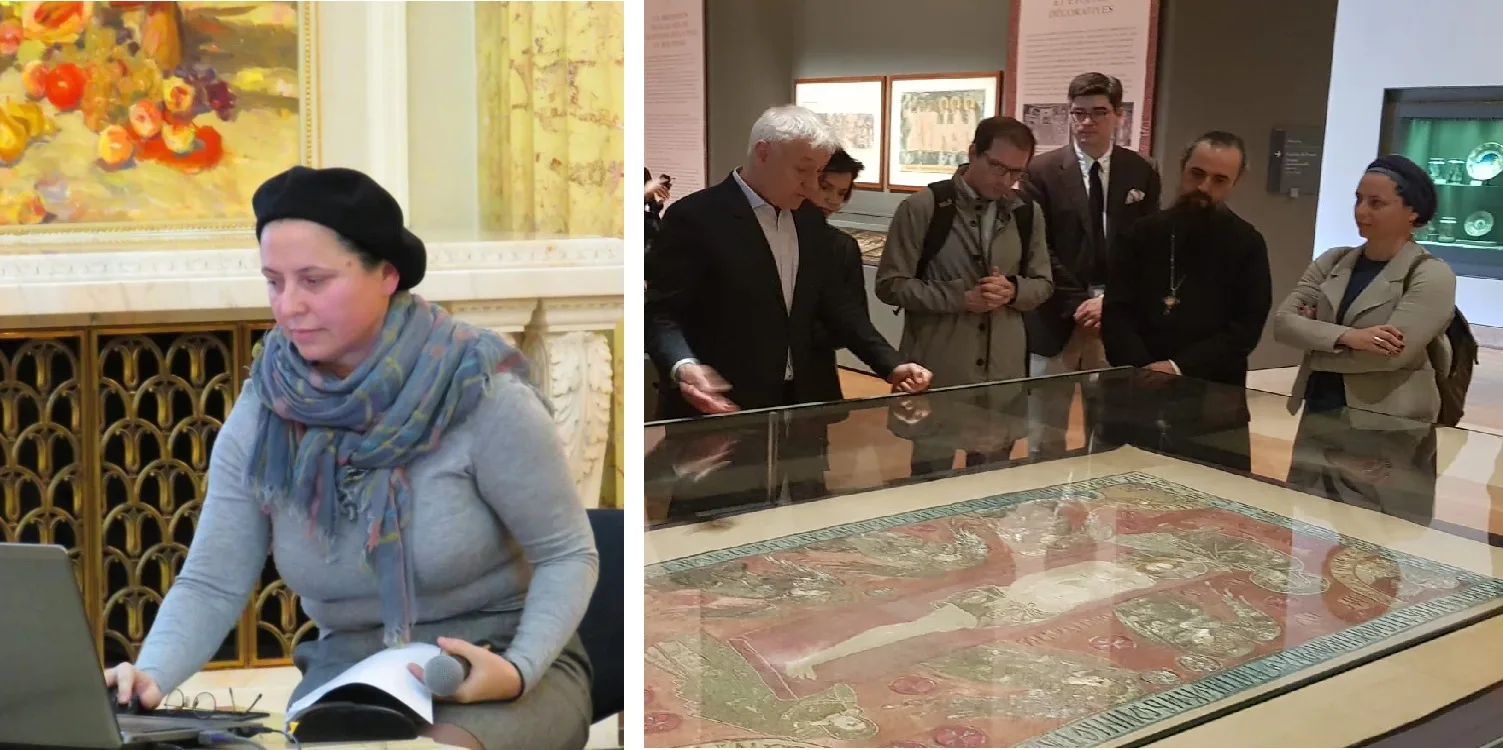
Photo: Medieval Art – XV
Emanuela Cernea is Head of the Department of Old Romanian Art at the National Museum of Art of Romania. She holds a PhD in Humanities and Arts, with a thesis devoted to Byzantine and post-Byzantine embroidery in the Romanian lands, completed at the School of Advanced Studies of the Romanian Academy. She is also an expert accredited by the Ministry of Culture in objects of artistic significance. Emanuela Cernea is co-author of Broderies de tradition byzantine en Roumanie du XVe au XVIIe siècle. Autour de l'Étendard d'Étienne le Grand, published on the occasion of the exhibition at the Louvre Museum in Paris (2019), and the author of numerous specialist studies on medieval liturgical textiles, epitaphs and Romanian sacred art.