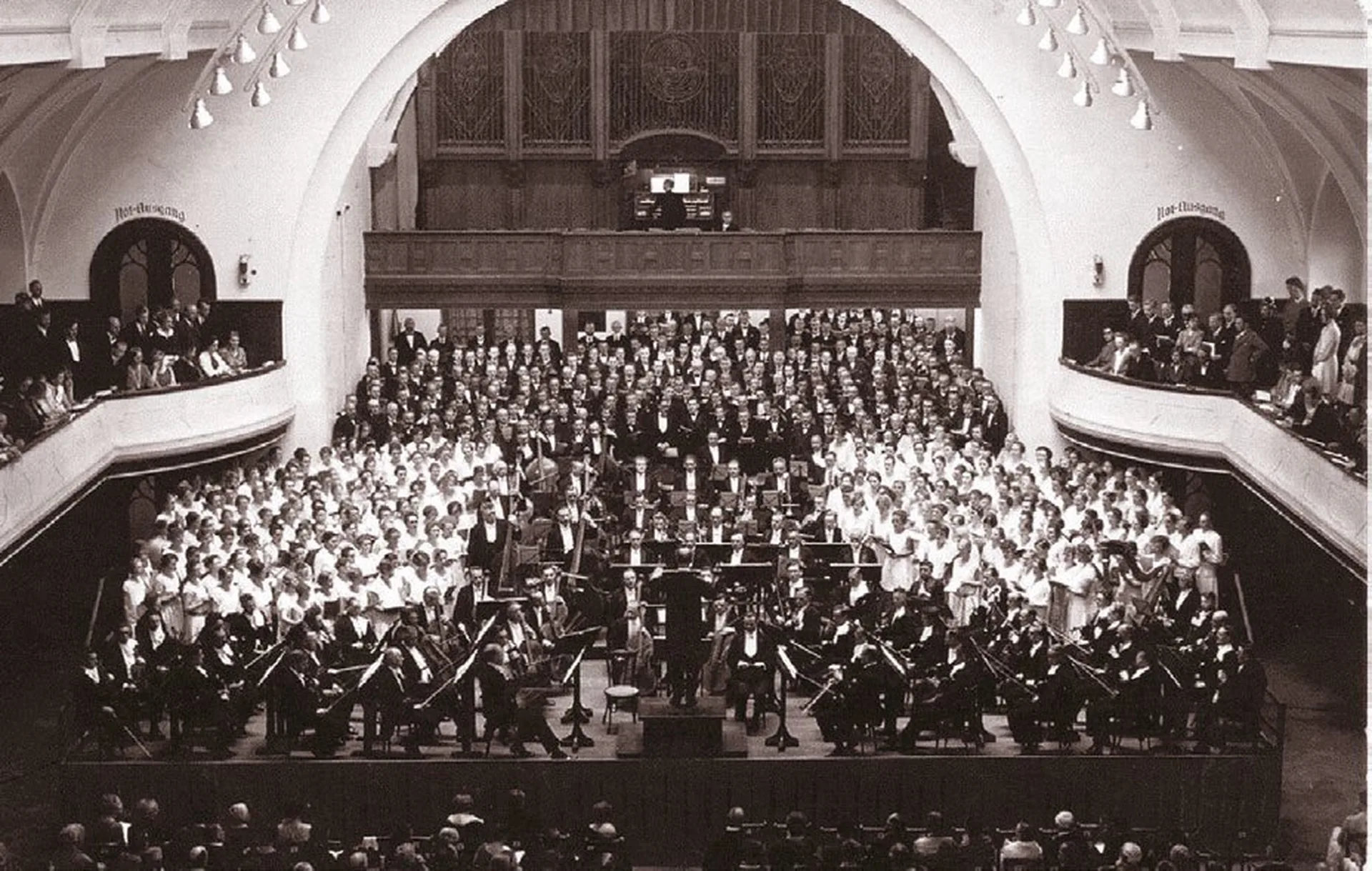
This is the great musical event of the year. It takes place at the end of the season, but it goes beyond everything that was musically offered for a while. I chose my words very carefully. I had some good evenings, I had listened to great maestros, I have applauded
great musicians. I do not forget – how could I? - Rubinstein, Milstein, Piatigorsky, Busch or Cortot.
I do not forget the few foreign conductors who, in the last few years, have passed by the rack of our Philarmonics. I do not forget Felix Weingartner, Clemens Krauss, Bernardino Molinari...
Yet, the concert played last evening, is - in terms of artistic quality – the best by far, in comparison with all other musical memories, regardless of how excellent they were. Because it was more than a concert, it was a wonderfulart lesson. Listening to the Orchestra of the Berlin Philharmonics we realize that our symphonic music is lacking style and tradition. We don`t want to rebuke anything. The general conditions of German
music, its long tradition, the cultural atmosphere in the midst of which this music had grown – all of these are things that one cannot achieve overnight. There are a few centuries of music in this field, in this cohesion, in this supreme facility that represent the mark of a great German symphonic band. There is a continuity of the style that cannot be replaced with anything and that is stronger than labor and stronger than talent. What can
an isolated musical talent do if it doesn`t find the land that allows it to develop and bear fruits?
I have listened to the first concert produced by the Berlin Philharmonics with a sentiment of respect, not just for the extraordinary musicians, but also for the supreme idea of art that they presented with almost an impersonal force. It is a precise symphonic band, it has a certain balance and unity that make this orchestra some sort of unique, very complex, very strong, yet ordered instrument that has one single central support.
It is a rare thing for a foreign orchestra (and never a Romanian one…) to provide such a feeling of organic fullness. The cords, the tuba players, the brass, the percussion – everything obeys the law of the band, having a sense of cohesion, a science of the detail, an intelligence of the resonance levels that provide each sound its own function of elaborate finesse.
What astonishes at this orchestra is, on the one hand, the individual quality of each instrument and, on the other hand, the architectural grandeur of the entire thing. The violin, the oboe, the corn, the flute – they all have a certain delicacy, precision and an amazing determination.
When each of the instruments gets separated by the orchestra, it preserves its individuality, its incomparable freshness of the sound. But afterwards, it knows how to get back into the band and to find its exact place. Finally, we can speak of a “resonance level”. It exists; it has a reality – an Berlin Philharmonic Orchestra Hermann Abendroth almost perceptible reality. There is no exaggeration to speak about a resonance level when it comes to such an orchestra. There is a volume, a depth, a height of the sound mass, and this “sound mass”: has all three dimensions, shapes and a physical reality in space. We see the architectural lines; we can follow the logics of the construction, its levels, its backgrounds, its symmetrical wings. We see music. Music earns a real visual force and – trust me – it is not just a figure of speech. We cannot figure out what the conductor did and what the orchestra did to achieve all of these. We are free to believe that the great merit belongs to the band, to the quality of each individual player and to the
teamwork spirit that unites them. I saw other great conductors, even here, in Bucharest. But what can a “great conductor” do – no matter how great he is – if he works with inert and heavy material?
Hermann Abendroth is, without any doubt, an interesting conductor, having talent and a perfect discipline. Although he doesn`t have the class of Bruno Walter or of Furtwängler, he is a musician who inspires the biggest trust possible. His baton is energetic, his presence is spare, his gestures are clear. This is needed to show the value of an orchestra that has the power, the cohesion and the flexibility of Berlin`s orchestra. The program of the first concert was dedicated to Bach, Haydn and Beethoven. The third Brandenburg Bach concert had a wonderful precision, accuracy and intelligence of the rhythm. I have listened to it a long time ago in Paris, admirably conducted by Walter Straram, and I have also listened to it with Mengelberg conducting. But it is not hard to chose: the interpretation of the Berlin Philharmonics produced yesterday evening is the best. Only Bruno Walter, with the Vienna Philharmonic could do it better, if “better” is even possible.
The Symphony in D by Haydn has continued the program in the happiest way possible. It is impossible to express the gracefulness, the freshness, the precision that was not at all arid and the intimacy of this execution. It seemed even more extraordinary after fifteen minutes, when the orchestra approached Beethoven`s Seventh Symphony, with a dramatic sobriety and a solemn power that attained the purest feeling of tragedy.
Being a critic is a humiliating experience after perceiving such an emotion.