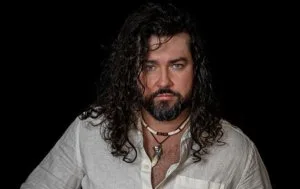
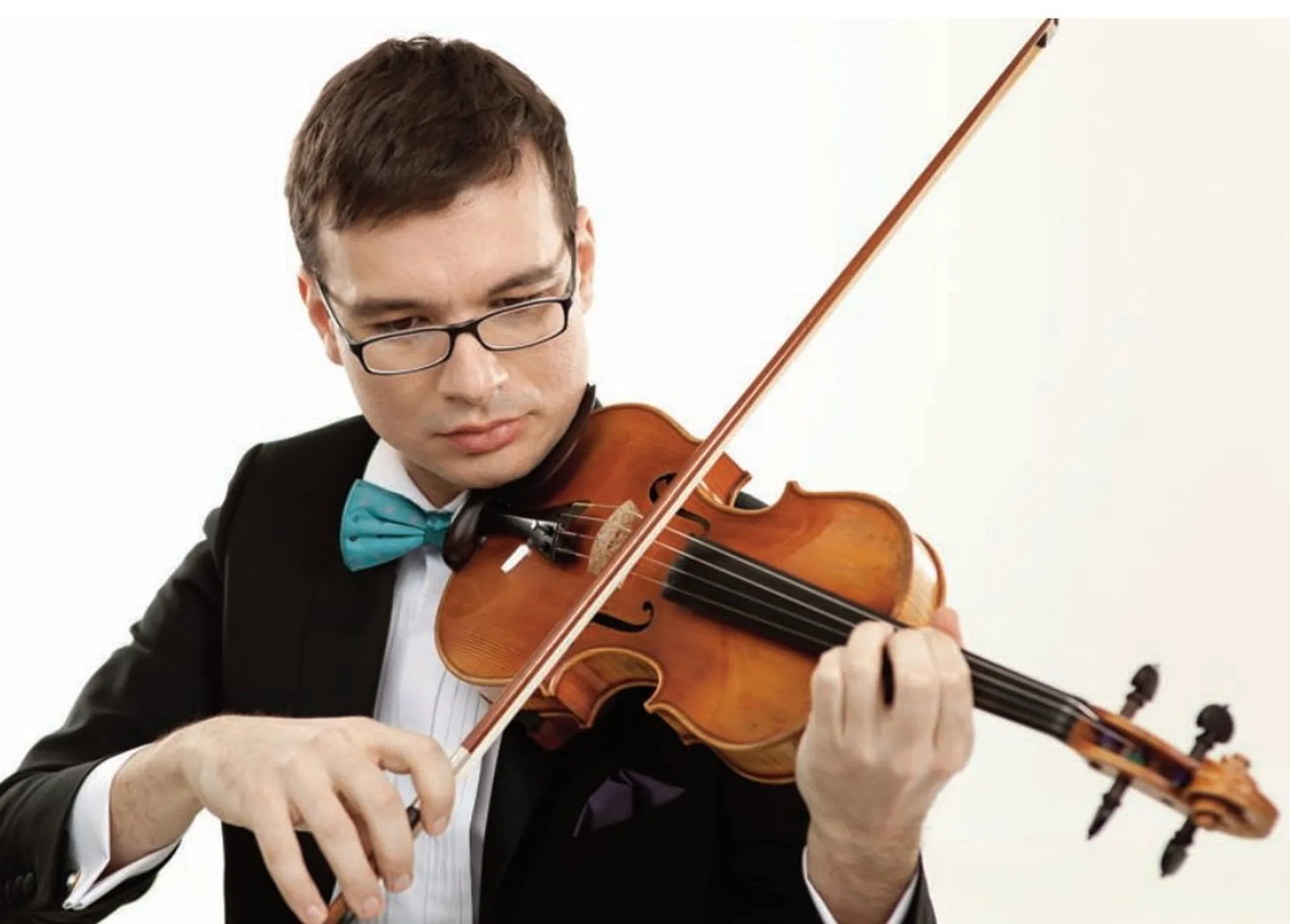
I have seen photos of him. Yet, when he comes through the door of the agreed upon teahouse, he still manages to surprise me. Alexandru Tomescu. The most famous Romanian violinist of our times. His voice is calm, soft enough that I constantly readjust the volume on my voice recorder. Over the next couple of hours, he systematically destroys every myth related to his profession. And it all started with such a mundane question...
by Laurențiu Diaconu-Colintineanu
How does one become such an internationally renowned violinist at such a young age? 1976 wasn’t that many years ago.
I wish I could define it, come up with a formula. “Do this and this and that and there you go: successful violinist!” But I’m not sure. I think for any of us, violinist, artist, what have you, it comes down to a personal choice, a personal path and a personal discovery.
There are way too many variables to be able to include them all in a formula for success. Back when I was just starting, I remember there were all these so-called “recipes” going around, the must-have qualities of violinists and astronauts. Astronauts, apart from everything else, needed cavity free teeth, and I already had a couple, so I gave up on that career path during my school years.
Physical stamina is still a requirement, though, when, for instance, you’re on an extended tour, or you have to perform every night, sometimes even twice in one day. Sure, it might not sound like too great an effort to make, but when you have to go through one or two months of that, it really takes it out of you.
And you start to contemplate the global view – not strictly the music aspect, but also how that music is !ts in your body, your physique. And then... then there’s the need to be ready for the long hours. I mean that repetitive work, the never-ending study.
My mother used to have this very young girl for a pupil, six or seven years old, and she said the cutest thing. She wanted to know at what age she’ll stop having to do the scales. My mother replied: Look, Alexandru is 36 and he still does his scales. Whaaaat? In 30 years I’ll still be doing scales?! There are also issues that have to do with each violinist’s hygiene.
The moment you start avoiding some of them, things start to decay. Not instantaneously, but in time. And that is why the time allotted for study is every violinist’s health indicator.
Fair enough, but how do things get going? What’s the main ingredient: talent or the parents’ decision?
Neither. It’s the love for playing. Enjoying it – that has to be the spark that kindles it all.
At six years of age?
That’s right. You know how intense children’s enjoyment is, and also their conscientiousness? A thoroughness even university students lack. But there’s also playfulness. Serious playfulness.
You remember when we were kids, we used to play Dacians and Romans? It was game play, but serious game play; we were really putting our hearts into those games. That is how it all started for me, too.
The violin was a toy other children, like my mother’s students whom I would be around at concerts and competitions, were allowed to play with. And I kept insisting. Give me, give me, let me play too. Well, at first they wanted me to study piano, but in the end, the violin won.
Talent? I personally believe there’s talent in each one of us, buried more or less deep in there. But talent alone is not enough. Or at least in my case, it took a great deal of constant work. I don’t believe in lotteries.
The “go figure – he doesn’t work, doesn’t study, has no long term plan, but he’s got TALENT, and talent’s enough” kind of lotteries, I mean. Natural ability can only take you so far. If your aim is to have a 10, 20, 30 years career, it takes more. And a parents’ choice, often enough, has nothing to do with the child’s choice.
The former decide for the latter, based on what they wish they had chosen for themselves back when they were young. But, surprise surprise, that child is a distinct individual, even though he’s your child. He’s his own person.
There are children who are obedient and, for a while, sometimes longer, sometimes shorter, they live out their parents’ dream. But eventually they realize it’s not what they truly want, and that’s where change comes in. The point is there has to be this joy, this inner energy that, of course, starts as game play.
And it’s important for that initial joy to last and gain new dimensions over the course of one’s entire life. For performing musicians, the choice of instrument comes very early, perhaps around four or five years of age.
With other professions, the equivalent choice doesn’t occur until the late teens. By that age, for us it’s more of a confirmation of our childhood choice, and bringing new meanings to it. That can either simplify or complicate things.
Who made you work the hardest by the time you became a full grown artist: your mother or your teachers?
My mother never made me work. I’m afraid I’m going to have to shatter the romantic image brought forth by Paganini, that of his father hitting him over his fingers whenever he made a mistake – smack smack! That’s an image that caught on rather well, and people expect it to get perpetuated.
They imagine me having had a tormented childhood, maybe locked away in a dark cellar, alone with my violin, having water lowered down to me in a bucket. Well, no, it was exactly the opposite. I actually wanted to study and I was looking forward to my mom coming home from work so we could have our daily hour of violin practice. I didn’t overdo it either. I started with one hour a day, then a couple, then three... I took it gradually. I couldn’t have been forced into doing something I didn’t want to. My mother didn’t just take me through childhood, but also through the next seven years of learning violin, crucial ones for a violinist.
Those are the years for foundation laying, and if that’s not done well, if it comes out awry and the angles are all wrong, the best you can hope for afterwards is to make adjustments; the building will still be crooked. It’s a huge piece of good fortune having a great professor from the very beginning. Sadly, many violin teachers, it seems to me, tend to look down on taking on children.
Perhaps they lack the patience, or maybe they think it’s beneath their pedagogical range. But that’s where they’re most needed, as that’s where it all begins. Following the seven years with my mother, I went on to become maestro Ştefan Gheorghiu’s longest lasting pupil. I attended his class for eleven, if not twelve years.
In fact, we remained very close friends throughout the rest of his life. I then took quite a few specialized training classes, mostly with career violinists, as I wanted to find out first hand what it was all about, what were the sought after traits.
But a top violinist is not necessarily a top tutor.
Those are two different callings. And the moment I took o" was when I graduated from the Conservatoire and completed my studies abroad and there was no one left to tell me what to do or how to play. The time came for me to figure what good came out of everything I had done thus far.
Did you feel at all lost at that point?
Nonononono, I was very fortunate to have brilliant teachers who allowed me to grow. Good teachers slowly fade out of their student’s life, and let him make his own decisions. Maybe they point out, here and there, whether they approve or not of his choices, but they no longer choose for him. I went through a great deal of experimenting. I still am in fact.
In our line of business, things are never set in stone. That’s why they call it “interpretation”. We interpret those pieces left to us by the likes of Bach, Beethoven, Brahms or Tchaikovsky. People are used to some things being immutable.
Some ask “What’s the best way to play Tchaikovsky?” That’s a hard question to answer. If it was athletics we were talking about, the best way to run the hundred meters flat is to run the fastest. That’s open and shut.
But a concert, a piece... speed can work for or against you, and it’s definitely not an absolute criterion. The criteria for evaluating a performance are much more subtle than that, much more complex and yet, at the same time, much more simple.
Mostly, it boils down to “I like it or I don’t”. And that can be explained a thousand different ways, or none at all. What we’re actually talking about is constantly reinventing every piece of music. There are pieces that have in them this sap, this resource that makes them bear well in all kinds of reinterpretations – much like with pop music, and cover songs. I strongly believe that classical music has this vivacity to it, otherwise I think it would have been long dead.
Bach remains Bach, whether it’s played on a baroque, modern or even electric violin. You can put a jazz tune to it, or hip-hop, and it will still be Bach. Which is what I aim to do with musical pieces, because once you’ve completed the killer stage of learning the piece, once the technical issues are out of the way, then the interpreter finds himself in a creative position.
Once you’ve got the piece down, most people would tend to think that’s that. If you’re able to reproduce whatever’s written there in the sheet, the piece is ready. But that’s just where it gets interesting, where your personality makes its mark.
Anybody can learn a piece. Bach, Beethoven, they’ve all written the indications there – faster, slower, harder, softer. But that’s not the point. Once this “programming” is processed, you have to incorporate the piece, to get it into yourself, into your blood. And you become a creator, you now have the power to model, to play with it, to take it where no man has dared to take it before.
That sounds a bit like Star Trek...
Yeah, I really enjoyed Star Trek, too. And music can take you even farther than that.
Let us go farther then. During the school years, what was it like being the one with a strong inclination towards music in a regular school?
There were actually two of us. Two musical mates. This guy by the name of Alexandru Nedelescu, I wonder if he’s still a pianist. I remember we were the ones responsible with singing the anthem each morning. Back then, it was “Trei culori cunosc pe lume”. That was the fun time of the day. Apart from that, I was one of those kids...
Well, in gym class, there were two or three of us who had absolutely nothing in common with basketball. Not to mention football. There was this kid, very good at math, too, and we were all there just making up the numbers. Funny thing is I got into sports, but well after school, much later. The No.3 School had a swimming pool, it was a very sought after school, and my parents sent me there to swim. But the teacher was so terrible, he simply scared us witless.
It was only after university that I started swimming and I have been doing it regularly ever since. Other sports found their way into my life as well, but only after they had stopped being mandatory. The No.3 School is a regular school, maybe even an elite one. For my folks it was a comfortable choice, since it was the closest to our home.
So they sent me there to get my education. Let’s tear down another myth while we’re at it: the one that says a musician can’t add 2 to 239, and needs a calculator for that. These kind of stories had been around since kindergarten. The teacher would tell my parents “he’s smart, he’s witty, why would you want to have him study music?”
So music didn’t get in the way. Not even in the way of childhood shenanigans?
There wasn’t much to fool around with back then. Some kids would play with calcium carbide, blowing things up…
You could nick that stuff on working sites...
Yep, that’s it. One of the memories very dear to me is that during my first trip playing abroad I bought a small pocket torch. Brilliant little thing. Back then it was the equivalent of having a Star Wars light sabre nowadays. No one had anything like it.
At one point I took it to school with me and, with the same wit and intelligence that kids play these days with laser pointers, I was playing with it on the blackboard during French class. Obviously it wasn’t long before the teacher figured out who was doing that, and it all ended with my parents being called over. My dad took my pocket torch from me then.
When was your first trip abroad?
1986. I was nine. We went to Germany and to Austria, in Vienna. I remember the remuneration for one of my first concerts was a Swiss army knife. I had it for many years afterwards, but unfortunately I lost it at some point. I was like Alice in Wonderland.
I was seeing things unimaginable in Romania. For a child, though, some of the things that would shock the adults might not have seemed as important, like the abundance of wares in the shops. I was enjoying, first and foremost, the trip itself. I was on the road for weeks on end, and it felt brilliant. It was a big challenge for my family, though. Obtaining a parent and child visa back then was the equivalent of getting an emigration visa.
To everybody’s surprise, however, we returned to the country. Not just the first or the second time, but every time after that. That made it possible for my parents to be able, with a huge amount of red tape, to send us abroad at least once a year, usually in the summer, for a few weeks. And during that period we would try to do it all: concerts and competitions and classes and everything. My father, who used to be a pianist, usually came along. He would keep me company, and accompany me at concerts.
We made a good number of recordings together, too. Before I was born, he was in fact #1, particularly in contemporary music, because he understood music. I often explain to people that even in Beethoven’s time there was such a thing as contemporary music. It included Beethoven at the time. The most appropriate filter is the passing of time, history’s say. We have so many composers these days, and one or two or maybe even three of them are brilliant. But that’s just it, we have the privilege to be able to choose.
Look, in Mozart’s days, Sarrieri was as convincing a composer as they come, in fact he surpassed Mozart in some ways. So they play Sarrieri these days, sometimes, but it’s rather something exotic, his music being somewhat boring. So one can easily see that some have and others are.
What was the first prize that you won?
That came really early. It was called “The Children Sing the Country and the Party”. I was six years old then and in my last year of kindergarten.
Each kindergarten had to produce their share of brilliant children, so the no. 112 kindergarten proudly hung my diploma on their wall. And music suddenly stopped being stupid in the teacher’s eyes as it had started to produce awards.
But perhaps more spectacular was my !rst international competition. I was... let me think... yeah, I was eight at the time. Città di Stresa in Italy. That’s where I was competing in the youngest category, covering ages 8 through 12.
In that interval, huge progress was made in very short bursts. I know I played some Paganini. I won. And since Italians have a thing for the bombastic wording, they awarded me the absolute first prize, as I had scored 100 out of a possible 100 points.
Plus a cup and, more valuable than that, each boy received, directly from the competition’s director, a few metal models of Italian cars, which were quite big, 1:43 in scale. The doors opened, the hood popped up and you could see the engine, the steering wheel worked, it was quite something... I had them all my childhood. I got a Carabinieri car, and a racing car.
Do you still have them?
I haven’t thrown them away. They’re somewhere, in the cardboard boxes of my childhood items.
How many competition awards have you amassed all these years?
I have no idea, I’m not necessarily passionate about collecting them. My mother used to gather them all, and she has this display case that’s already not spacious enough. They’re stacked on top of each other there, in a tower of Babel kind of mess. One of my favourites, for instance, is the first place and Grand Prize at the Jaroslav Kocian competition that was held in the then Czechoslovak Republic.
It’s one of the awards I worked very hard for. I took part in that contest for the first time when I was nine years old, and I got second mention. Infinitely less than I was hoping for. I came a second time, and got the third place.
Then we weren’t allowed to leave anymore just as I knew that I was ready, I knew I could win it. So right after the Revolution, in 1990, I went and not only I won first place, but I also got the Grand Prize that was over all the competition categories, and a plaque with Kocian’s face on it. He was a kind of... well, not quite George Enescu, but one of the most important Czech violinists.
Plus it’s a rather important competition, it must be at its 40th edition at least, and quite a few Romanians take part every year. I believe that to this day I’m still the only Romanian to have won the Grand Prize. I had a very competition-crowded period at one point. I started participating when I was eight, and the peak was between 16 and 23.
Was that the period when you asserted yourself?
Nah, I assert myself every day. There are several theories on the subject, though. Some say you must take part in competitions as that is the only way to make a name for yourself, the only way to meet agents. But I know enough present day performers who haven’t attended a single competition in their lives. It’s one of those options you get to make.
I went to all these competitions mostly to further my music learning, to be able to practice, to form a program of the highest possible level. Because no matter how important a concert might be, there’s a colossal difference between a concert where people come and listen to you play, even when there are critics among them, and taking part in a competition where there’s a table somewhere in the back with all those people holding a pen in their hand.
That’s probably the most stressful image. And it forces you to improve and perfect yourself, and it’s also a useful mental training exercise for any other kinds of event. Plus, apart from all that, it’s a great socializing opportunity. I remain friends with many violinists.
After all, there was a group of about ten or twelve of us who would make it to the final stages every time, so we ran into each other at competitions. And I can honestly say we were a good generation, as most of my colleagues with whom I shared podiums have confirmed.
It’s interesting to note that it’s not necessarily the first prize winners who confirm. They have a lot of pressure to deal with and often they get one, two, three years after the respective competition before they just fade out. Anyway, there are plenty theories.
But there’s another important point to be made. I finally came to understand what a competition really meant only when I was part of the jury. There came a time, pretty soon if you ask me, before I was even 30 at the time, when I was invited to judge a very serious, very prestigious competition in Spain. It was a revealing moment as I understood first hand all the things my teacher used to tell me.
Things about balance, about how much you can sway this way or the other, about one’s personality. Many people think that preparation for a competition or for an exam has to be something special.
That you have to play a certain way, so that you can please everybody. One couldn’t be more wrong. The only thing that could come from something like that is a bland, flat performance, with no personality whatsoever. In one word, boring. These kind of competitors, even though there’s nothing you can impute to them as far as technique is concerned, they always lose in the end. It’s all about the courage to be yourself. What matters is the force to convince others of your point of view.
Has this musical power of persuasion helped you with the ladies?
No, I’ve never used my violin to this end. Sure, it’s a very romantic image – playing a serenade at the foot of the tower where your princess resides, but no. Plus, it’s a bit more complicated with a violin…
Has, then, your violin been a problem in your relationships? In regards to the time invested in one more than the other. That wasn’t the case either. I am who I am, and I have no intention of changing. Obviously playing a violin involves quite a fair amount of study time, and frequent concert trips, but I guess that’s my calling. Music.
It would have made for a great story to recall some jealous lover taking my violin and smashing it to bits. Maybe the Stradivarius, why not? That never happened to me. But I did play on one of those, you know. From 1999 till 2007 I played on a very old Italian violin, also from the 1700s, made available to me by a French collector. A violin that had been in her family for generations.
And one day, as her father was playing that said violin, her mother, very jealous of his long hours rehearsing – he played a lot, he was a first violinist in Strasbourg – took the violin and smashed it to smithereens. I met her mother, too, a very classy, distinguished lady, with white hair, and very calm; I couldn’t even picture her in my head thrashing such a fragile and beautiful musical instrument.
I was trying to imagine what the poor man must have felt when he found his violin in pieces, how he took it to the luthier, the tens, hundreds of hours of work needed to repair it, to get it back in one piece, with all the vitality these Italian violins always seem to have. You can smash them, thrash them, break them, cut them, tear them up, drown them – they must each have at least nine lives, cats have nothing on them.
But how did it come to be that you had this violin?
Well, the lady in question is a true music aficionado. She goes to French competitions, sometimes even the international ones, in order to listen to the finalists. She goes to Switzerland, the Netherlands, quite a few countries in fact.
After this one contest, she comes up to me and says: listen, I have this instrument, this gorgeous violin, would you consider using it? I was impressed, of course – here was this French person who saw this Romanian from the wild East for the first time and she was considering trusting him with such an extremely precious family heirloom. I’m sure I didn’t betray her trust, and she was there every single time I had a concert in Paris.
She even came down here, in Bucharest, specifically for the George Enescu Festival. It was a fantastic, unique gesture for which I am eternally grateful. The violin is still with me, and I use it every now and again.
The lady’s intention is for this violin to end up as part of the heritage of the foundation my parents created, a foundation that aims to help young musicians, violinists in particular. They’ve been holding a contest in Sinaia for the past twelve years. And who knows, maybe one day I’ll be organizing my own contest to and an owner for such a violine.
That brings to mind the contest for the placing of maestro Ion Voicu’s Stradivarius violin. How did that go?
Well... Veni, vidi, vici. Of course, I would have loved to participate in the first installment of the contest, the one that took place back in... I can’t even remember the year. I was 23, so it must have been in ’98 or ’99.
There was a minimum age requirement back then, and I was too young to qualify. Now, however, I was allowed in the competition, and I was the only one. I played a huge selection of many concerts, sonatas, etudes, pieces, caprices.
The jury was the same as the one at the George Enescu International Competition – I was granted five years’ use of the violin, with a unanimous decision. Now, the deadline has been extended indefinitely by the Ministry of Culture, until another contest will be organized.
In which I will be participating. I think the Stradivarius violin was the best investment of the Romanian state. What it bought back in 1955 for I think 70.000 Swiss Francs is easily worth a few million Euros nowadays. At first it can be rather complicated handling such an instrument, but during the five years I have grown accustomed to it. And I do have some reliable help. I’m thinking about, for instance, the three security guards that ensure the violin’s safety during tours and concerts.
By now they have become music lovers. After four years of Stradivarius tours, and after, I think, over 100 concerts they have already developed a taste and an opinion. They told me they preferred the 21st caprice I played in Baia Mare to the one I played in Sibiu.
These are finesse observations a music critic might not even make if he’d not been paying utmost attention. For me it’s just another proof that you don’t need a Conservatoire degree to understand and to enjoy music. You simply need to give it a chance.