by Bogdan Munteanu
How would you describe the 75 years of British Council activity in Romania, celebrated in 2013?
This is one of the first offices to be opened (1938), so I think it’s wonderful to see what has been achieved, because it was set up initially as the British Institute and it was very much about literature. Over the years, it has developed its work, working with very prestigious institutions in Romania. I’m very struck about how many wonderful cultural institutions you do have here. I visited your National Museum of Art yesterday, not only to see the ‘Out of Britain’ exhibition that we brought, but I also really enjoyed seeing the Romanian contemporary art. I think through cultural relations we understand each other, but I think much more important is the work that the British Council has done with the Romanian Ministry of Education in terms of teaching, curriculum development, teacher training and so on.
From the start of your life, you have been a very ‘international’ person. What would be the key to your successful career?
The word success is not how I would describe it. I think what I would describe it as a development of my interests and creating an opportunity to contribute in various ways I wanted to. I am of Indian origin, born in Kenya, having lived in the UK for 50 years, and that makes you a very global, international person, which means you can be both part of a society and step back and look at it from the outside. I am generally very interested in global issues, because my starting point is one world, one humanity and respecting different cultures. You only respect if you understand. I think it’s my passion for an interest of making a difference that led me from one thing to the next. Whatever I did wasn’t in terms of personal success, it was in terms of making a difference. When I came to the UK, I got involved working in equality, because I really wanted to see that there is equality, respect for women, minorities. Then I wanted to get involved into policy in that direction. I was always interested in the less fortunate or the disadvantaged and this is what has motivated me.
Does this mean that volunteering is part of your personality?
I suppose it is. Not all work is voluntary, but I think giving back to community, volunteering, voluntary work is very much part of my interests. I’ve made a nice combination of working in paid jobs where I could make a difference and also in voluntary work. Being the deputy director of the British Council is a voluntary job for me.
When we look at somebody’s remarkable CV, we may imagine that everything went smoothly in their lives. But what were the toughest moments you faced and the lessons learned that are worth sharing?
Looking back, I think that making a transition at a very young age from one society into the next was quite tough. But if you approach it with a positive attitude, since it’s part of learning, and you develop curiosity about learning, that transition is not difficult, but challenging. Once you make that transition, trying to navigate your way through different cultures, you can either take it as a problem or as excitement. You become as much curious about your own culture, in a deeper sense, when you became curious about a different culture. I would like people to approach diversity and multiculturalism in a very creative way, because that brings you richness which is so needed in this world. What I would urge for the younger generation is not to have a superficial understanding of culture through social media quick knowledge.
Speaking of choices and equality reminds us that there are still nobiliary titles in the UK. How do you see the relevance of the House of Lords today?
I think there has been a debate about the reform of House of Lords for decades. One argument is that it has no legitimacy because it is not elected. The other is, and that’s my view, that its legitimacy comes from the experience of the people who are in it. They have vast experience from their professions. The House of Lords works like a revising chamber. The legislation has to be passed by the elected House of Commons, then it comes to us, we revise it and send it back. It is very rare that legislation is actually blocked. I’m of the view that the House of Lords performs a very positive action, as a revising chamber, but the question I would like to see reformed is this: I think they should disentangle the honours in the House of Lords and what they should do is appoint people based on the expertise they think they need.
You have been part of the boards of two British televisions, ITV and Channel 4. How do you see television’s role in education today?
I think the media is very good, the question is how people use it, how the media are used for giving young people the ability to develop their mind, criticize and asses what’s good and what’s bad. Television can be a very good thing in terms of education, of awareness. Some programmes, like ‘Coronation Street’ for example, have used themes like volunteering as an integral part of the story. Similarly, programmes which are very popular can be used to promote reading. I think it can be a positive force. The way in which you use the media is a question of imagination - of being able to engage, to inculcate the values you wish. However, there is a danger that if the glamour and the celebrity culture are what youngsters see, they will get a very superficial view of life. It is imperative that we have education systems which develop the critical faculties and instill values, so that they are not completely imbibing what’s coming through the media unquestioningly.
As long as the media incite people to have fun and schools teach people to be competent, competitive and efficient, who teaches our youngsters to be happy, to have a meaningful life?
In my view, it basically has to do with your family life, to the kind of upbringing you have. If I have one concern is that, in the modern world, there’s too much emphasis on materialism and consumption. If go down that road, you will never be satisfied, you will never be happy. If you become very materialistic, that’s insatiable. There is more to life than just materialism. Because I’ve been so involved myself in volunteering, one of my favourite sayings is that you work to make a living, but you give to make a life. In my experience, people who actually get engaged for the improvement of society are happier people.
What would be the recipe for a balanced life?
Individuals have their own specific personalities. To me, a balanced life has to do with the ability of making choices. But before people can make choices, they’ve got to be given a set of values. It is important that people are given the opportunity to have a choice, so that’s why I believe in equality of opportunity. We should make sure that everybody has the opportunity to make their choices and is able to do what is within their capability.
There’s the view that art is reserved to elites, do you agree with this?
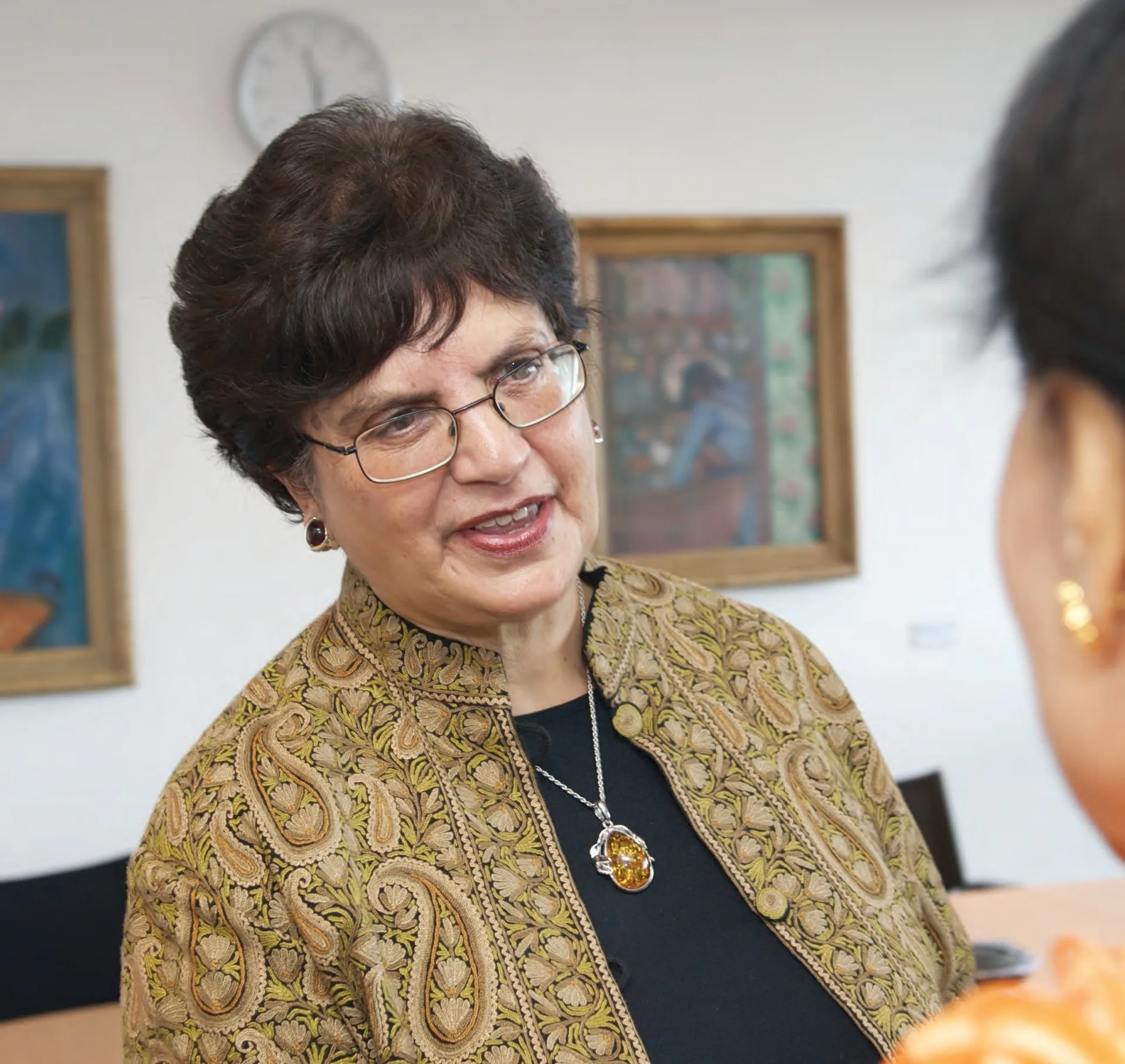
Access to art is very important and every effort should be made that everybody is exposed to art. We tend to have a very elitist view of it, but you can see a child in a village engaged in art. You could do lots of outreach projects, like taking children to museums galleries, and when they go back they could discuss and write about what they saw. We shouldn’t focus only on excellence in art, but also on accessibility.
“We tend to have a very elitist view of it, but you can see a child in a village engaged in art.”