by Mirela Meiță
The beginnings
Between 1382 and 1421, a community of Macedonian-Romanians left Dobrogea with their flocks of sheep to escape the Turkish and Tatar invasions. They crossed the Carpathians and settled in the place that would later be called Țara Bârsei, Şapte Sate or, after 1950, the city of Săcele. Thus, they settled in two of the seven villages of Țara Bârsei: Cernatu and Satulung, consolidating a settlement whose origins are attested by artefacts from the Dacian period.
They were wealthy people from then on and continued to be so in the following centuries, so that in 1789 they were considered the richest people of the Transylvanian villages, having come as free men from beyond the Carpathians.
Transhumance
Although settled in Țara Bârsei, the newcomers from beyond the Carpathians remained tributaries of the places they came from and would return every winter with their flocks of sheep to Dobrogea, to provide shelter and food for the animals. The men from Țara Bârsei, the Mocans, as the sheep owners were called, would leave every year in September with their flocks, travel hundreds of kilometers to Dobrogea and return in May - June.
It is estimated that around 1850 most of the Săcele’s Mocans owned flocks of between 2,000 and 15,000 sheep and stud farms that could reach up to 900 horses. After 1900, transhumance began to decrease in intensity.
Of the three ethnic groups of the villages, only the Romanians practiced transhumance, the Hungarians were mainly engaged in agriculture, and the few Roma families on the outskirts of the villages helped with household chores or were fiddlers
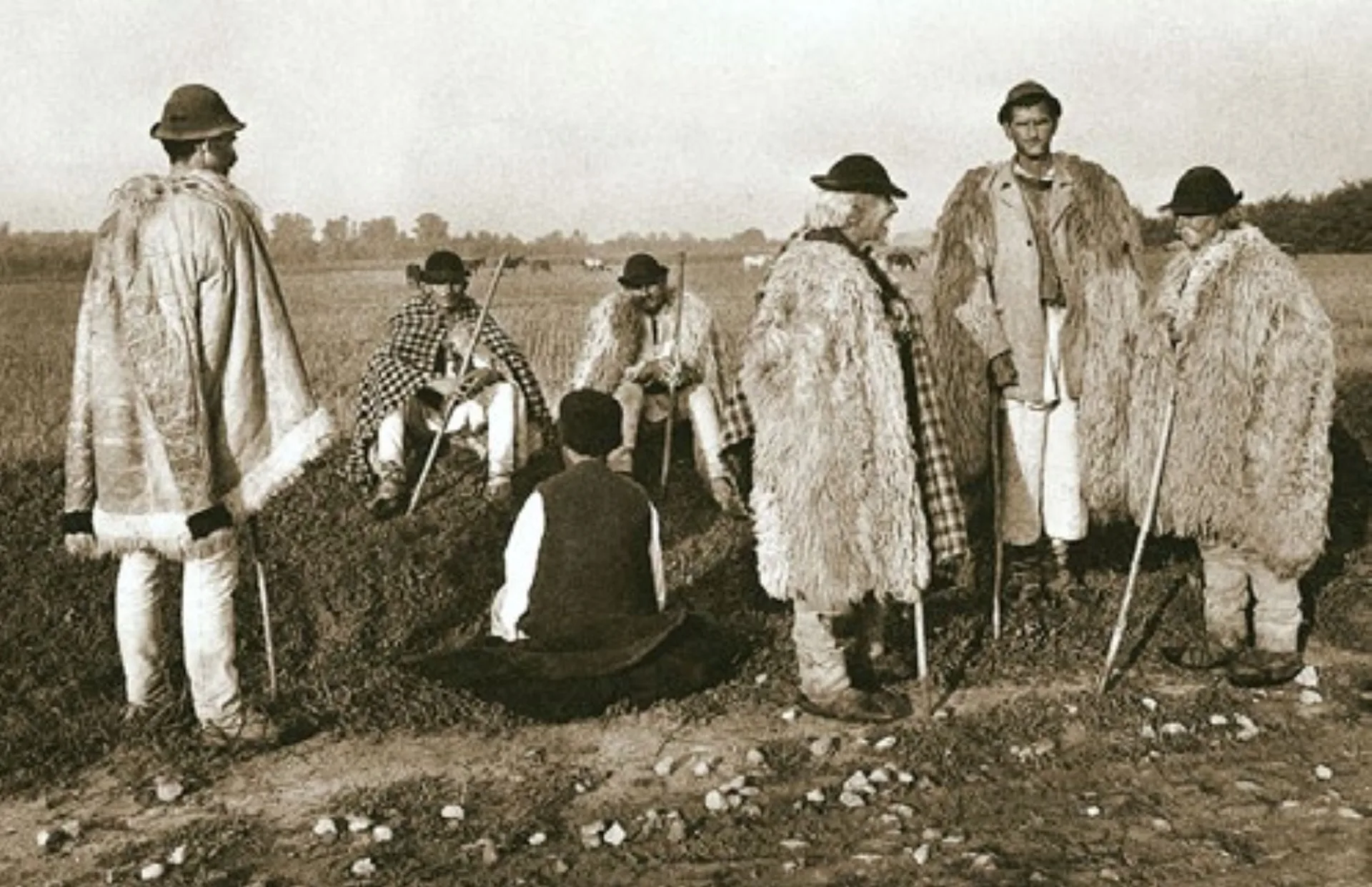
Mocans in transhumance
Landowners
In 1945, many of the large landowners in Dobrogea came from the Mocans, who transformed these lands into true granaries of Europe, using modern machinery for large-scale exploitation. Being good traders, many of them eliminated intermediaries by establishing direct relations with major exporters. Some of them kept their sheep, and compensated with the income from sheepherding for the years when the weather affected a large part of the harvest.
The Trade
With thousands of sheep, the Mocans had developed a very clear procedure for the good functioning of the sheep; cheese, meat and wool were sold in the right time intervals to make the best profits and to maintain and develop flocks.
The woolen fabric was prepared by the Mocans wife’s after a traditional way transmitted from mother to daughter: the wool was placed in hot water, washed several times and then beaten until a consistency close to the leather. This canvas as well as the light summer canvas made of wool were very expensive and appreciated by merchants.
One of the richest Romanians in the interwar period was the Bunea Bunescu, a Mocan, who left Săcele at 11, went to Bucharest where he started out helping in a shop. There he went on to become one of the wealthiest merchant in the country. One of his homes on Kiseleff Boulevard was nationalized in 1945, and after 1960 became the residence of the United States Ambassador in Romania.
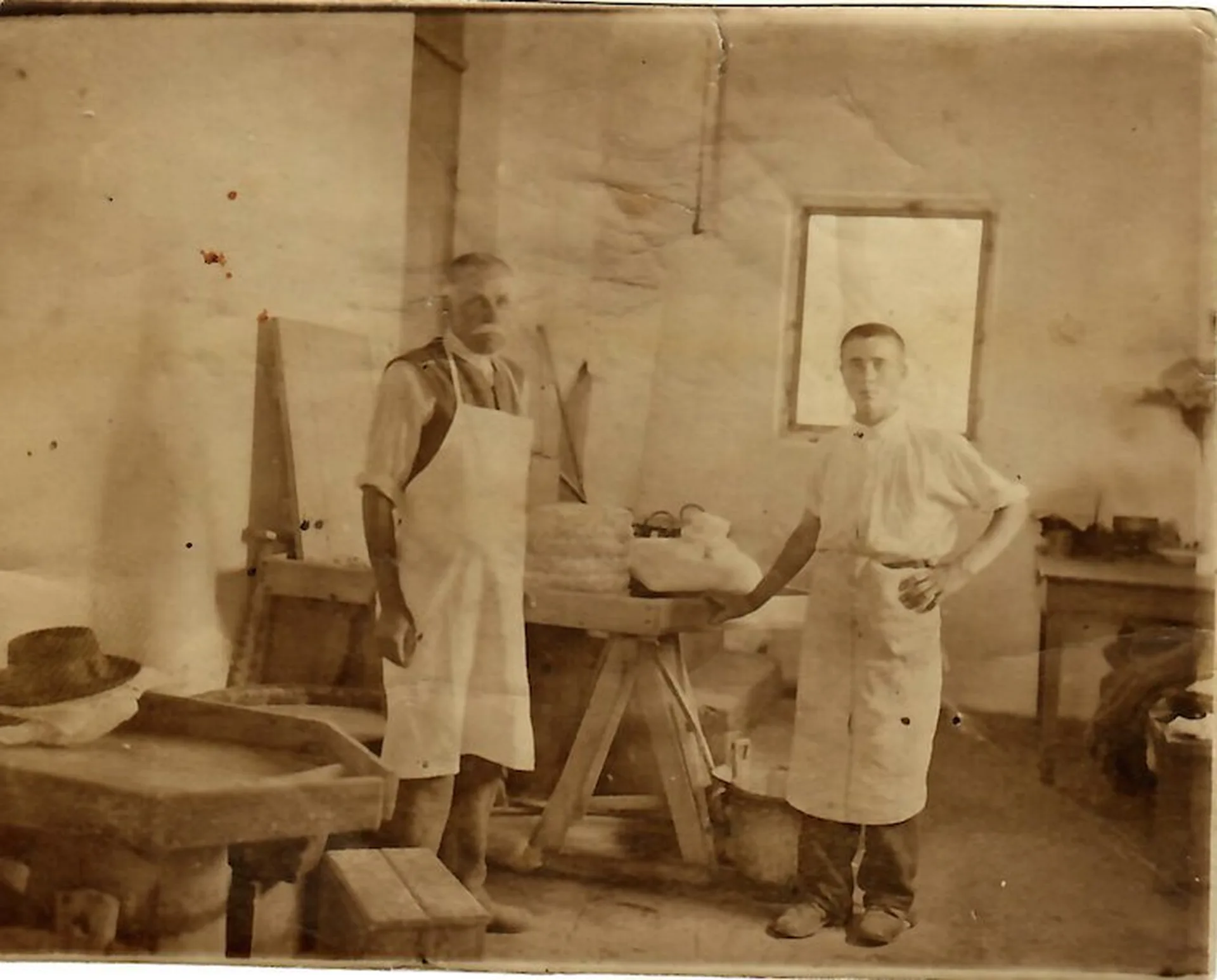
Mocans making cheese around 1880
In the villages of Săcele, for hundreds of years representatives of different religions lived in harmony: Orthodox, Catholics, the Reformed. Each religion built its own church, Săcele being one of the cities in Romania with the most churches relative to the number of inhabitants.
Education
The education of the Mocans was far beyond the what was common at the time. Due to practicing transhumance, the community had to know how to write, read and speak at least one foreign language, in order to fulfill the necessary formalities to cross the border, between the Hungarian Kingdom and Romania. The education system had developed as a necessity, highly valued by the Mocans.
In 1544, the existence of two schools are mentioned quite often. These functioned around two churches (Cernat and Satulung). School was important to the community, each family had to contribute with money to maintain the teacher, whether or not they sent their children to school. In 1866 there was at least one kindergarten, and in 1870 the foundations of the gymnasium in Cernatu were laid where sculpture, drawing and music classes began to be taught.
The Mocans generally had many children whom they supported to continue their studies in the country or abroad. Between 1850 and 1945, many Mocans sent their children to universities in Paris, Vienna, Berlin, Budapest and Bucharest. Most of them came back to Romania and become bishops, ministers, academics, professors, sculptors, generals. Paradoxically, the better education was one of the reasons that led to the diminution of transhumance because the young people who studied at the universities did not return to the sheep.
Religion
In the villages of Săcele, for hundreds of years representatives of different religions lived in harmony: Orthodox, Catholics, the Reformed. Each religion built its own church, Săcele being one of the cities in Romania with the most churches relative to the number of inhabitants.
The Mocans did not have many customs, they did not believe in ghosts, curses, but they were very religious, their entire universe being governed by the will of God. They considered the icons to be the most precious possession in their homes, inherited from one generation to another; being painted on glass or wood, many of them having representations of Saint Nicholas.
After 1781, the Orthodox in Transylvania obtained approval to replace wooden churches with stone churches; churches that are still used today as places of worship, without major changes. The Orthodox churches always had schools around, one of them boasting approximately 3,000 books in 1920.
Family and culture
The Mocans were not contemplatives, poets or great party lovers, but they loved nature, freedom and an abundant life. The men were away almost all year round, managing their herds, negotiating the products they bought or sold, or buying land in Dobrogea. The women stayed home alone most of the year and took care of the house and raised children.
Extremely proud, they were keen not to be confused with other inhabitants of Transylvania. They had a rather uncommunicative nature, valued honour, family and wealth, being rigid and proud of the status conferred by their wealth, education and the crafts they knew.
Wealthy families were related only to each other because they did not want to alienate their wealth and lineage. Girls were obliged to marry husbands chosen by their parents from families with the same financial and social status. The traditional wish was: “May you live, may you get on with each other”.
The Charity
Donations were frequent and were part of the culture of the Mocans: whether it was about churches and monasteries, or about high schools or hospitals. They quickly understood that not only the well-being of the family was important but also that of the entire community and, although thrifty by nature, they did not hesitate to support the church, education and health.
The people of Săcele initiated or contributed to the construction of a significant number of churches and monasteries in the areas they crossed during transhumance - the Cocoș monastery, Cheia, Suzana - or in other parts of Transylvania. The people of Săcele also constantly donated money for the development of schools in their city or in the vicinity, the “Andrei Șaguna” High School being one of the examples.
Professor Colceag, a renowned high school teacher, donated his entire fortune for the construction of a hospital in Săcele for poor children “with bad lungs”. The hospital still exists today and bears his name.
The Architecture
The houses of the Mocans had a specific, easily recognizable architecture: 3-4 rooms, with 70-100 cm thick stone walls, with two entrances: one for guests and another for those of the house. The guest entrance was through a porch with beautifully rounded masonry pillars and arches closed with wooden gates. Each house had a cross made of masonry or mounted on the roof of the house. The rooms frequently had wooden beams and vaults and a few beautifully arched niches.
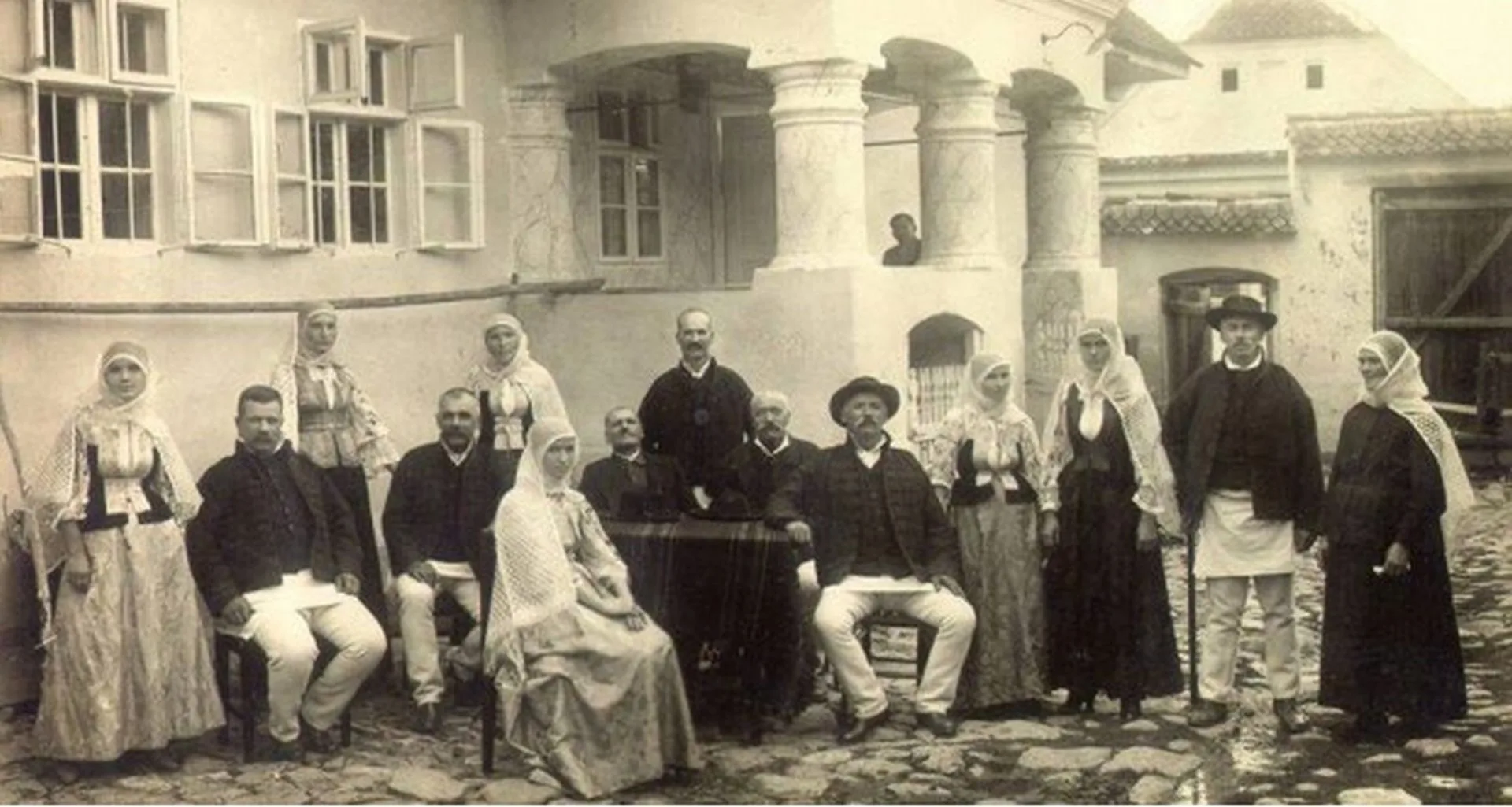
Mocans in the courtyard of a traditional house, around 1880
The Food
The food of the Mocans consisted mainly of mutton, cheeses and other dairy products. They strictly observed fasting days when they ate mushrooms, berries, cabbage, potatoes and fish from the rapid mountain waters. They drank wine, brought from Wallachia or Moldova, beer or spirits not being among their preferences.
Guests were treated to sherbet - a teaspoon of sherbet placed in a glass of cold water, or two teaspoons of jam placed on a small saucer and a black coffee, all served in very good quality porcelain dishes.
The outfit (around 1850)
Men wore white shirts with a high collar, sewn in a traditional pattern. The collar was always turned up, and a wide leather belt of various colours was worn over the shirt. The trousers were also white wool, and on their heads they wore round black hats with brims, which protected them from rain or sun. Women wore borangic headscarves, linen shirts, silk vests and skirts, and a silver belt with a gold or silver clasp and sometimes with precious stones. Men’s clothing was made from home-made materials, while women’s clothing was made from purchased materials, especially silk.
The Magazines
At the beginning of ’30s two magazines were founded: “Viața Săceleană” had the objective of cultivating the traditions and history of the area, and “Plaiuri Săcelene” aimed to be a point of connection between Mocans in the country and those who remained at home. Both magazines ended their activity at the beginning of World War II.
The Club
In 1922, the cultural and sports club “Izvorul” was founded. From the members’ contributions, they managed to buy and develop a football field, with locker rooms and the necessary equipment, as well as other materials necessary for sports such as skiing, weightlifting, javelin and discus throwing.
The “Izvorul” club organized country celebrations, festivals, dance evenings, theater performances, choral concerts, keeping young people’s interest in culture alive.
The Bank
In 1925, “Banca Populară Săcele” was founded in Săcele with a capital of 24,170 lei, with the aim of supporting the economic activities of the villages. Between 1925 and 1938, the bank granted loans worth 20 million lei. In order to provide the people of Săcele with a system of life, fire, goods and livestock insurance, the bank bought the “Vulturul Insurance Cooperative”.