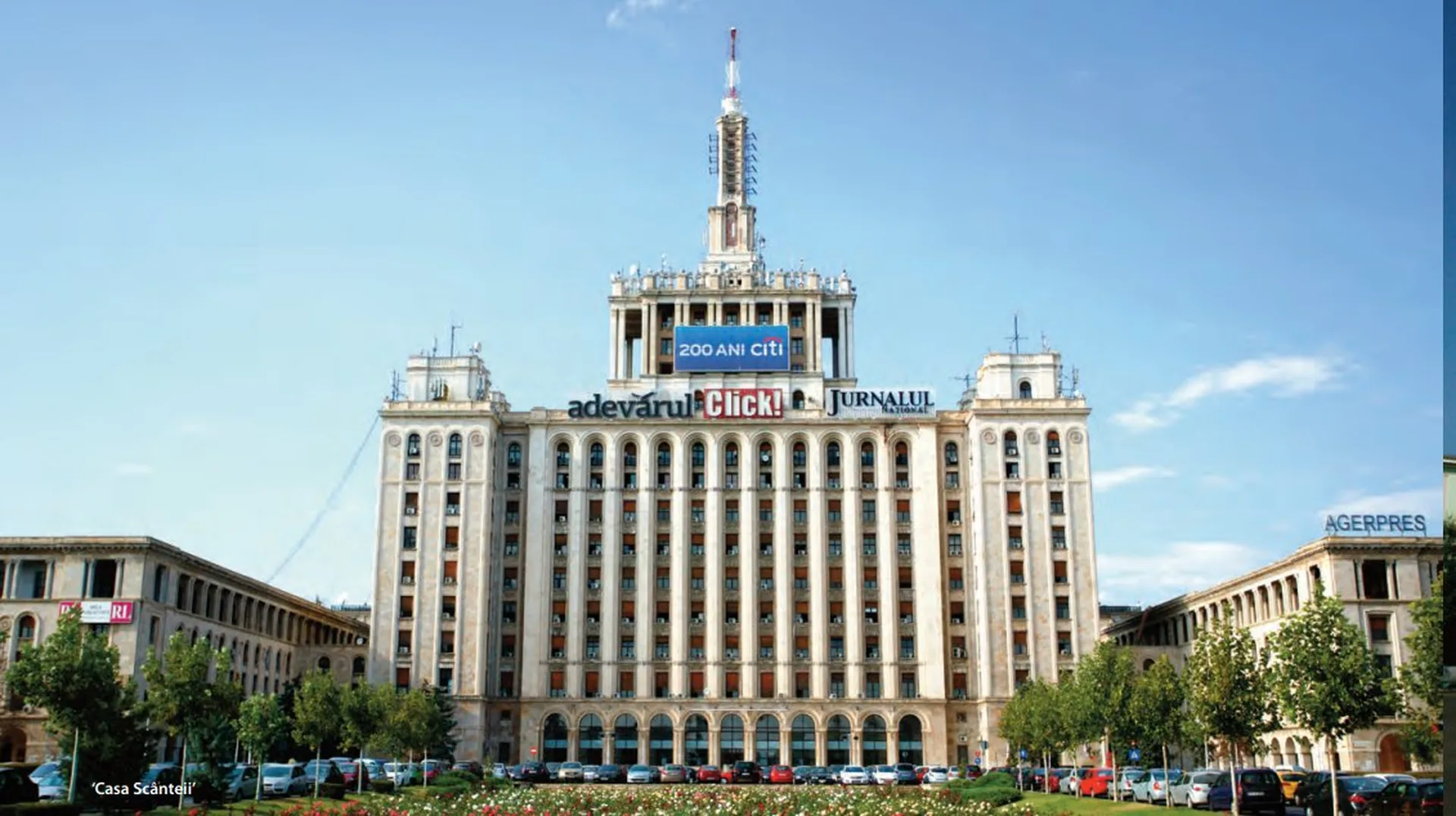
The period following the forced abdication of King Mihai in 1947 and until the death of Stalin in 1953 saw Romania embark on a building spree of buildings designed to follow a Soviet ideological blueprint. A phrase was coined, “Socialist Realism”, and was described by the slogan “Architecture and art in general need to be socialist in content and national in form ”.
by Augustin Ioan
The styles are reminiscent of Neo-Classicism, flattering those episodes in the architectural history that were on the ‘correct’ side of ideology such as Greek Classicism, the Renaissance, and the Russian Synthesis of the 17th and 18th centuries, as well as Russian Pseudo-Baroque. The movement required dimensions to be monumental, to support the superiority of the Bolshevik regime. Buildings were planned to be placed in a context that would erase over time any traces of previous urban history.
The House of Press
The location of Casa Scânteii, now ‘The House of Press’ is not accidental being situated on a boulevard named Pavel Kiselyov, after a former Russian administrator of Bucharest. Casa Scanteii, Scanteia being the name of the official daily newspaper of the Romanian Communist Party, thus became the local version of a Stadkrone, namely a representative building for the new regime.
At first, between 1948-1949, the headquarters of the communist propaganda machine was designed in the interwar manner of the purged Classicism. Nevertheless, having taken the plan to Moscow, the team of architects comprising H. Maicu, N. Bădescu, L. Staadecker and M. Alifanti met with rejection and was given a different plan instead. The proposed building was intended to be a replica of the seven post-war buildings erected in Moscow,epitomized by the Lomonosov University building.
Another similar building was allegedly a gift from Stalin to the Polish people. This building survives still in the centre of Warsaw, the centre of which was destroyed by the Nazi bombings of 1944; it was rebuilt after 1945 in the same Soviet representative style of the new regime paralleling the Palace of Culture.
The Bucharest replica, however, built in 1951 is significantly lower in height than the Moscow replicas albeit, it needs to be said, it bares a striking resemblance insofar as its planimetry and typology are concerned. A part of this decoration is of folk inspiration, namely national in form, done as a gesture of subservient recognition to the pre-eminence of the worldwide capital of communism.
It seems that the hippodrome, a centre of the bourgeois and aristocratic social life before the war, was demolished in order to erect the Spark Building in Bucharest and a series of bonds, never to be redeemed, were issued. Archive footage with the construction using patriotic labour of the building, namely compulsory unpaid labour, survives. Fragments of this footage have been incorporated into my film ‘Architecture and Power’ made in 1992 and directed by Nicolae Mărgineanu.
The building is crowned by, to quote Grigore Ionescu, an aedicule shaped like a tower. There is a story behind the way the Muscovite building and their respective replicas in Bucharest and Warsaw finish on top where the future is heralded. Despite the historical iteration, the top, ie. the future, couldn’t under any circumstance draw inspiration from the traditional closing method of historical buildings, be they local Russian ones.
Therefore, nothing like a fleché, a vault or a cupola could be used! Since there are not that many ways one can finish a building’s upper section, the architects had to create new ways to suggest the era’s idea of the future. They took inspiration from the example of American Art Deco of contemporary skyscrapers such as the Empire State or Chrysler buildings in New York, while others, like Tatlin’s Monument of the Third Internationale, incorporated solutions from Russian Constructivism.
In the building’s defence, one needs to mention that it has a vast and very well controlled perspective at the end of the Kiselyov axis, and, therefore, an elegant urban presence in an area that was at the time beyond the city limits. Moreover, it was very well built in such a way that it has stood relatively intact until today despite the fact that it has never been restored.
In 1999 when the building was still housing the Ministry of Culture, the then minister issued an order for the communist stone stars that decorated the house to be removed in a manner reminiscent of the way one pokes out with a penknife the eyes of a political opponent from electoral posters.
While in Bucharest the flagship building of Stalinism in Romania was being disfigured, in Berlin, the Stalin/Karl Marx Alee was being restored with details of Meissen porcelain, details superior to the original, and the democratic character of the East- Berlin urban intervention was, I was told, being appreciated.
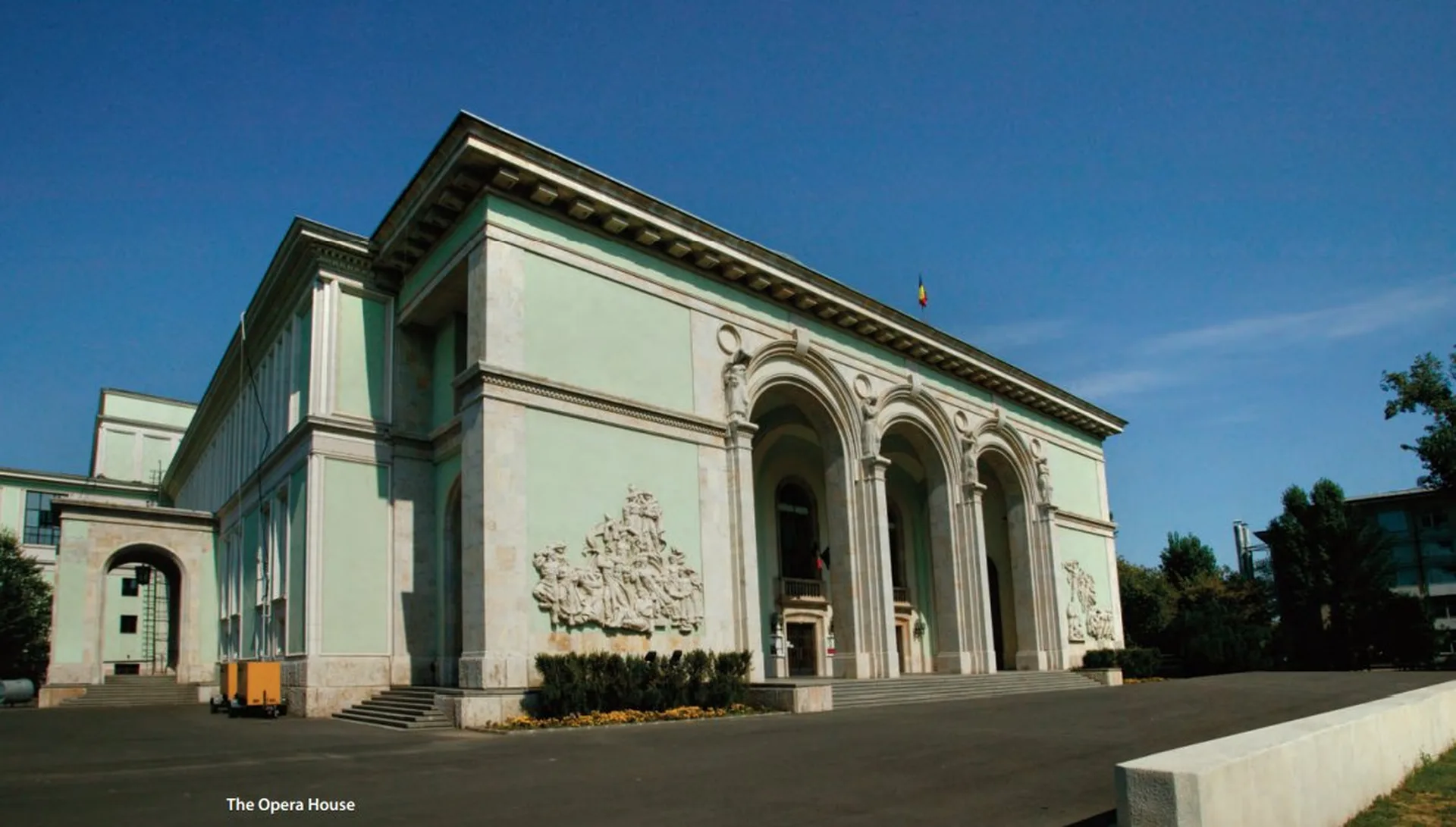
The Opera House
The highlight of this fortunately short Stalinist intermezzo in the architecture history of Bucharest was probably reached with the International Youth Festival of 1953. Many youths from the socialist countries and decolonised or developing countries visited Bucharest at that time. On the occasion of this international exposure of the capital of the Popular Romanian Republic, a few ensembles and new buildings were quickly erected.
The most important of these is the Romanian Opera House designed by a team led by the famous interwar architect Octav Doicescu. As with Casa Scânteii, the original plan met with opposition in the form of a Soviet plan, the Baku Opera House, a building merely dressed up with other decorations of the same nature by its architects. Today, painted garishly, the Opera House doesn’t intimate in the slightest the idea of the affirmation of the national character in art as it did for Grigore Ionescu.
Regardless, its neoclassical character, its reserved monumentality and its remarkable execution leave a positive impression. Removed from the boulevard, from its garden square, the Romanian Opera House has an elegant urban position.
The City Block (The Kvartal)
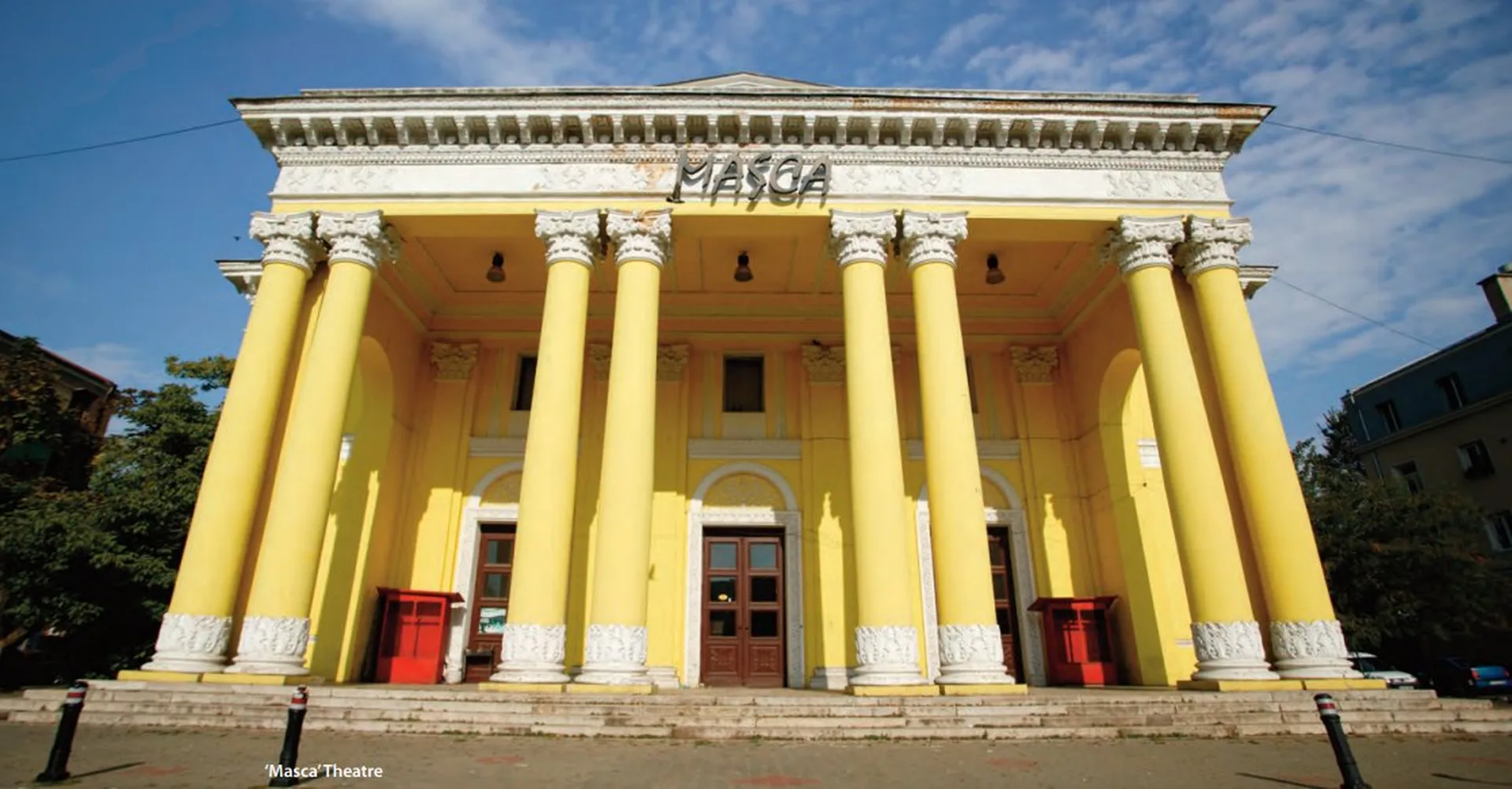
The open air summer theatre by N. Balcescu in the Bucureștii Noi neighbourhood belongs to the category of 1953 communist propaganda building while, literally just across from it lies the cinema house ‘’The fellowship between (the) nations’’ nicknamed the fellowship between the legs because of the loose morals encouraged by the youth festival mentioned above. The latter building is now Masca Theatre and is surrounded by a group of city blocks.
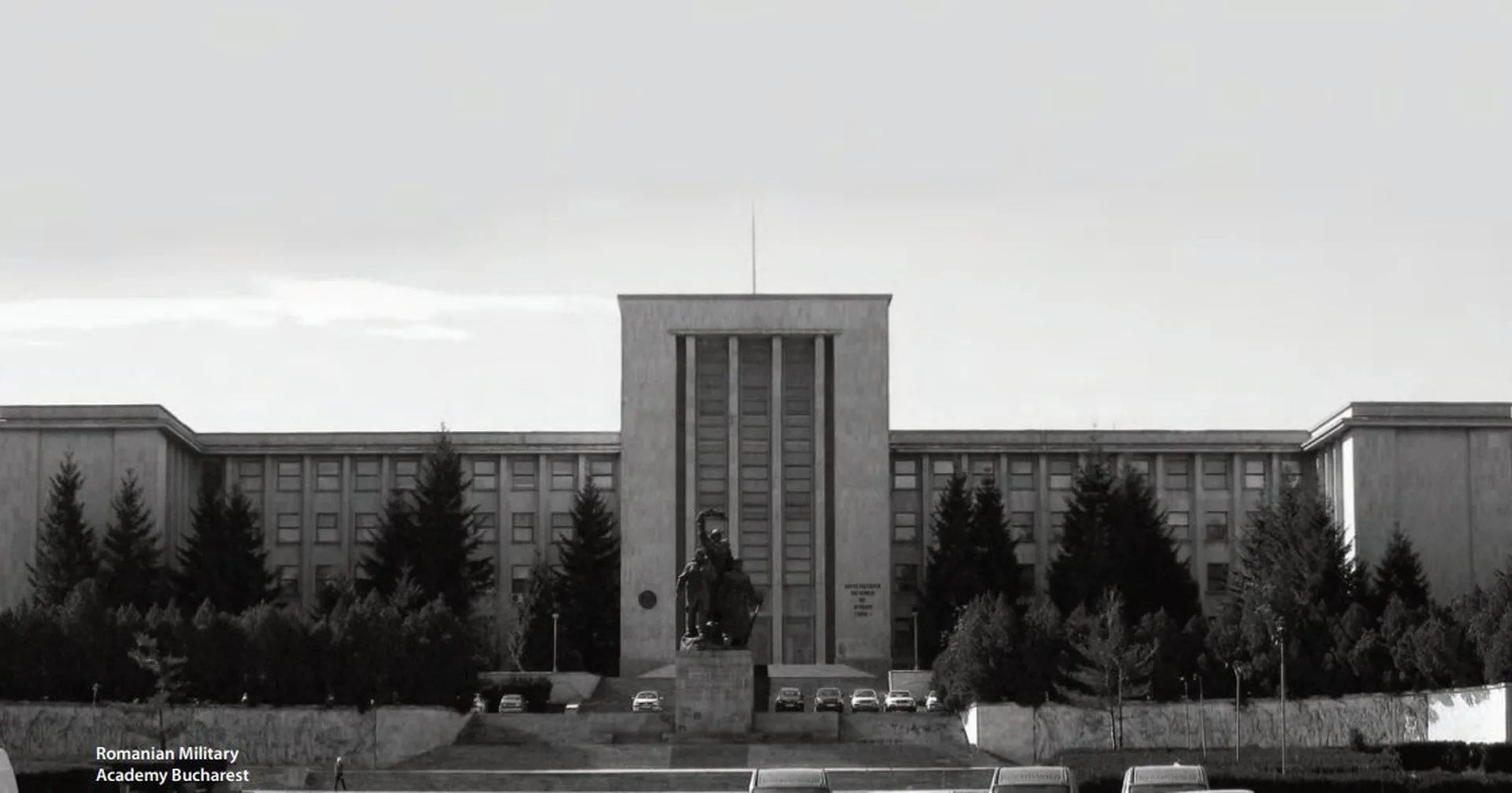
Other places one can find such city blocks is west of the Cotroceni neighbourhood around the Military Academy, the former School of War inaugurated in 1937 by King Carol II; at Ho Chi Minh and at the entrance of what would later become Drumul Taberei neighbourhood in the Razoare and Lieutenant Nicolae Gaina area.
The kvartal is a Soviet urban unit consisting of four streets bordered by blocks of flats that create an inner courtyard inside. If the apartments are minute in size under the Existenzminimum concept of Western Modernism, the facades of the blocks are monumental and richly decorated.
G. M. Cantacuzino, a war correspondent from the USSR arriving in Odessa in 1941, wrote about the minimalistic character and the army barracks architecture of the Stalinist architecture style. He couldn’t understand why these enormous squares designed for parades were bordered by blocks that housed shabby dehumanised dwellings. Couldn’t the regime, I wonder, leave less void and more private space for the population?No, it couldn’t. As it transpired, G. M. Cantacuzino will find out the nature of the regime from his own experience as he was arrested in 1947 after he published ‘‘For an Aesthetic of Reconstruction’’.
His book lays out his alternative social solutions to the totalitarianism brewing over the horizon of his homeland. To read the book today, however, is heartbreaking, I have re-edited it as part of the ‘Imagined Spaces Collection’ from Paideia Publishing House. Without exception, absolutely all the potential errors signalled by Cantacuzino were committed in the Romanian cities during the communist regime.
Be it so, even a catastrophe has nuances of collapse. The Stalinist city blocks are indeed minimal, but they do offer a semi-private space, the inner courtyard, where dwellers can meet and children can play.
In addition to that, the rudimentary building technologies from that period made the typification and the prefabrication at the industrial and national scale of later, still impossible. These inner courtyards are tended by the microcommunities who inhabit them.
Last but not least, also built for the Youth Festival of 1953, Stadionul Republicii, the Republic’s Stadium and today the National Arena, was erected with the abundant less skilled labour. As with Casa Scânteii, this was done to the detriment of technology, in as such as the stadium was really an enormous excavation and its tribunes were surges of excavated soil.
Not only was it conveniently located in a park over the city limit of interwar Bucharest, but because of the construction methods employed, it seemed that the stadium had its own microclimate. It was also a place of large popular en masse manifestations, as the language of the time described them, where people showed their passion for sport, particularly for football.
Destalinisation
Finally, there is a corpus of buildings in Bucharest that were designed during the Stalinist period, that is according to its aesthetic and ideological taste, but were built after the death of Stalin and, particularly, after Khrushchev’s speech of 1954.
It needs to be mentioned that this speech, intended for architects and the construction industry, renounces the architecture of Stalinism. This resulted over a short period of time under pressure on architecture to purge itself literally and figuratively.
Bucharest has several such examples where the design differs significantly from the erected building. Romarta Copiilor Department Store, today BRD, across from The Army House where Calea Victoriei and Elisabeta Boulevard meet, is such and example. The Stalinist design was published in Architecture magazine and the erected block was built in a manner used even after 1954 by the East German architect Hensellmann on the design of Berlin’s Stalin Alle, in the area called Karl Marx Allee towards Alexanderplatz.
This new architecture that can be called Classicised Modernism, like in the Lincoln Center in New York for example designed by the architect Philip Johnson; or purged Classicism, as in stille littorio, the official style of the Italian Fascism; or, in Bucharest, the style practiced by Duiliu Marcu in Victory Palace (Palatul Victoria), the Military Academy (Academia Militara) or the Ministry of Transport (Ministerul Transporturilor), resonates with the blocks and offices erected towards the end of the fifties.
Coming out of Stalinism, the question was raised over the option of several styles of Modernism and of several local references, and especially after 1958-1969, of national references. One can look at a building like the Radio Building (Radiodifuziunea), built in 1960 by the two architect brothers Ricii and Leon Garaci as an essentially classicised building in the similar manner to other Stalinist buildings. It was, nonetheless, draped with an antebellum façade.
T. Ricci worked in Duiliu Marcu’s design studio, and it seems that to him we owe the facade of the Administration of Monopoly (Regia Monopolurilor)/The Ministry of Industry (Ministerul Industriilor) on Calea Victoriei, an interwar building with a clock so very similar to the Radio Building.
It is very likely that here too we are dealing with a building designed in the wake of the Stalinist period and later only superficially adapted on the exterior to the new political requirements. So here we have in short the history and the description of Stalinist architecture in Bucharest.
On a casual half day walk, you can see it with your own eyes: the centre escaped untouched, the buildings located on the outskirts, where the important access zones were, didn’t, however.
Although these are buildings of no insignificant scale, the skilful way they were placed in the city, preceded by spaces of great expansion, somehow diminishes their impact. The architecture itself seems tranquil now leaving behind a period that hides this country’s darkest period of totalitarianism