by Bogdan Munteanu
Since it clearly isn’t an actual gallery, what is the Basil Gallery in fact?
It is not an actual gallery and it wasn’t intended as such. The dream that me and my husband had since the beginning of the 2000’s was to own an art gallery. But, later on, our goal has changed. We observed that, unfortunately, in the period of 2005-2006, the galleries were visited by just a small number of people and they were more or less the same all the time. My husband got the idea of creating a new concept – a gallery-workshop, where, people would come and, in time, they would become an informed public. Gradually, the classes of drawing, painting, modelling, architecture and many others replaced exhibitions. At one point we were organizing two events each week, now we don’t have time and space anymore – the classes are taking it all.
What was the starting point, how did you transform the dream into reality?
This is a lifestyle, it is not a dream. If you are dealing with a long term project; if the steps you take are small but precise, then for sure you shall succeed. The capital for the investment was the money we got after selling our first house – a double studio located in the Aviatorilor neighborhood.
With this money, we opened the gallery and we agreed on a two years term to see if we would manage earning an income that would be sufficient to support our project. We knew that it is a field that has many risks: artists don’t have much money, the market wasn’t yet well shaped and our desire was to support exactly young artists. After one year, in the middle of the deadline that we had set for ourselves, we realized that we will not have an income able to support the gallery. We were still brining in our own money and we were under the impression that the same situation would go on long term.
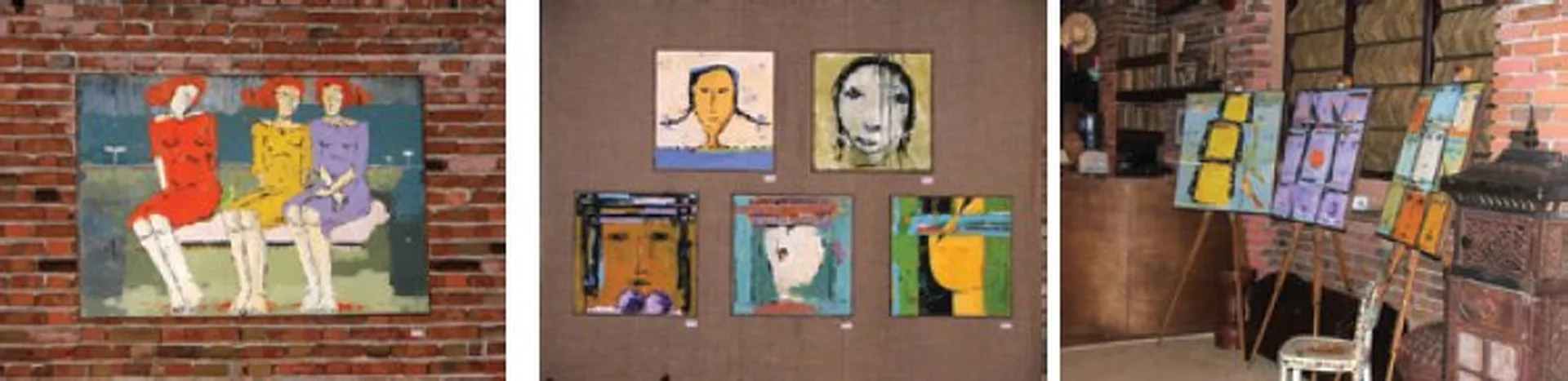
Anyway, we were a nonconformist gallery, located in the underground of Casa Universitarilor, with brick walls covered in painted cloth. Everything was different. Therefore, we introduced the workshops and we opened a small store selling painting materials. People would come, would learn to paint and would come back to exhibit in the same place. In Bucharest, at that time, only the Mora gallery was having this sort of activity.
Did you have any studies in the field of art, were you dreaming of becoming artists?
We recevied artistic education in our adulthood, in the workshop of some wonderful artists named Hristofenia Cazacu, scenographer & painter, and Mihail György, graphic artist. They are two less known artists because they left the country in the ‘70s. After 1989 they came back but they were already old. When we stepped into their workshop they were a bit over 70 years old. We spent some good years with them and this is how the dream of our gallery was born.
We were dreaming, but we didn’t do anything towards that. When they found out about our dream, these two people encouraged us. We said that we hadn’t graduated the Art University, but they told us: “It is ok, this will help you”. We learnt a great deal from them.
The first dream of a gallery was about exhibiting together. They wanted to pass the legacy over. The first exhibition, it was the four of us. And so, we opened the Basil Gallery, in the courtyard of Casa Universitarilor.
How did you find people to attend your classes?
It was very difficult to convince people to let their children join the classes. The adults were still coming by to ask whether oil can be mixed with water, so we said to ourselves that it would be best to work with children. Well, in six months we had barely convinced six people, and so we formed a first group.
This was in 2006. In 2008 we have managed to have 70 students each year, from September until June – people who would come once a week. Today, in 2016, we have a bit over 300.
I think all we did was to learn in the same time with our students. There are many children who grew up here. During 2006-2008 we had children, who were 5-6, maximum 8 years old, and now we still have many of them who still come to classes and they are high school teenagers. There are many children, but also adults who, after attending our classes, went to study at Art Universities, even at the Florence Academy of Art. We have a realistic painting class taught by a professor who is teaching at this Academy.
We have hobby classes and also intensive classes for children and shorter atypical workshops (Fleming painting, Titian painting, glass icons and wooden icons). For adults there is the hobby category and the “Academy” class that is three years long. If we were to take into account that, the average of those who come back for more classes is about 80%, I would say that we had over one thousand students up to the present moment.
Did you fulfill the dream of creating a new public?
I believe that all the older students say about us that we are the “Basil school”, or the “Basil community.” There are just a few people who imagine that they will succeed in coming 5-6 weeks in a row. And there are even fewer who think that, in 3-4 years’ time, they will have their own personal exhibition.
Yes, we have certainly created a new public. I am absolutely convinced that all these children who attended and would attend will know to make the difference between workshop art and exhibition art. Then, any museums they might enter, they will look at art with different eyes. They are closer to the field of art and they have more courage, because they have received encouragement right from the start. Even if their first works are but simple scribblings – for their parents. But, for us these are stories.
Could you tell us how is art changing the lives of your students?
Things are relatively simple. In order to draw, the first step you need to make is the paging. It seems like a constraint, but it helps you get organized. In order to put some elements in the page, I need to think how to arrange them, so that they have a certain balance. If we speak about color, then some new horizons appear.
For example, the parents tell me that young children start matching their clothes better. Then, their sense of observation develops when they study, and not just execute, because they need to observe beforehand. This is what I wish to the students: “Inspiration and observation!”
Then, parents tell me how the children notice architectural elements on their way home, something they wouldn’t have never noticed before. The children who join our classes write more beautifully and they learn a universal language, because drawing is the only language that we all understand, no matter where we live on this planet.
We create a balance between the grey outside and the colors we have in here. This is the reason why art helps in all areas of activity. Imagine a doctor that deals with a large amount of unfortunate cases! The moment when beauty and color play together, suddenly the sky becomes clear. Many adults come here looking for art therapy; they are in search for a balance.
As for the brain, it gets a lot of benefits from art. When we learn to play an instrument we are forced us to use both hands at the same time. And we do this experiment. If someone has their right hand hurt, we ask them nevertheless to attend the class and to work with the other hand. There are right handed children who have worked with their left hand and were amazed of their accomplishments.
Basil Gallery is a proof that art can provide a living. Do you lack anything else – friends, family?
Think about all the friends we have here, all the students and their families! And then, I work together with my husband. Our son, whenever he can, helps us a great deal, although he doesn’t work in this field. He is a student in aerospace engineering. Still with the head up in the clouds, sort of speak… He is a sports pilot. He paints also, and he often attends architecture classes. Just like us, he has discovered late that he would like to try art…
Behind this gallery there is a lot of work and this is the message that I usually send to children. No matter how talented, gifted and wonderful we are, no matter how easily we make things, the key is a lot of work, persistence and… dreaming. Neither us, nor their parents set out the objective for them to become artists.
I would like them to remain artists for themselves, to apply what they have learnt, regardless of the field they will end up working in: mathematics, informatics, medicine. The play with color and creativity should help them have a more open mind. In today’s world, we can be very talented but, if we are not creative, we are not moving forward. Creativity is the greatest benefit of the classes that we teach.