by Alice-Claudia Gherman, photo archive Putna and Cristina Cojocaru
An old Orthodox icon possesses, alongside its spiritual dimension - a quality that, incidentally, can also be found in a more recently painted icon, provided it adheres to certain canonical principles - a material dimension: a value determined by its age, the name of the master icon painter, the subject depicted, and other factors. Together, these elements contribute to the intrinsic value of ancient icons. In Romania, there are dozens of Byzantine or Byzantine-influenced icons preserved from the 14th to the 16th centuries.
The Icon of the Mother of God from Neamț - Romania’s Oldest Byzantine Icon
The oldest icon scientifically documented in Romania is the miracle working icon of the Theotokos from Neamț Monastery, which dates from the 14th century. “Of course, there may be older icons, but we cannot say this with certainty. Further research is needed into some of the works preserved in Romania before their age can be established.
Over the centuries, it was customary to riza icons, that is, to cover them with a protective revetment made of precious metals and stones, usually gold or silver. In many cases, these coverings now prevent the painting as a whole from being properly examined, making it difficult to establish when they were made. Once the riza or later overpaintings are removed, however, many surprises can come to light. For example, approximately two years ago, in a church in Suceava, an icon of the Theotokos was found beneath a 19th-century riza. Once specialists removed it, they discovered that the icon itself dated back to the 16th century. So, there may well be many more such surprises waiting to be uncovered,” says Cristina Cojocaru.
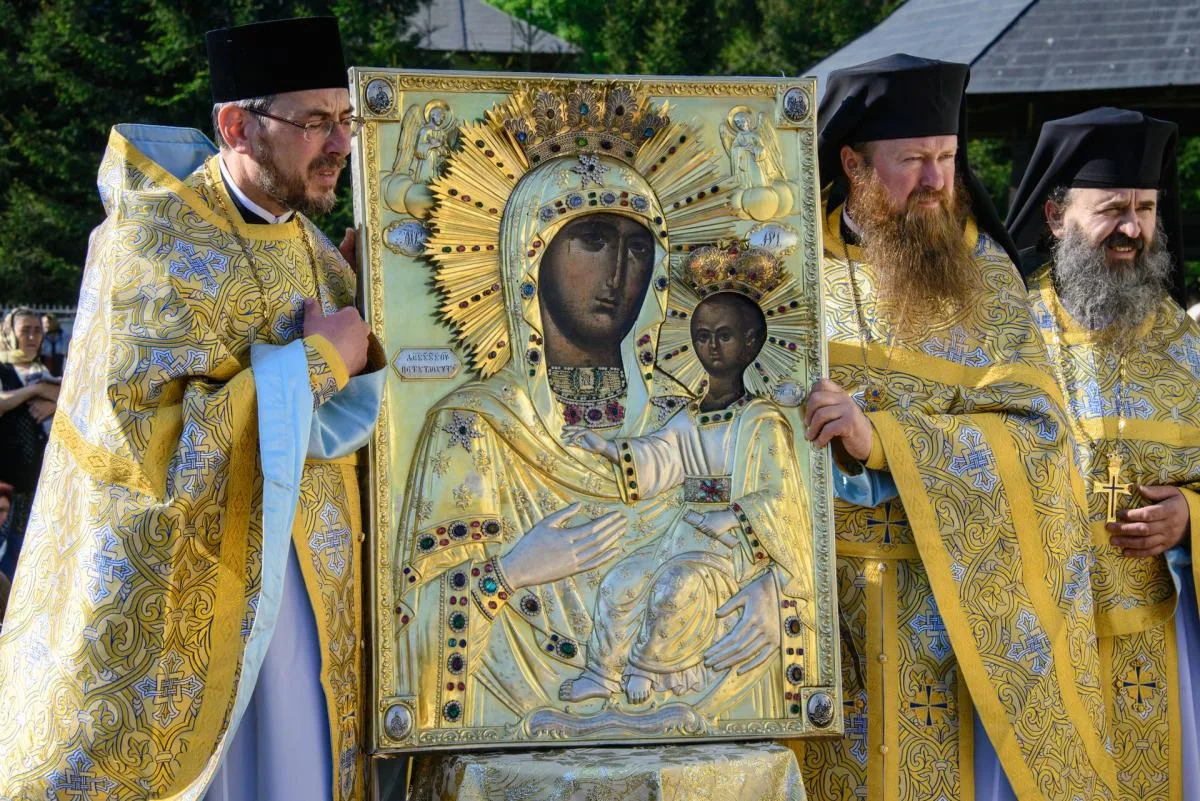
Photo: Neamț Monastery
It is known with certainty that the icon of the Theotokos from Neamț Monastery dates from the 14th century. “There are, however, uncertainties surrounding other icons. It is said that, in addition to the miracle working icon of the Theotokos from Neamț, an icon of Saint Anne with the Virgin Mary as a child, which is now preserved at Bistrița Monastery, was brought to Moldavia from Constantinopole. These icons were gifts from the Byzantine Emperor and the Patriarch of Constantinople to the ruler of Moldavia, Alexander the Good, and his wife, Lady Ana. It is therefore presumed that the icon of Saint Anne may also date from the early 14th century.
The age of the miracle working icon from Dintr-un Lemn Monastery, Vâlcea County, is also a matter of debate. The specialists who have examined it could not accurately determine when the icon was made. All of them gave various origin dates, ranging from the 13th to the 16th century. Unfortunately, due to the lack of more complex analyses, a precise origin date cannot be given to the icon, even though its riza has been removed” declares Cristina Cojocaru.
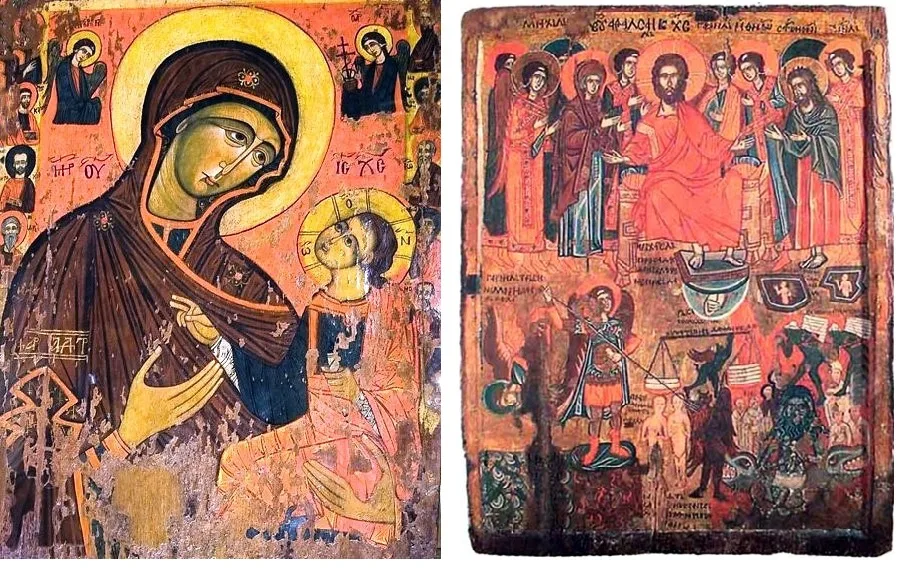
Photo: The Icon of the Mother of God at Dintr-un Lemn Monastery
Byzantine icons, whether painted in Constantinople, Greece, Russia, Moldavia or Wallachia, share a number of common characteristics, universally recognised and accepted as defining features of the medieval period. As we approach the modern era, certain changes begin to emerge and the Byzantine canon becomes more relaxed. Consequently, icons begin to incorporate Western influences, such as Renaissance, Baroque, Rococo, and so on. For this reason, some scholars speak of a “decline” in the Byzantine painting tradition. Cristina Cojocaru, however, has a different perspective. Rather than seeing this as a dilution of the Byzantine spirit, she regards it as a natural transformation over time, a process of renewal and adaptation to the changing course of society.
The Classical Byzantine Icon: Rules, Canons and Conventions
“Personally, I do not see it from this perspective, although many people are convinced that the Byzantine tradition began to be lost after the 16th century. Many, for instance, prefer Byzantine art in the form it took before the fall of Constantinople. What does this pure Byzantine character actually mean? First and foremost, classical Byzantine icons are characterised by the two-dimensionality of their compositions, drawing and modelling of forms. This creates an impression of transcendence by setting aside the rules of natural perspective and rejecting naturalistic representation. Everything is transfigured through a distinctive form of stylisation. Reverse perspective is utilised, which runs contrary to the so-called geometric, or Albertian, perspective, in order to dispel the perception of an immediate physical reality and transport the viewer into a transcendent one. In other words, the viewer is meant to imagine that the action or figure represented in the icon exists in the Kingdom of Heaven, in a realm not governed by the laws of physics that apply on Earth, but somewhere beyond space and time.
There is also the use of light and shading, those lines and hatching used to convey effects of illumination and depth, arranged in such a way that what we see in an icon is not a copy of reality, but a conceptual interpretation of it. The way the light and shading is used suppresses any sense of physical corporeality and suggests that the figures represented in these compositions are not human beings, but belong to the spiritual realm.
There are other drawing conventions characteristic of Byzantine painting. The eyes of the figures, for example, are deliberately enlarged because they were regarded as the windows of the soul, the means through which a person’s spirituality could be perceived. The mouth, by contrast, is depicted smaller than in reality, suggesting asceticism, silence and the inward contemplation to which the saints devoted themselves. The faces are generally stretched and emaciated, with markedly elongated noses, expressing the nobility of their nature while also signifying that those depicted were great ascetics who practised fasting. Through all these stylised features, the viewer is meant to understand that the figures portrayed in the icon have attained another dimension of existence, and that they led holy earthly lives governed by particular disciplines and restraints,” explains Cristina Cojocaru.
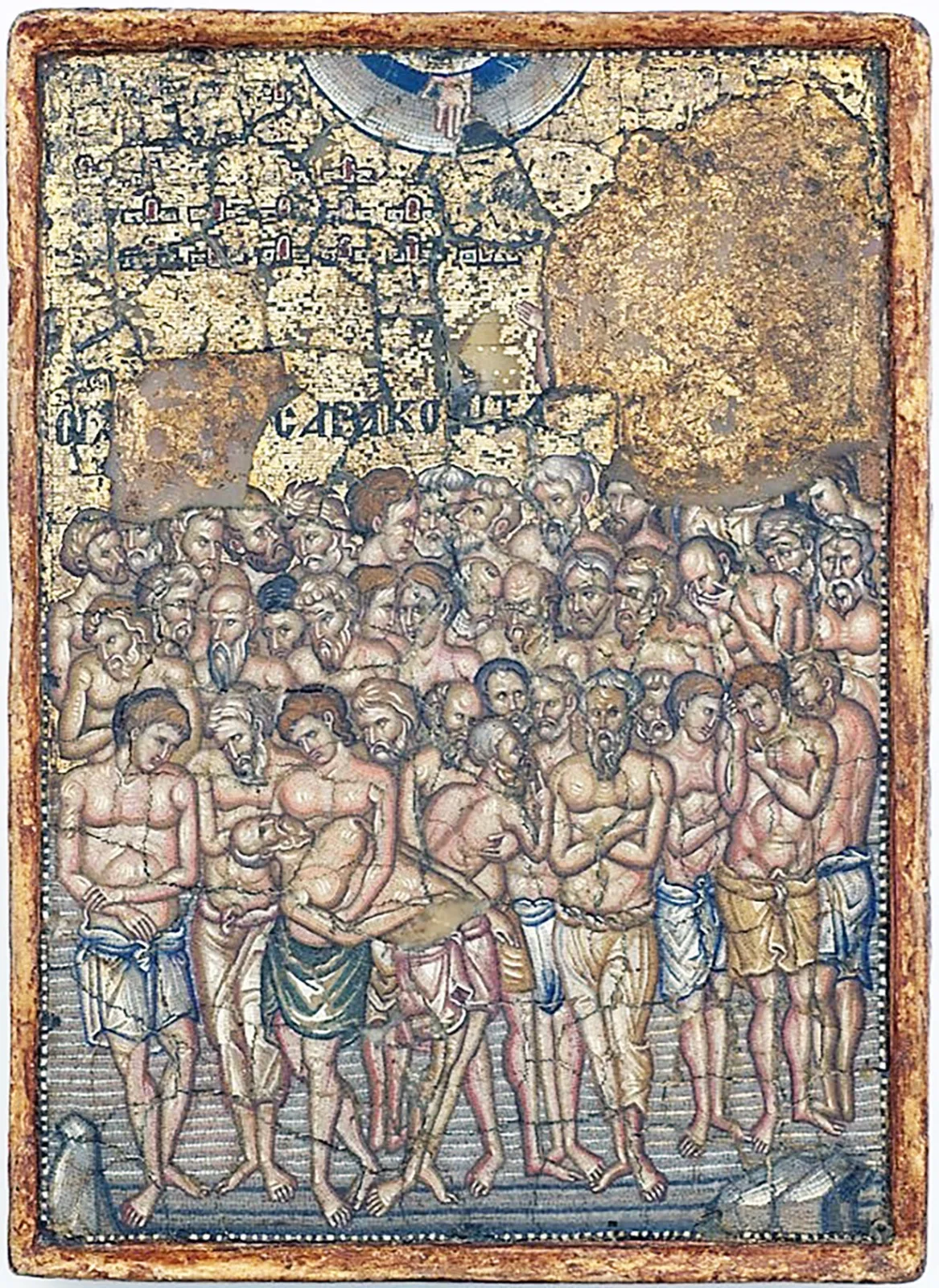
The Forty Martyrs of Sebaste, a Byzantine micro-mosaic icon, DumbartonOaks Byzantine Art Collection, USA.
Another defining feature of Byzantine icons is the principle of isocephaly, whereby the figures in a composition are generally depicted with their heads and halos at the same level. This was intended to suggest that all people and all saints are equal in the Kingdom of Heaven, as well as the belief that, after the Last Judgement, we shall all be resurrected with transfigured bodies. There are also specific chromatic codes and conventions, according to which certain saints are traditionally depicted in particular colours. The Virgin Mary, for example, is almost invariably shown wearing a deep crimson maphorion over a blue tunic. These colour conventions vary slightly from one period to another, but in general, icon painters adhered to them with remarkable care over the course of many centuries.
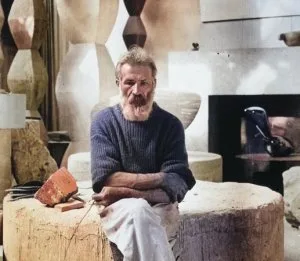
Although it is generally considered that we can speak of an authentically Byzantine icon only up to the mid-14th century, after which Eastern Christian painting gradually came under Western cultural influence, giving rise to what is known as the post-Byzantine period Cristina Cojocaru reminds us that the modern era also witnessed a significant revival of interest in Byzantine iconography. This began towards the end of the 19th century and gathered particular momentum during the 20th century, when “many modern artists have discovered themselves in this abstract visual language, which was of course, in tune with other forms of abstraction emerging at the time. Think of African art, or the inspiration drawn from folk art by some modern artists, including Constantin Brâncuși. There was a rediscovery of the Byzantine artistic tradition in Romania through artists such as Dumitru Norocea, Costin Petrescu, Nicolae Tonitza, Olga Greceanu and others, who incorporated elements of the conventions of Byzantine painting into their own work,” says Cristina Cojocaru.
Church painting has evolved over the centuries. Thus, a 17th-century work of ecclesiastical art can look remarkably different from one produced in the 14th century, just as 19th-century painting differs from that of the 20th century. However, this does not mean that we should impose a hierarchy of artistic merit or quality upon them. In the 19th century, the entire Orthodox world experienced a stylistic influence from the West, and many painters, including Gheorghe Tătărescu and Nicolae Grigorescu, created works of sacred art infused with Western influences, experimenting with new visions that departed from the traditional Byzantine manner. They introduced a Westernised, academic style into Romania’s monumental sacred painting, but this should not be regarded as a loss of either the spiritual or artistic value of these works.
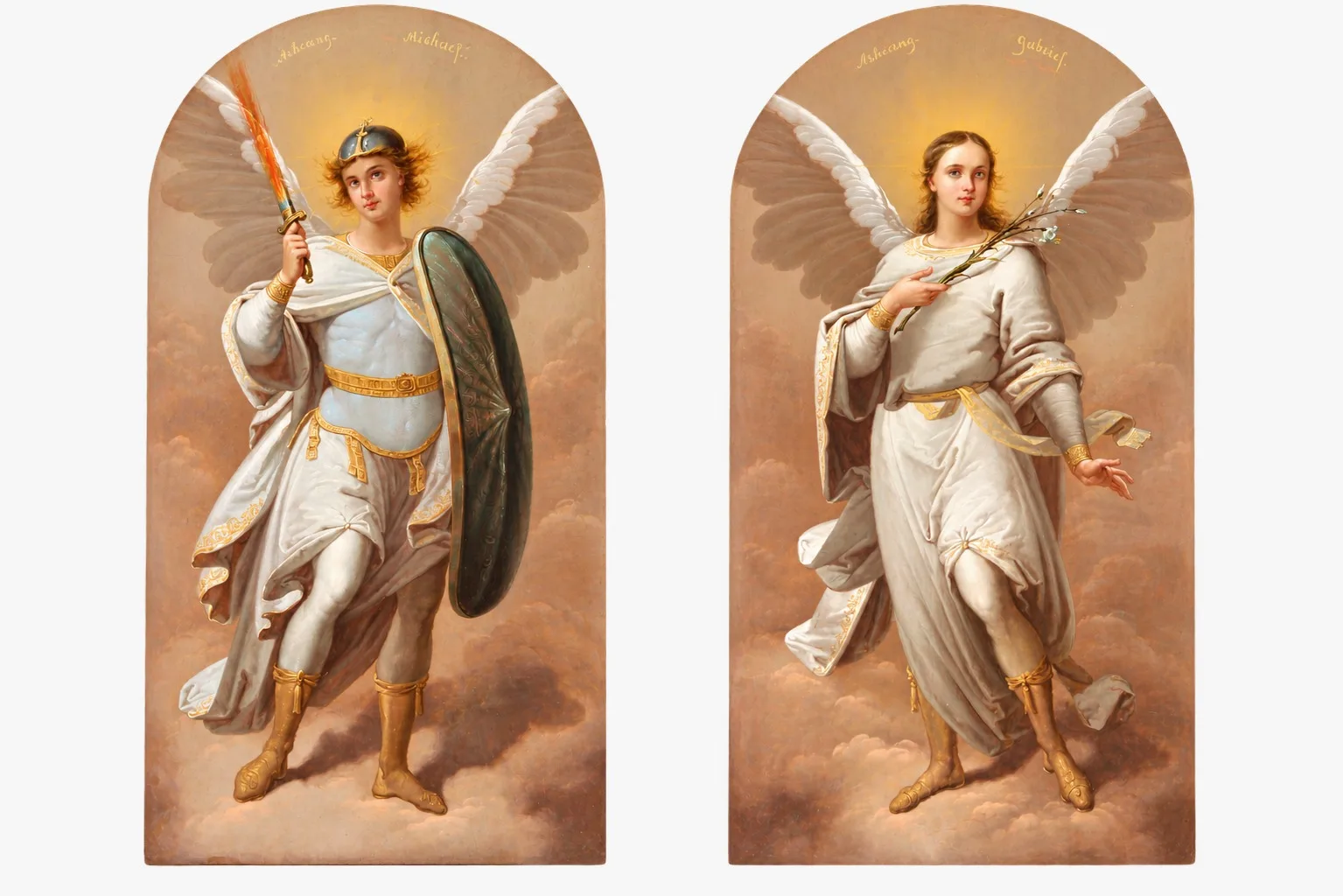
Artistic and Historical Value versus Spiritual Value
The effect a Byzantine icon has on the viewer, and its artistic impact, vary from one person to another. How can we distinguish between its artistic value and its spiritual significance? Cristina Cojocaru offers a particularly compelling answer.
“I believe there are three categories of viewers. The first are those who see the icon strictly in spiritual terms and believe that the saint depicted is present within it, in person, and that through this object they can communicate directly with the divine - that being precisely the function that Orthodoxy ascribes to the icon. Then there is a second category, to which I myself belong, who perceive the icon in both senses. On the one hand, we recognise its spiritual dimension, on the other, we understand its artistic qualities and historical significance. Finally, there is a third category of viewers who appreciate icons purely as objects of artistic expression and financial value, as do art collectors and those who admire iconography in museums and galleries.
So, it depends very much on the perspective from which a viewer chooses to approach an icon. I do not believe that any one of these perspectives excludes or invalidates the others. But, from my point of view, the middle ground is the richest, because it allows you to see both sides - to perceive the spiritual and the artistic dimensions simultaneously,” concludes the art historian.
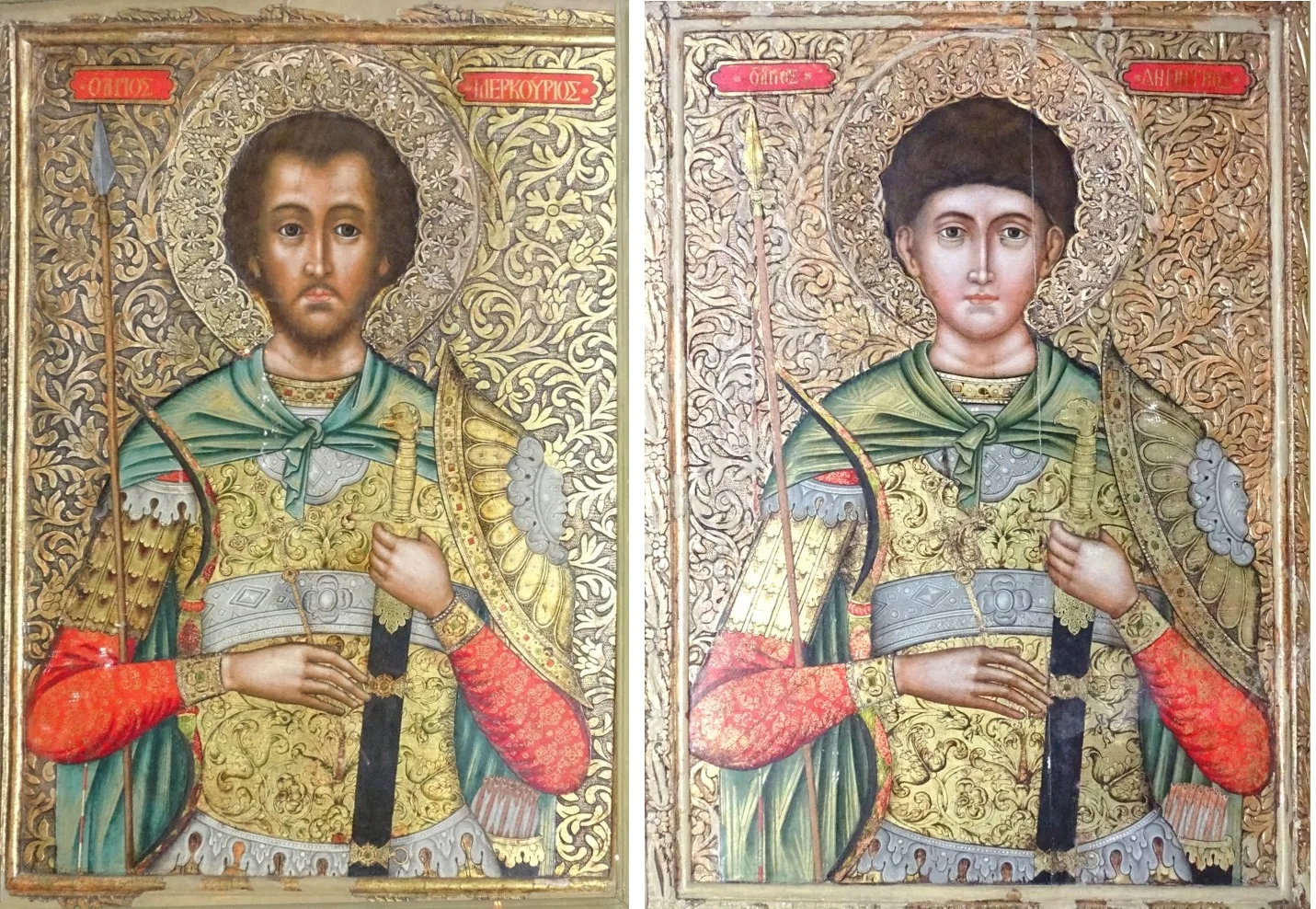
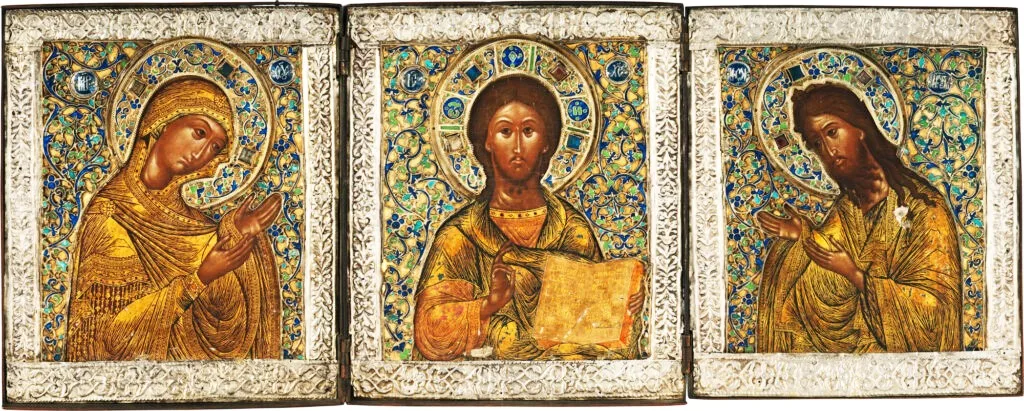
Imperial Icons from Plătărești Monastery, photo: Cristina Cojocaru
Cultivated Panel Icons Were Once a Mark of High Social Status, While Ordinary People Relied on Mass-Produced Russian Icons and the Glass Icons of Transylvania
During the medieval period, icons painted on wood were largely the privilege of the Church and the nobility. Ordinary people generally lacked the financial means and social connections required to own an icon, let alone several, in their homes. Until roughly the beginning of the 18th century, peasant families and residents of the poorer quarters of market towns could rarely afford to purchase or commission icons for private devotion. Such works were found almost exclusively in churches and monasteries, princely palaces and the mansions of prominent boyars. In earlier times, ordinary people did not even have the privilege of acting as church founders or patrons, as building a church or commissioning icons was an extremely costly undertaking.
“When people needed an icon for use in the rituals marking important stages of life - baptism, marriage or burial - they would borrow one from the church in their village or neighbourhood. For example, the custom of giving or receiving an icon as a wedding or baptismal gift - the so-called ‘house icon’ - first emerged among boyar families, then among wealthy merchants, and only later, towards the end of the 18th century, spread to ordinary people, alongside the development of mass production in this field. Wooden icons became considerably cheaper and more accessible to an ever-growing number of people from the late 18th and early 19th centuries, when specialised centres were established in Russia producing remarkable quantities of icons, either painted on wood or cast in bronze. For instance, entire families of painters lived in the village of Kholuy, with some workshops spanning four generations. Among them was the celebrated Gorbunov dynasty, particularly the masters Nikita and Ivan Gorbunov. By the middle of the 19th century, they were producing around two million icons a year, which were exported throughout the Orthodox world.
During the autumn, winter and spring seasons, when the weather was cold, the craftsmen remained in their workshops and worked on a production-line basis: one carved the wooden panels, another applied the gesso, another prepared the backgrounds, someone else laid down the colours, another added the inscriptions, while others applied gold leaf or worked on the incised decoration. During the summer, the icons were transported by covered wagons towards the Romanian Principalities and into areas of present-day Bulgaria, Macedonia and Greece, which at that time were part of the Ottoman Empire, reaching as far as Serbia. The icons were sold at fairs and at the patronal feasts of major monasteries, when large crowds would gather.
In Romania, Moldavia, Wallachia, Oltenia and even Banat, I have found thousands of such icons still preserved today, which gives us an idea of the enormous scale of this trade. Of course, we also had our own local icon painters, as well as numerous workshops, centres and families of artists, but they could not keep pace with the ever-growing demand. As a result, the inexpensive yet high-quality production coming from Russia became extremely popular,” explained Cristina.
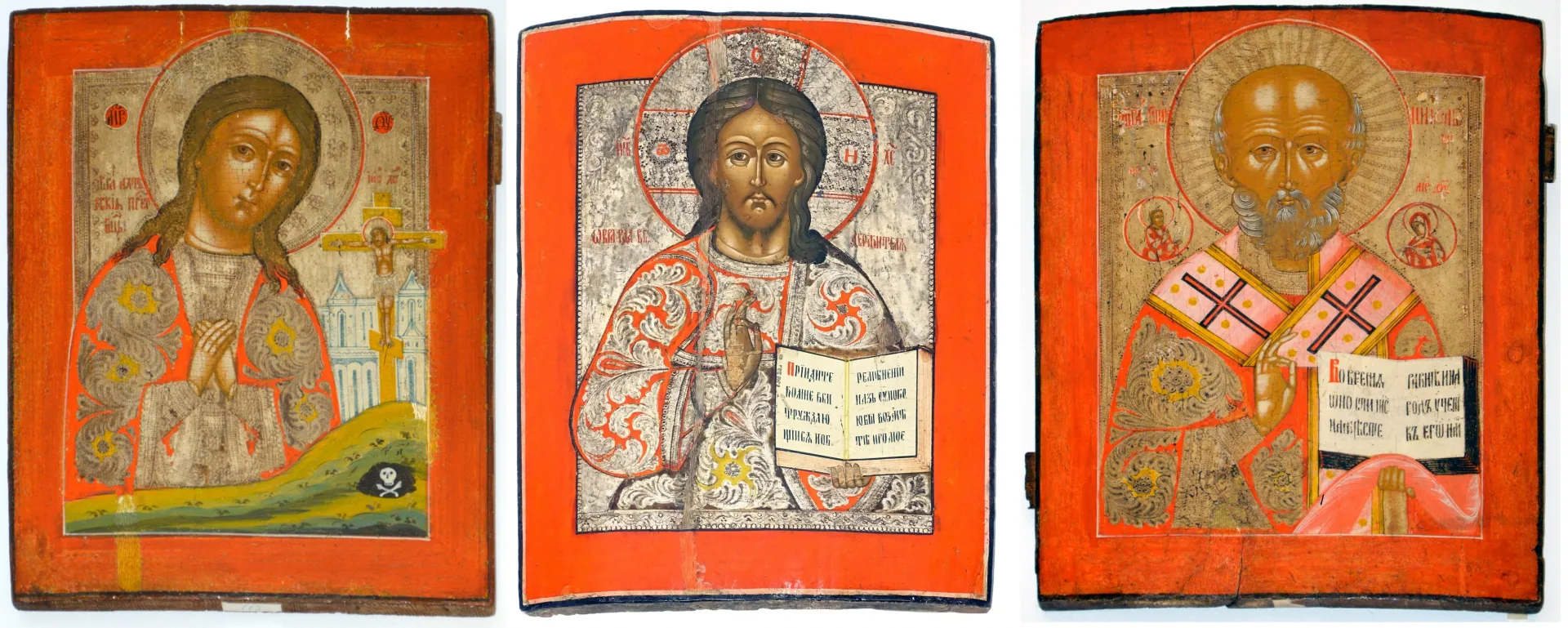
Source: Russian Icons from Transylvania. Exhibition Catalogue,edited by Ana Dumitran and Dumitrița-Daniela Filip, National Museum of the Union Alba Iulia Publishing House / Mega Publishing House, Cluj-Napoca and Alba Iulia, 2023.
Glass Icons Were Characteristic of Transylvania
While Russian wooden icons were the most accessible option in the southern and eastern parts of the country, glass icons became the most widespread form of popular iconography in Transylvania. “Glass icons first appeared in Transylvania around the middle of the 18th century, inspired by the folk tradition of glass painting in Bohemia. Their popularity, however, only really took off after 1785, when Emperor Joseph II of the Habsburg Empire banned the import of Russian icons for political reasons.
Glass-icon production therefore emerged precisely to compensate for the shortage of inexpensive wooden icons available to ordinary households. This is why the phenomenon of glass icons is found almost exclusively in Transylvania. In the other regions, Moldavia and Wallachia, there was no such ban on the sale of inexpensive wooden icons produced in Russia.”
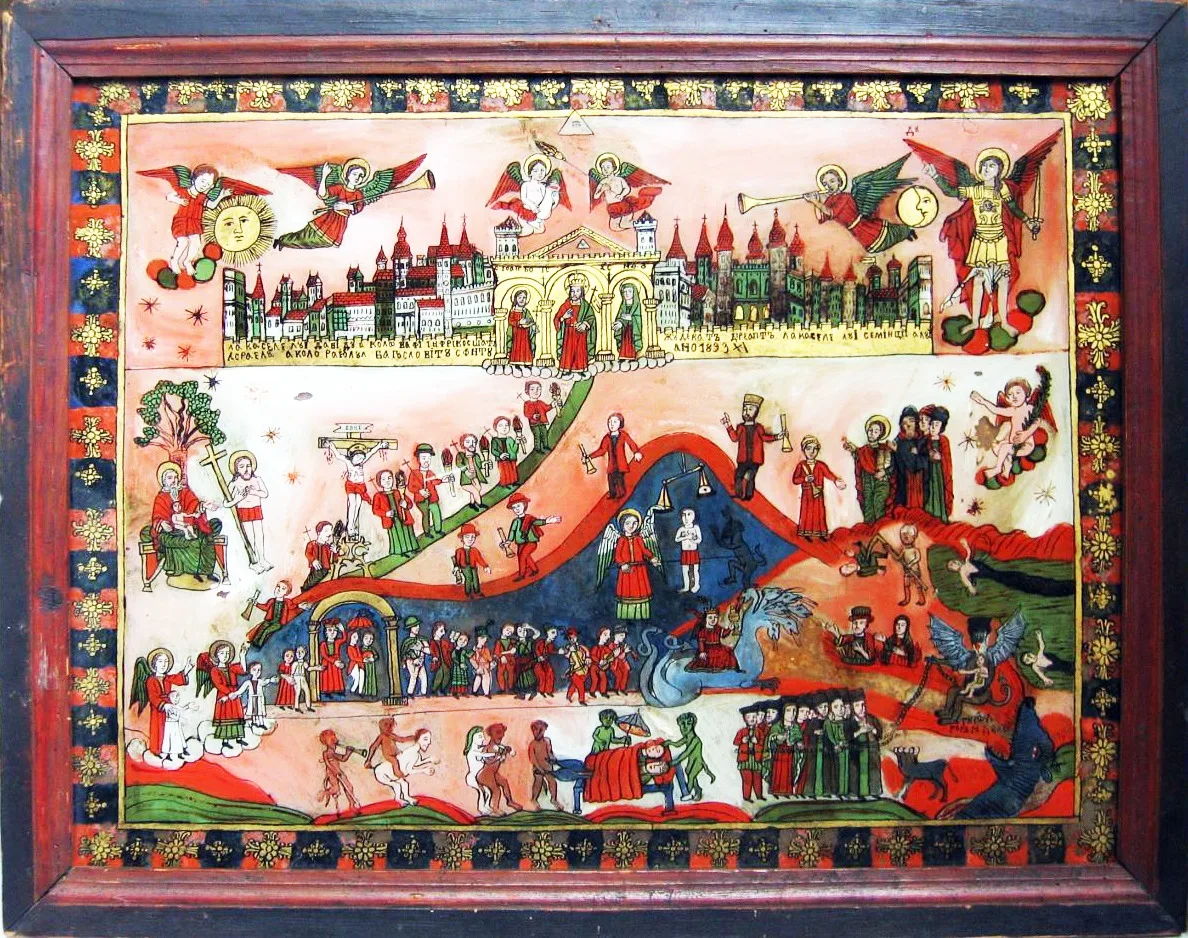
Photo: CIMEC – The Terrifying Last Judgement, Matei Timforea
Religious Heritage — A Historical and Cultural Testimony
It should be emphasised that, beyond their artistic qualities, ancient icons also possess exceptional historical value. We should not forget that the frescoes in churches and the icons on their iconostases are also historical sources, offering insights into rulers, boyar families and more broadly, the history of the Romanian people. The votive portraits found in churches bear witness to the past, telling the story of an era in visual form.
“Most of the surviving early evidence of our history is connected with the Church. If you look at museums, in the galleries devoted to medieval art and culture, you will find considerably less secular heritage than religious heritage, because objects of everyday use have not survived the passage of time to the same extent. It is not unusual to find icons, royal armchairs or liturgical vestments preserved in 16th-century churches, while not a single secular piece of furniture or court costume has survived from the palaces of the same period. This is because the Church played an essential role in preserving our local memory and the identity of the Romanian people, by creating and maintaining spiritual ties and a sense of unity among the three Romanian lands. That is why I would like religious heritage to be understood and appreciated not only for its spiritual significance, but also as a historical and cultural testimony,” says Cristina Cojocaru.
Painters Gheorghe and Ioan of Wallachia - The First Artists to Compile a Portfolio of Their Work
The painters themselves also had fascinating life stories, which can be traced through the icons and other works they created - particularly those who, alongside their artistic craft, performed other duties at princely and boyar courts. A notable example is provided by the Macedonian painters Gheorghe and Ioan, who worked in the service of Prince Matei Basarab in Wallachia during the first half of the 17th century. They left behind what can be regarded as the first curriculum vitae in the history of Romanian art.
”Believe it or not, they actually compiled a record of their activities - a kind of early forerunner of the modern CV, if you like - in which they listed the churches they had painted in Wallachia, including those at Căldărușani, Brebu, Strehaia, Cornățel, Plumbuita, Plătărești and Soveja monasteries. They also prepared something resembling a letter of introduction, with which they travelled to Russia in 1655 to present themselves to Patriarch Nikon of Moscow in the hope of securing new commissions. Beyond the fact that they were accomplished painters, it is important to emphasise that their remarkable careers were also shaped by their abilities as intermediaries and political agents,” says Cristina Cojocaru.
Another painter with a particularly fascinating life was Jovan Četirević Grabovan, born in Grabova, Albania. He began his studies in Buda (now Budapest) and subsequently continued his training in the Russian Empire, probably in Kyiv. He later travelled to Moldavia, where he painted the church of the Roman Bishop, and subsequently lived and worked for a time in Bucharest. There, he took on as an apprentice a young painter, Grigorie Frujinescu, also known as Popovici - none other than the grandfather of the painter Nicolae Grigorescu.
Grabovan spent more than two decades travelling in pursuit of his work, moving between the Habsburg, Ottoman and Russian Empires, covering distances of more than 2,000 kilometres a year. “Jovan, whom his Romanian apprentice called Chir Iancu, carried with him a notebook filled with sketches, notes, icon descriptions and painting recipes. Besides his work notes, he had also written down the birthdays of his nine children, who remained at home with their mother, first in Albania and later in Croatia. He also recorded observations about places and events he had witnessed, medical remedies, pharmaceutical preparations and magical practices, creating a kind of personal journal that is a treasure trove for researchers and the public alike. It offers a unique insight into the lives and mindset of people in the 18th century.”
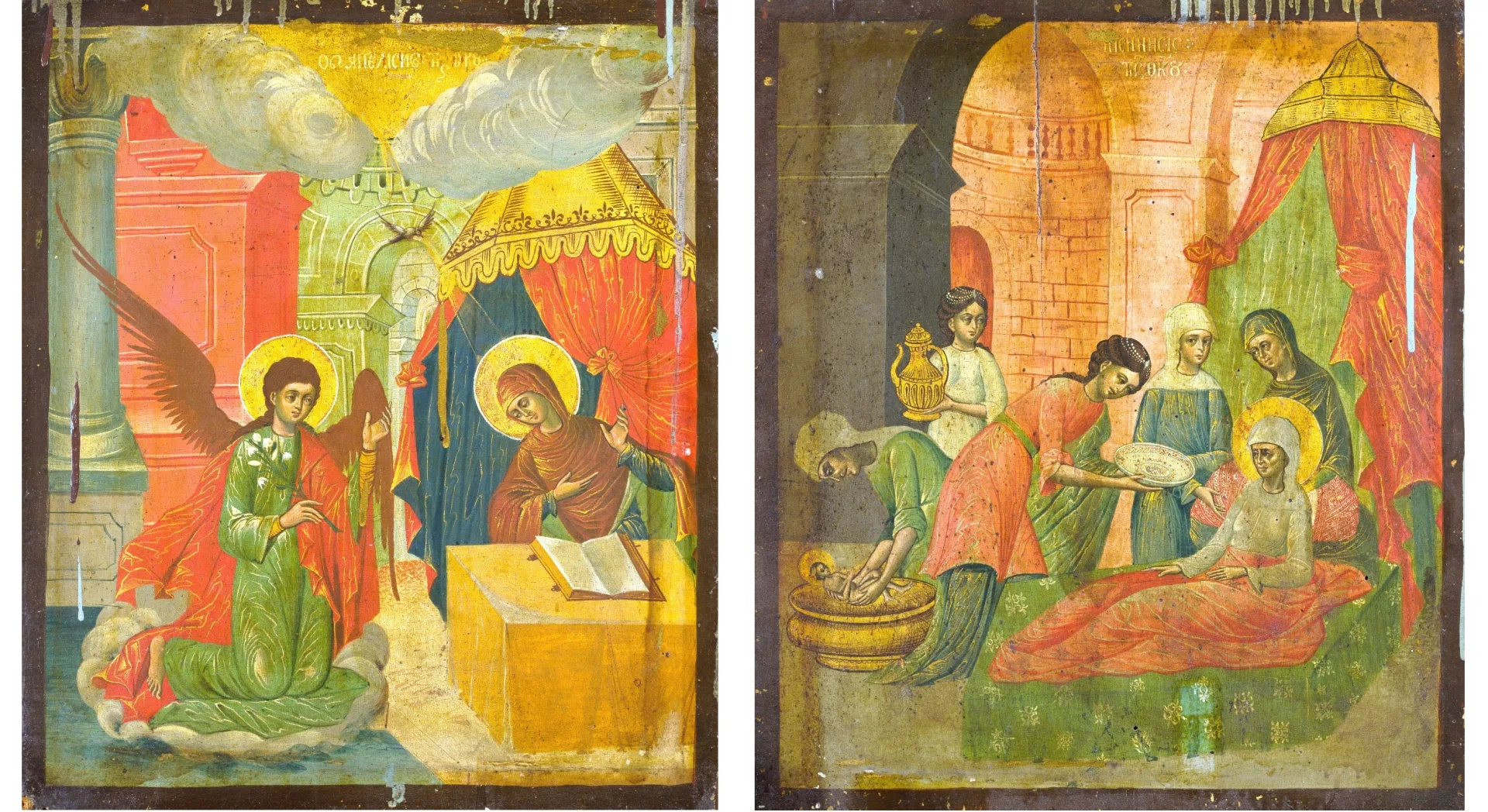
Jovan Četirević Grabovan, icons from
the Manea Brutarul Church in Bucharest. Photo: Serioja Bocsok. Source: Museikon.ro
Among the best-known names in the history of Romanian ecclesiastical art is Dobromir of Târgoviște, whose fame is closely associated with the celebrated paintings from Curtea de Argeș Monastery, founded by Prince Neagoe Basarab at the beginning of the 16th century and regarded as “a benchmark of beauty and artistic mastery throughout Wallachia”, according to the art historian.
“We also know the names of numerous painters who worked in northern Moldavia, contributing to the churches founded by Stephen the Great and Petru Rareș in the 15th and 16th centuries. These include Gheorghe of Trikala, who is believed to have worked at Pătrăuți and Hârlău; Gavriil the Hieromonk, whose signature appears at Bălinești; Dragoș Coman, who worked on the church at Arbore; Toma of Suceava, who painted the frescoes at Humor; and Stamatelos Kotronas, whose signature appears at Râșca. Many of them also held positions at court or served as diplomats. These celebrated names are merely the tip of the iceberg. Behind them stood many other painters whose names are known to specialists but not to the wider public.
There were also many more anonymous painters, apprentices and members of painting teams, since a church or a large icon was never the work of the master whose name it bore alone; many assistants were required. It is difficult to paint an entire church single-handedly, and in the Byzantine tradition collaboration was the norm. For example, the team led by Constantinos the Greek, who painted Hurezi Monastery, the Princely Church in Târgoviște and Râmnicu Sărat Monastery for Prince Constantin Brâncoveanu and the Cantacuzino family, also included Ioan, Ioachim, Stan, Andrei the Greek and Neagoe - all Brâncovenian painters trained in what became known as the ‘Hurezi School’. Another important artistic school of the period, which trained a large number of painters and left behind numerous followers, was that of Pârvu Mutu of Bucharest.”
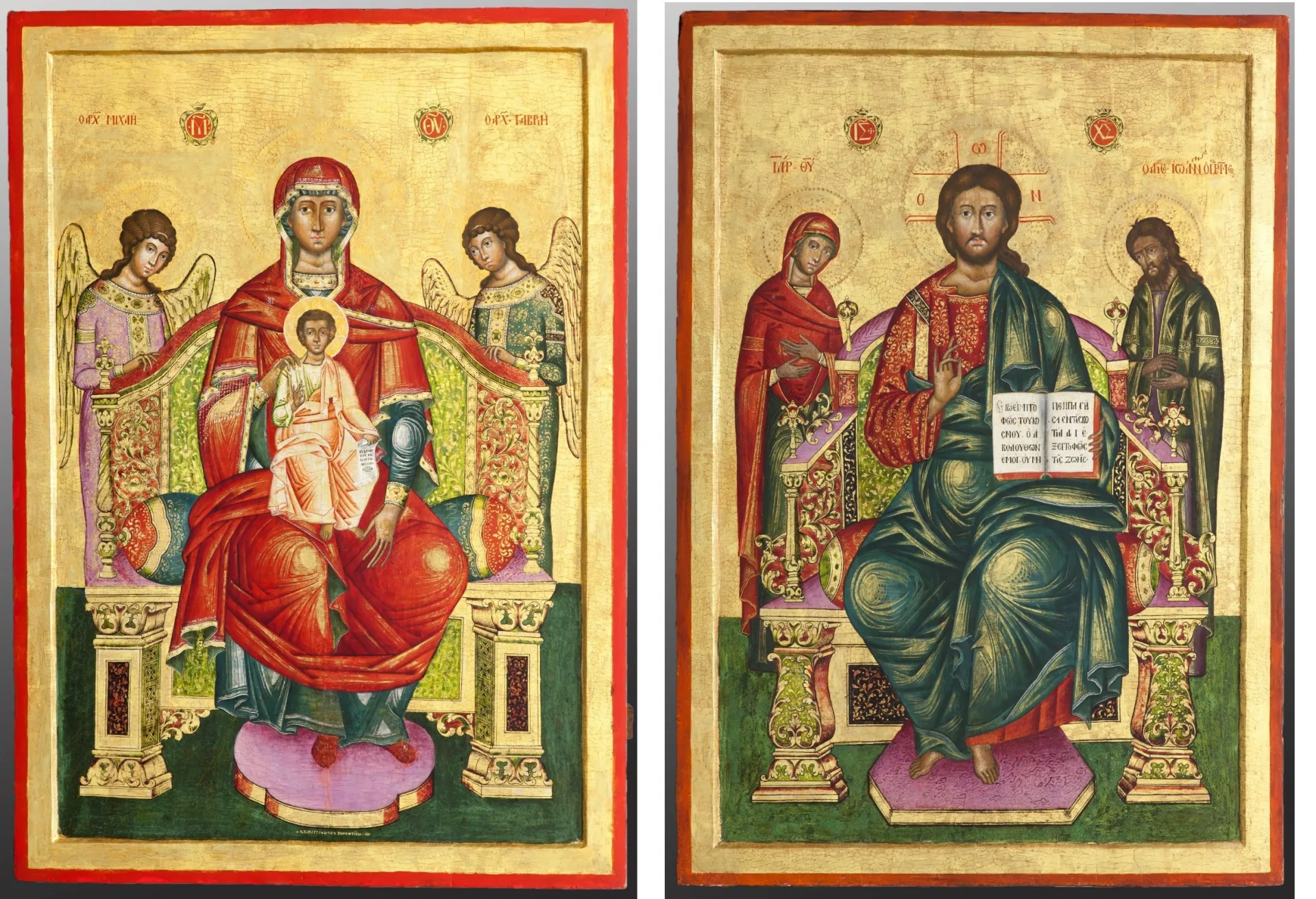
The Painter Constantinos the Greek, Imperial Icons from the Princely Church in Târgoviște. Sources: Wikipedia.org
The Greatest Threat to the Preservation of Icons Is Inappropriate Restoration
All these ancient icons must be preserved and conserved so that they may remain living testimonies to the Christian heritage of these lands for generations to come. We might be tempted to assume this is something that happens only in museums, but that is not necessarily the case. According to Cristina Cojocaru, “the greatest threat to the preservation of icons is unsuccessful restoration or restoration that fails to comply with all the regulations in force. I would say that an icon which remains in active religious use, in a church or monastery without structural or humidity problems, tends to be better preserved than one which falls into the wrong hands - for example, those of a collector without the necessary expertise, or an art dealer without ethical principles and eager to make a quick profit - and is subsequently restored improperly.
We have many examples of icons that have retained both their good state of preservation and their authenticity while remaining continuously in use, particularly when they were also protected by the riza I mentioned earlier. Of course, there are dangers everywhere. I know of museum collections that cannot provide optimal conditions for the works in their care. Equally, I have seen many neglected churches where icons have become infested with insects and fungi that damage their wooden panel, or where the painted surface has deteriorated because of candle smoke, overly aggressive cleaning by church staff, or fluctuations in temperature that cause cracks and lifting of the paint layer.
Most damaging of all, however, is the attempt to restore a heritage object excessively or improperly, through additions and overpainting that alter its authenticity and thereby cause irreversible harm. It is always better to leave an icon undisturbed, in the condition in which it is found within its own environment, and to focus solely on protective and conservation measures. Very often, in trying to do something good, we can end up doing far more harm” Cristina Cojocaru believes.
The art historian also draws attention to the danger of icons and other ecclesiastical treasures being stolen from churches and subsequently sold on the black market, where collectors may seek to restore them to their former splendour, subjecting them to alterations that irreparably destroy their heritage value. Cristina stresses the need for public-private partnerships through which religious heritage held in private or church collections can be promoted and brought to wider public attention, including through the mainstream media and social media, while never compromising on quality when it comes to its restoration and scholarly study.
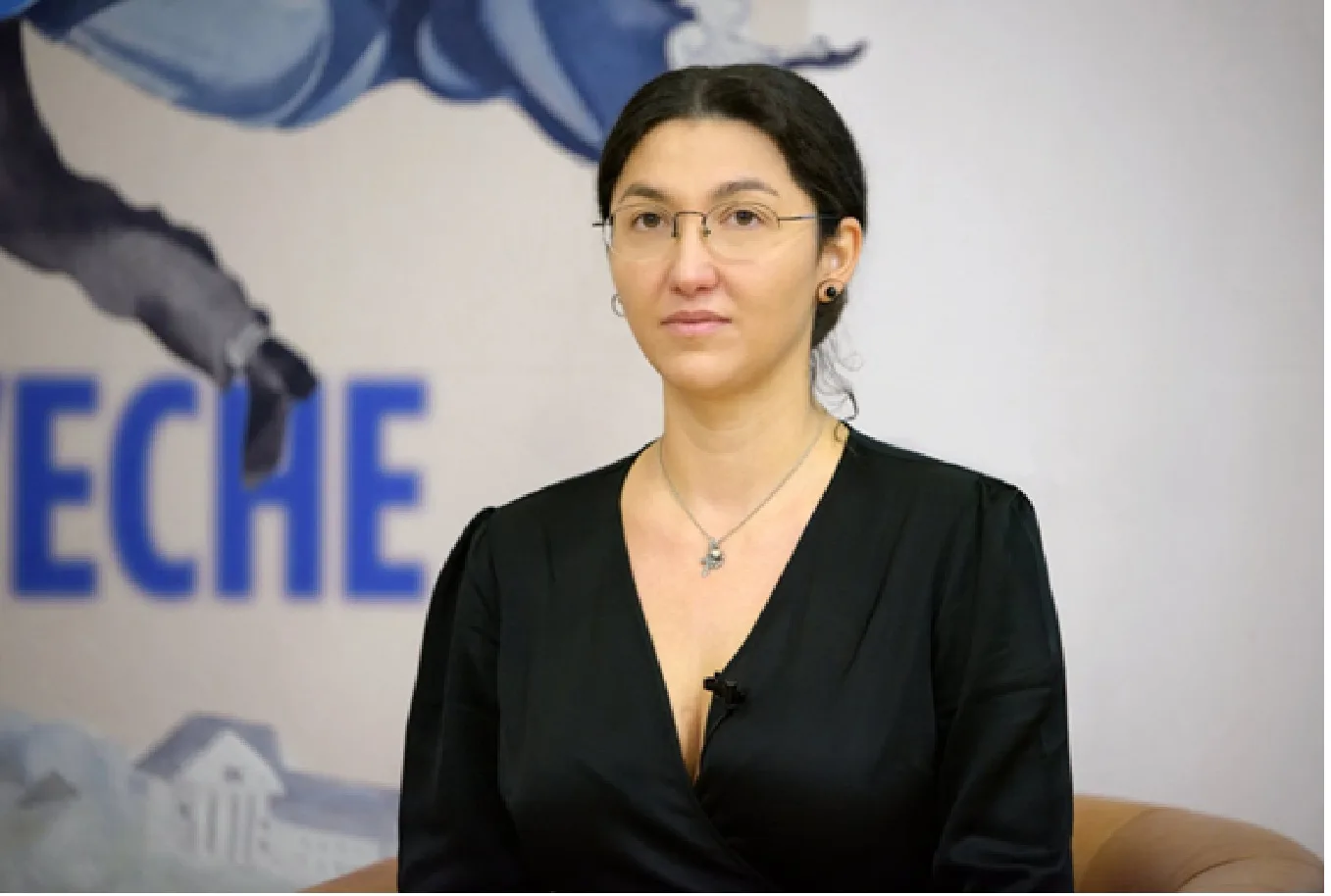
Cristina Cojocaru is a research fellow in the Visual Arts and Architecture – Medieval Period sector of the “George Oprescu” Institute of Art History of the Romanian Academy. She completed her undergraduate degree in 2011 and her master’s degree in 2013 at the Faculty of Art History and Theory - National University of Arts in Bucharest, where she subsequently continued her doctoral studies. In 2020, she obtained a PhD in Visual Arts and was awarded with the summa cum laude distinction, for her thesis, Tradition and Modernity in Orthodox Religious Painting in the Romanian Space, from the Brâncovenian Era to the Contemporary Period.
Born into a family of artists, Cristina encountered Romanian iconography from an early age and painted icons herself. As an adult, however, she chose to study art history and pursue a career as a research scholar specialising in pre-modern, modern and contemporary art. She is co-author of Iconostases in Bucharest. 17th–19th Centuries (2017), Saint Paphnutius – Pârvu the Painter. Tradition and Modernity in Brâncovenian Art (2017), and of the catalogue Russian Icons from Transylvania (2023). Her most significant recent contribution, however, has been her chapters on 18th and 19th-century religious art in the two-volume synthesis Art in Romania from Prehistory to the Contemporary Era, published by the Romanian Academy in 2018.