by Ioana Ciocan
How did the story of Ioan Sbarciu the painter begin?
If we are to talk about stories, there is a moment (an episode if you wish) that somehow marked my childhood… I was 4 years old and a friend of the family saw one of my realistic drawings that depicted two horses – and told me: You will become a great painter! He took the drawing and every time we met again, he would ask me what else did I draw…at school, my teacher was always encouraging me to draw. I was always the example to follow and this meant a great deal to me. I continued drawing; everyone knew this was my talent. So I decided, without any doubt in my mind, that I would be a painter. However, if we are to discuss my activity in this field, there were some important moments. First and foremost, I was admitted to the Institute of Plastic Arts „Ion Andreescu”. I studied there, I had professors I highly valued and friends and colleagues who inspired me ambition, I won first prizes in many national contests (back in the days, these competitions were the only way for students to make themselves known because there was no art market, no international artistic system – the Painting students from Cluj were competing against students from Baba`s or Ciucurencu`s classes in Bucharest). Afterwards, I worked as a professor at the High school of Plastic Arts in Cluj and this has a left a fundamental mark on me (I was with my disciples all the time, I have invested a lot of time and commitment to help them evolve, win prizes and become artists).
Before the Revolution, the Union of Plastic Artists had a closed attitude towards young artists – this seems extremely interesting today. There was no international context back then and the Union, controlled by the party, had its doors closed and the same artists were praised by the critics and appreciated by the public. I didn`t attempt to become a member at that point, because I was in total disagreement with the situation; I focused on my artistic and pedagogical activity; my works, in particular the Don Quijote series, were illustrating a lot of the convictions I had. After becoming a member of the Union (at the end of the 80s) I got extremely involved in its activities and became president of the Cluj branch and vice-president at national level and I also organized many exhibitions. However, after 1990, the fact that I became a full time tenured professor at the Painting Department within the Plastic Arts Academy „Ioan Andreescu” (currently the University of Arts and Design in Cluj-Napoca) determined me to fight for reforming and internationalizing the artistic university education; thus, the consequent jobs I had as the manager of this institution (senior teacher, dean, rector between 2000 - 2008 and president of the UAD Senate since 2008 and up to the present) played an essential role in the fulfillment of this aim (which
was not a personal one but it was the aim of our entire generation of professors and in particular of our students) and in the transformation of this institution and, I believe, of Cluj`s cultural context in becoming what it is today.
What recurrent themes and motives do we find in the universe of Ioan Sbarciu`s artworks?
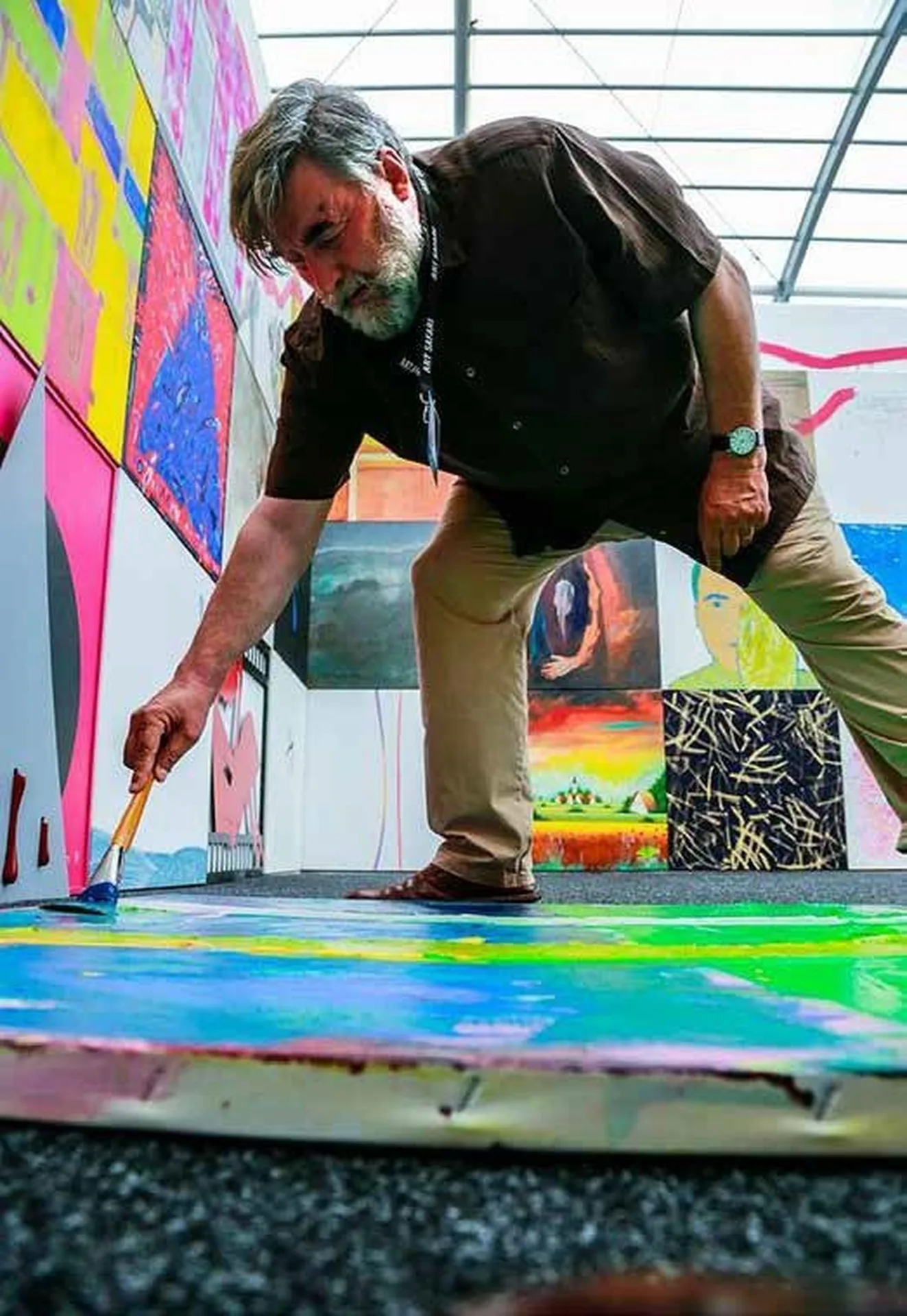
There are moments when a theme or an idea obsess me so I start from there. And I do it in several ways. In general, there are themes connected with the reality of course and so I start from reality and get my inspiration from reality. I desire, but without forcing it, to get to the abstract. And that`s because I am not interested in the exterior form, yet I know it is extremely important; for me tough, like Kandinski said, the inner sound matters so I am interested in the relationship between the forms (certain forms lay in colors, others in the drawing or in the embosser) within a space and it is always for implying something (a certain feeling or attitude towards the things we live day after day, an attitude which remains definitive in a moment that I consider to be finite – whenever it corresponds with what I want it to imply). I wish that the attitudes of my works imply something. To get there I feel some sort of a trance and I can work a lot if I have this state. My works do not please me all the time… sometimes I end up destroying them. But, anyway, considering that we are talking about painting, the idea is what matters the most and also the aim of the work, the message to convey. This is from where all other things emerge. The painter is some sort of a witness of what is going on in the world and practically speaking, his works are an attempt to mark the moment; he has to succeed in convincing or implying, he has to express himself beyond theoretical concept and common language. My themes are on one hand a sort of obsession coming from the childhood and teenage years that I lived in the socio-political context of the 60s, when the generations learnt to look beyond words (unlike today’s generations who are much more direct), read between the lines, look for the untold and so they unavoidably became self-referential. This self-reference trait was permanent, because, not being able to express – not even using a narrative or an anecdotal manner – thoughts into painting had to find other means. Back then I was also interested in the philosophy of this area, somehow obscure, secret societies, mysticism, things that seemed interesting because it felt like we had to find a personal labyrinth path for everything that would go on in the world, for everything that was mythical and symbolical. All my interests (Corpus, ladder, labyrinth, column, snake, birds, hexagon, triangle, octagon) are taken out from philosophy, but also from religion and popular art (in the end, it is the human figure in the center of the universe and everything has to be in harmony). All the significations of symbolic forms are utilized in relationship with the things going on today. Likewise, I am very much concerned with the contrast in order to be able to emphasize forms, but also for not taking the form out of the context and the passage – both concepts must be understood in their complexity. The usage of “exaggerations” or “diminutions” or the “elimination” of forms in order to build and emphasize contrasts must be in a certain harmony, where measure and balance are essential. A balance must be found. There are recurrent themes or motives that have accompanied me all my life and I cherished them or I often removed, rediscovered or offered new significations. There are themes with which I still enjoy working with. I would mention the series Don Quijote, Transylvanean Landscapes, Black Sun, Nudes, Corpus, Black Sun at Roșia Montana, Ash Forest, Kindapping Europe. The aim of my works, what I seek to express is beyond the mythological (like in some of the series – Labyrinth, Prey for the build up), social (such as the one connected to Roșia Montană) or even political (from Kindapping Europe) component is mystery. The mystery is maybe hidden in the frenzy of the daily life or maybe it has even disappeared completely from the contemporary world. In my works I am interested in compositions, colors, shades and the implicit. I seek the state of mind that I am conveying to whoever is looking at my work, the impact and the force. I believe this is the reason for which, in the last years, I worked more and more on very large canvases (7 m x 5 m, 5 m x3 m), having thus an entire series of Transylvanean Landscapes recently displayed at the Contemporary Art Center „Hugo Voeten” in Herentals / Antwerp, Belgium – this was both a challenge in the making-process, but also a huge contentment at the artwork’s completion.
How did the “Cluj School” phenomenon emerged?
Yes, there is a phenomenon known under the name Cluj School of artists. Accidentally, this is also connected to me, as many of those who gained international recognition were my students. Of course, there are many groups and waves of students and despite the fact that they got to a very high level (and this is without any doubt their contribution) there are many former pupils/students coming from succeeding generations who gained global recognition. The first generation after 1990 raised from the ranks thanks to Cristian Rusu, Dan Coroian, Bencze Laszlo, Miki Bencze, Percă, Luminița Dejeu – some of them had major contributions to the Mindbomb movement (an anonymous group, recognised at social, national and international level); after that, a second strong group was represented by Mihai Pop, Istvan Kudor, Andrei Cîmpan, Aurelian Piroșcă, Vartic, Victor Man, Adrian Ghenie, Șerban Savu who had great international success; then there is the generation of Marius Bercea, Mircea Suciu, Ioana Olăhuț, Veres Szabolcs, Betuker Istvan, Dan Măciucă, Oana Fărcaș, Anca Bodea Mureșan who work with very important galleries all over the world. I could also mention a third wave, another very large group of extremely talented and active young people who started to be seen: Ioana Iacob, Anca Badea, Lucian Popăilă, Mircea But, Alexandra Șerban, Oana Nastasache, Marcel Rusu, Szekely Bogdan, Filep Norbert, Cristian Lăpușan, Andrei Ciurdărescu, Andreea Tivadar, Anca Brânzaș and many others.I believe that an important element was our openness towards the international. And in this respect, I think I had a major contribution, because I wanted to sign partnership agreements with important international institutions (art centers, museums). For this purpose I put in essential work to convince them that we are interesting and important (our students who had scholarships abroad made an impression) and those who came to visit us were also impressed of what they found here. The point was that us, not having economical strength or a well positioned artistic system at an international level (gallerists and collectors that would place the artists together with the great names), we didn’t have the same achievement opportunities in the world; therefore, thanks to these contacts, some new horizons expanded and of course, some new ways emerged for artists to succeed. It is completely different from the way in which some people made a name for themselves – we all know that, we heard the stories, because there is no rule. It is very easy right now to have a context and a Cluj School, because its prestige brings important international visits of some gallerists, curators, museum directors who, aside from the famous names, get to see other less known artists and this means an opportunity for them. The Cluj School has gradually emerged, more on an international level, after the year 2000, following all the factors that have determined this phenomenon. One of our students, Mihai Pop, took a curator class in Germany, part of a Leonardo da Vinci mobility scholarship and after coming back to Romania (together with Adrian Ghenie) had launched Plan B project, which today is the most important Romanian gallery (recognized at global level). The international prestige of the Cluj School of artists is linked to their efforts and to Adrian Ghenie`s connections with important names of the contemporary art scene, Victor Man who is a true talent, Marius Bercea and to Mircea Suciu who are currently working with some major galleries around Europe and the USA (Mircea Cantor is also involved, but he was only briefly our student as he studied in Nantes and I think it was through Idea and Tim Nădășan that he kept in touch with Cluj). The accomplishments of Mihai Pop in the first phase and afterwards of all other Paintbrush Factory artists have had a huge contribution. Presently there are also some other galleries that do well at international level, but Plan B had an essential input; it would be impossible for me to not acknowledge this. The fact that the Cluj School of painting became famous is also due to a certain type of education that we are promoting here – discipline combined with creative freedom. Right after 1990 we have attempted to create a very solid school, based on a fundamental, rigorous system of education, with all the clear and firm rules of an academism that is not at all simple. Then, we wanted to emphasize creation so the first two years focus on basic education, but the second year is more about creation and then the third year, the Master and PhD. are all about personal creation). The idea was for us to adapt to our students and not the other way around. I think we have succeeded in creating thissystem; certainly, in time, the results will be visible. The changes we made in the area of painting shall last. We did everything very seriously. We also had the opportunity to have a very good team: Florin Maxa, Victor Ciato - older and very demanding artists; I was next in age and then Ioan Aurel Mureșan and Nicoale Man. We left a mark in the school; we were very concerned to provide complete freedom so that our students can be themselves. I hope that the younger team (Marius Bercea, Florin Ștefan, Istvan Kudor, Ioana Olăhuț, Anca Bodea, Andrei Ciurdărescu, Veres Szabolcs, Ioana Popa) will carry on with this type of education. Certainly, it is up to them, but our school was and is very appreciated in the world. I have tried to inspire a direct relationship between professor and student, exigent on one hand, tolerant and understanding on the other (no exaggerations tough). I spent a lot of time with the students, to better understand them and for them to be able to understand me. This teaching is more than just knowing the theory of color and the laws of composition, in fact it is necessary to be very careful to create a state of harmony or competition (again, without exaggerations), a state of pleasure and joy. The students must be helped, guided, but, in fact, I tell them from the very start, that they could disregard my opinion entirely. Art education is something of extreme complexity. The Cluj School is not only based on this formula, but we aimed to form them as disciplined, solid artists with strong personalities. The education of a student is more than what they do at the university, the reference points around them matter a lot. In time, their honesty and moral fibre are very important. The Cluj School exists. There will be many romanticized stories about this phenomenon. And there will be groups saying “the Cluj School is just us”, or others saying “we are better than this groups”. In fact, we are all contributing to the Cluj School, because, if we were to define it, its specific roots are in a fundamental academic education and emphasize on a completely free creation.
What are the painting arguments and the plastic structures of Ioan Sbarciu`s works in the context of contemporary Western art?
After 2010 and after neorealism (that I accept, but have some personal and inner reservations due to the period of socialist realism in Romania), the art that is promoted today at an international level matches the things I do very well. I have many proposals for gallery exhibitions, art centers, and important museums…I believe I do very well in the current international context.
”I spent a lot of time with the students, to better understand them and for them to be able to understand me… in fact it is necessary to be very careful to create a state of harmony or competition (again, without exaggerations), a state of pleasure and joy.”
How is the pedagogical activity of a professor-artist, whose students are writing history in the great galleries of the world?
My pedagogical activity is complex, it is like a game. It is easy to play as long as generations change, they are more and more interesting and informed (the today generations have the library in their pockets, they can get information at all times; it is incredible the point where the world gotten to). In this respect, there are some extraordinary students. As long as we succeed creating a framework, a working vibe where the students desire to come and work then it is very pleasant to do the job. As long as they are enthusiasts and they desire to climb many stairs to get up there, then relevant communication links are being created. It is not simple to have an internationally successful student and still maintain balance within the group. This requires working experience with young people in order to be able to contribute to their education. However, the professor must not expect gratitude from them. We should believe that each and every one of them has something of a genius. It is important not to destroy the personal touch and I think this is something that requires time to create. Experience and concern for a specific age, education, background, upbringing, context, moral fiber… everything matters in working with art students. This is not a place where we teach standing at the desk. This is an area where the professor must draw closer and get to know his students. Perhaps one student requires a tougher attitude, otherwise he doesn’t understand or accept and others require a great deal of care. It is important not to destroy their wings…not even one feather. Anyway, it is not the professor who creates those feathers, he can only produce a context to help them shape or strengthen their wings; it is important to be able to ease their flight, without changing it…we can`t put an eagle wing on a swallow, because it will be incapable of flying… Working with each student is very, very different and it is a very inciting and pleasant activity knowing that 2nd or 3rd year onwards they will already be in the international eye. The professor must always adapt to the new generations and to the things that happen in the world, otherwise he is outdated and thus excluded. The effort doesn`t come from the student, but from the professor who must adapt to the students and not the other way around. Therefore, it is of extreme importance to know each generation, what their expectations are and to give them what they expect; it is only at this point we can intervene and give more. Anyhow, it is up to them to choose from what they are being told or whatever matches their personalities. Or, when someone comes to ask for help, giving them a hand is very important.
Tell us some thoughts on the artistic present of painter Ioan Sbarciu.
My artistic present…is going through a good phase because I have some ongoing projects in galleries and museums…things are going well… I am delighted with my situation.