by Monica Crânganu
You are one of the contemporary Romanian artists most prized abroad and this fact is well known and certified by numerous prizes, recognitions and participations at the most important international events and art shows. Your success was confirmed naturally, gradually and the path you have built with solid steps is ongoing. What is your artistic element that has remained constant in time and represents in fact the pillar on which the world`s appreciation and popularity is based upon?
I am one of the Romanian artists who have an international career, but I am not the only one. We live in some interesting times and we can have more than a few types of success – financial, among the public or the critics etc. Romania currently has approximately 20 names of active and renowned artists on the international scene. This is a small miracle. Some of them live in Berlin or Paris. I live in Sibiu. My success has come gradually (I made my debut before the times that make us superstars this week and then next month we are forgotten). It took me ten years to get out of school and another ten to be able to find a plastic and conceptual language that would please me. After working for twenty years, success has emerged… I like drawing. I draw in my notebook, on the walls of the great world museums, in a small artist run space in Heraklion or on the staircase of Negruzzi High School in Târgu Ocna. I loved to draw since my very beginning… for as long as I can remember.
”Contemporary art is no longer about being gifted and working hard. Global competition doesn`t allow us to exist unless we are well informed and curious.”
How would you describe the contemporary art vibe of today? What is it that we lack?
We lack the institutional support. Any city has a state theater and philharmonics, but it doesn`t have a Kunsthalle (“white cube”) with staff and production budget paid by the state (the city hall or prefect’s office). In Romania there are no scholarships for individual creation or workshops spaces provided by the local administration. None of the candidate cities for the European Capital title (the long and the short list) have any investments in visual arts. There are no programs to reconvert communist industrial buildings into workshop or display spaces. The cities are building football stadiums and shopping centers. There is no coherent cultural policy for visual arts, no fiscal thinking (as you may see all the freelancers are being crushed); there is no tax discount for artists or sponsors and their financial and time investments into art. There are no life annuities for artists (and if there are merit scholarships or places in the Academy, then these are awarded for the conservatory, Eminescian positions so to speak, and not for the revolutionary ones). A painting by Grigorescu is better off than Dada. There are many good things in Romania (artists, projects, independent spaces and even commercial galleries), but the general emphasis is on the market (money, money and art fairs) and not on the research… What is that we lack in Romania? We lack investments in visual culture, theoretical research and long term ambition. If we are to summarize the condition of the artist, it would look like this: no pension and no health insurance!
Why did you chose to live in Romania considering that your value and international recognition offers multiple opportunities in countries that are much more open from the cultural point of view?
I have invested here a lot of energy and time; we need critical and independent positions in this country, we need solidarity and support. I got used to living here (although, once every ten years the scene changes, the amnesia comes back and we start over, we drop things or, on the contrary, we come up with new and interesting ideas) with our madness, with the artistic motivation outside the art market. Abroad everything is already built (there are still some questionable issues and this is why I am permanently invited to analyze them), on the other hand in our country everything is still to be done. And I am saying this with all due respect to those who spent their lives building remarkable cultural platforms in the 27 years of freedom so far. I love contradiction, greater contrasts, denser touches and the humor…either absurd or constant. Lia Perjovschi (editor`s note - the artist`s wife) has produced in the 90s a contemporary art archive that didn’t include Romanian art, but art that was forbidden here for 50 years. Back then, we felt it was our duty to share the things we were discovering and seeing the big world with the small world of our country. We now feel the same. We are lucky to participate to the great artistic events of the world and we see how the international art is done and conceived from the inside; this is something that we also need to share here. It is also about mental comfort. There are no surprises here, although we are being shocked every day.
Do you believe in native talent, in the “gift”of an artist or is it that his value must be shaped up during school? What did the old Romanian art school teach you?
There is talent in boxing and in making pancakes. Whatever happens with it depends on the institutional context and the resilience of the individual. Contemporary art is no longer about being gifted and working hard. Global competition doesn`t allow us to exist unless we are well informed and curious. And I am not talking exclusively about art, but also about politics, social theories etc. Aesthetics ceased to exist on their own; now we have aesthetics in certain contexts. And the context of contemporary society is complex and permanently changing. Romanian school has educated my fingers and not my thinking. In a way, it pushed me to get into an outline that wasn’t my own. If we look at a pre-school visual art manual (the age when children draw more expressively than their teachers) we can see the intention of putting the individual into a template, an outline and of cutting his curiosity or rebelliousness. It could be very easy…The technology we have today allows us to be only one click away from any great biennial or art museum in the world…The Romanian art education is still focusing on techniques and not on lines of thinking. And, to make matters worse, it doesn’t have anything practical in it. The future artists don’t learn anything about being a freelancer, about taxes, commercial galleries, price formation and alternative financing sources. So, they fall into a void after graduating from university. Just as I did, back in 1985…
The art that you make is unique also due to the particular and less conventional ways in which you have chosen to express it– visual art, performance, gestures. What is the freedom that all these offer you in comparison with the traditional means of expression – painting, sculpture etc.?
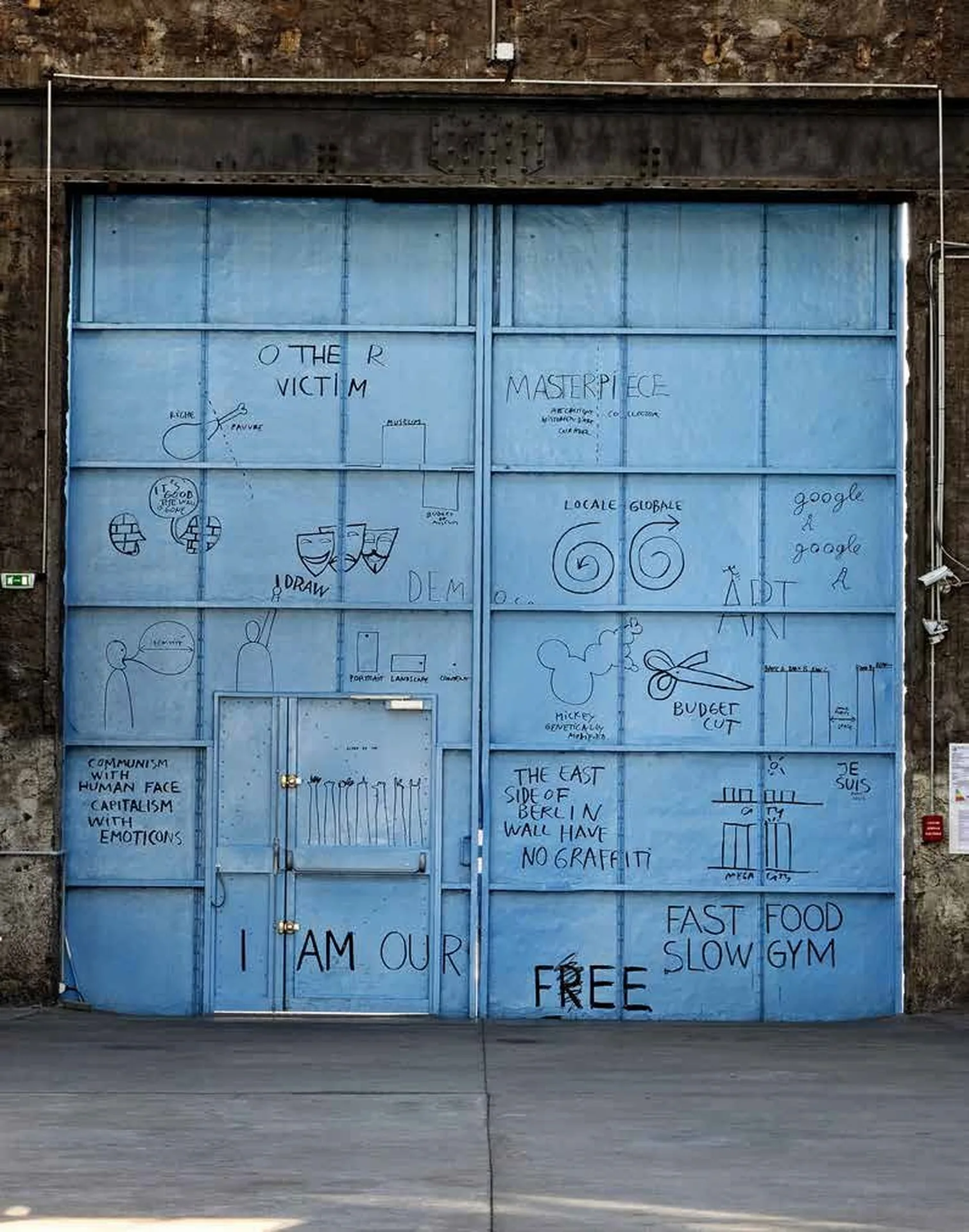
First of all I am free to do what I want, the way I want it. Those who invite me do not know beforehand the things I am about to draw and I don’t know either while on my way to the exhibition. In other words, I receive a blank cheque (there is a term in English that I like a lot and it comes from tennis - wild card). I receive this freedom and along with it comes responsibility. I receive some square meters of free expression. And I can’t forget that I was educated during censorship, I don`t forget that other colleagues of mine from Kurdistan or Palestine, Burkina Faso or Venezuela, and even New York or London cannot express themselves freely, either because of political or economical censorship. Whenever I draw, I am trying to speak also on their behalf. I don`t need transportation or insurance (I skip the associated costs and bureaucracy). I can adapt to any space, wall, window, ceiling, floor, entrance hall, staircase and hallway. I am free to make mistakes. I am free to change my mind. I am focused on what I do…on ideas, 12 hours per day.
Your drawings and caricatures are often momentary and volatile sometimes their fading away becomes an act of creation. Considering that each artwork is unrepeatable, what do you feel whenever you erase your drawings, even when you do it as an artistic act, after long days of work and focus? Do you do it easily?
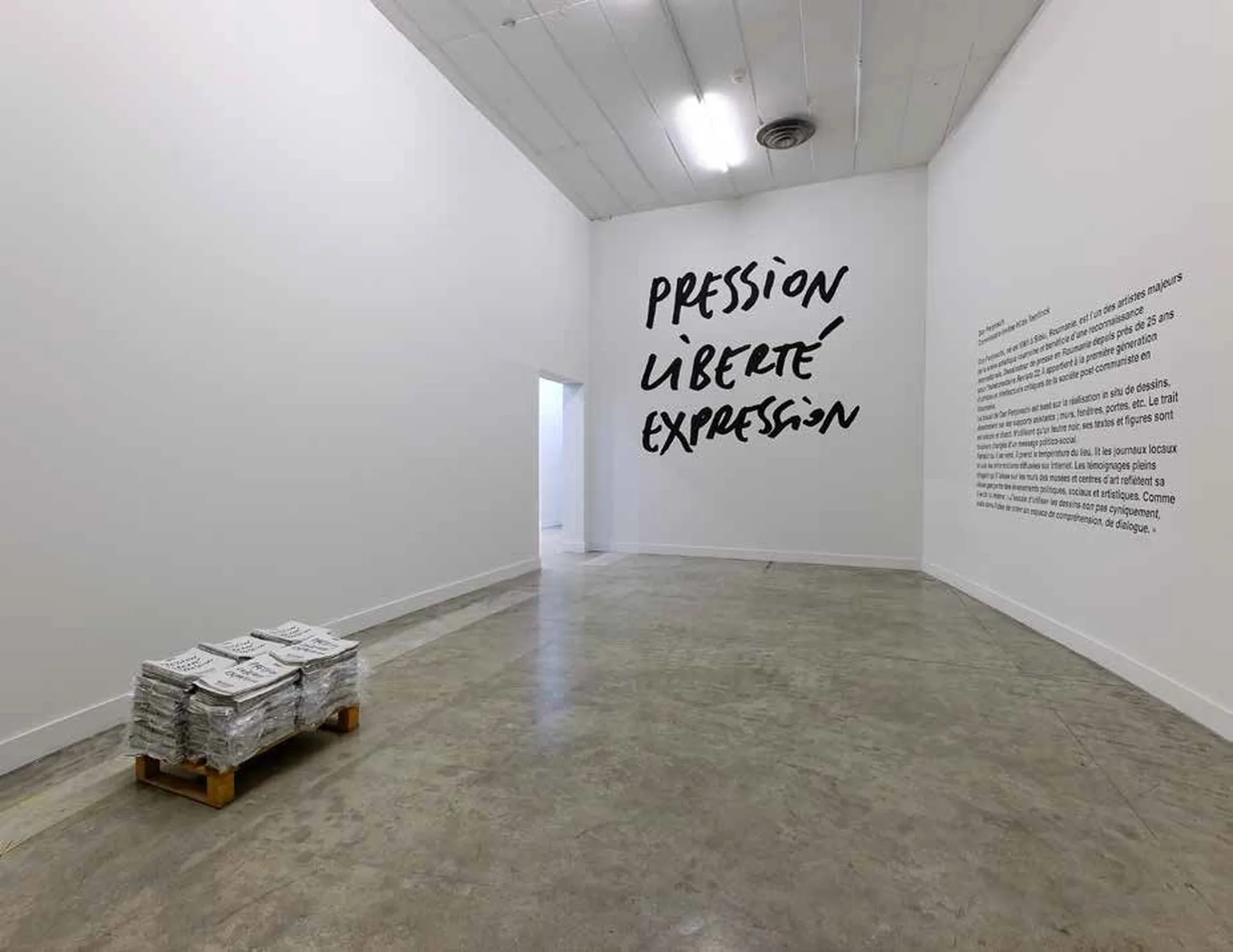
I don’t erase anything. The institution that had invited me is the one that erases the drawings. I recycle my drawings, I don`t let them die; I move them from one wall to another, from a continent to another. The context around them disappears…Indeed I have incorporated the fading in the flesh of my projects. They all come from a notebook, a micro-workshop where they are invented and re-drew until they get to a form that is transferable to a wall.
Nothing of what I drew so far got lost. But the “show”, the “spectacle” is fading away. The ideas remain; Gedankenbild – like a German critic used to say. Whenever I know that my mural drawings shall be erased, I receive a great deal of freedom of expression. I can make mistakes. I can change my mind. I can change things on the following wall. And this means freedom of thought and freedom of the drawing line. You know, after 35 years of working, no matter how much ephemerality I desire, the system is fixing me (one paper drawing here, an artist book there, the door of that museum, National Technical Library in Prague, a blackboard here, a wire drawing there). Once we make ourselves seen, we shall not fade away.
Creating becomes an objective in itself, it is a modus vivendi that gets fulfilled at a conceptual level; it doesn’t materialize into a physical object. Your creations bring to life public spaces, walls and windows – apparent mundane and unconventional places- and convey social and political messages. What else is inspiring you?
It is not an objective in itself. It is part of society. I am a reporter (either an economical, political or a cultural one) and what you see are my documentaries or my essays. I extract ideas from the press (in particular the written one), from everyday life (streets, coffee shops, terraces, stores) and from the discussions I have with the people around the project – the curator, director or the doormen of the museum where I display. For some years now I get inspiration from social media. It is like an enormous and ultra-complicated puzzle that produces a summary of a few lines. I am extracting the essence from the daily wrangle. And for this, any space is good (windows, hallways, ceilings). I am inspired by everything that can be expressed with humour and intelligence.
Is there a special place/public space where you would wish to intervene and to change things and you didn’t have the opportunity yet?
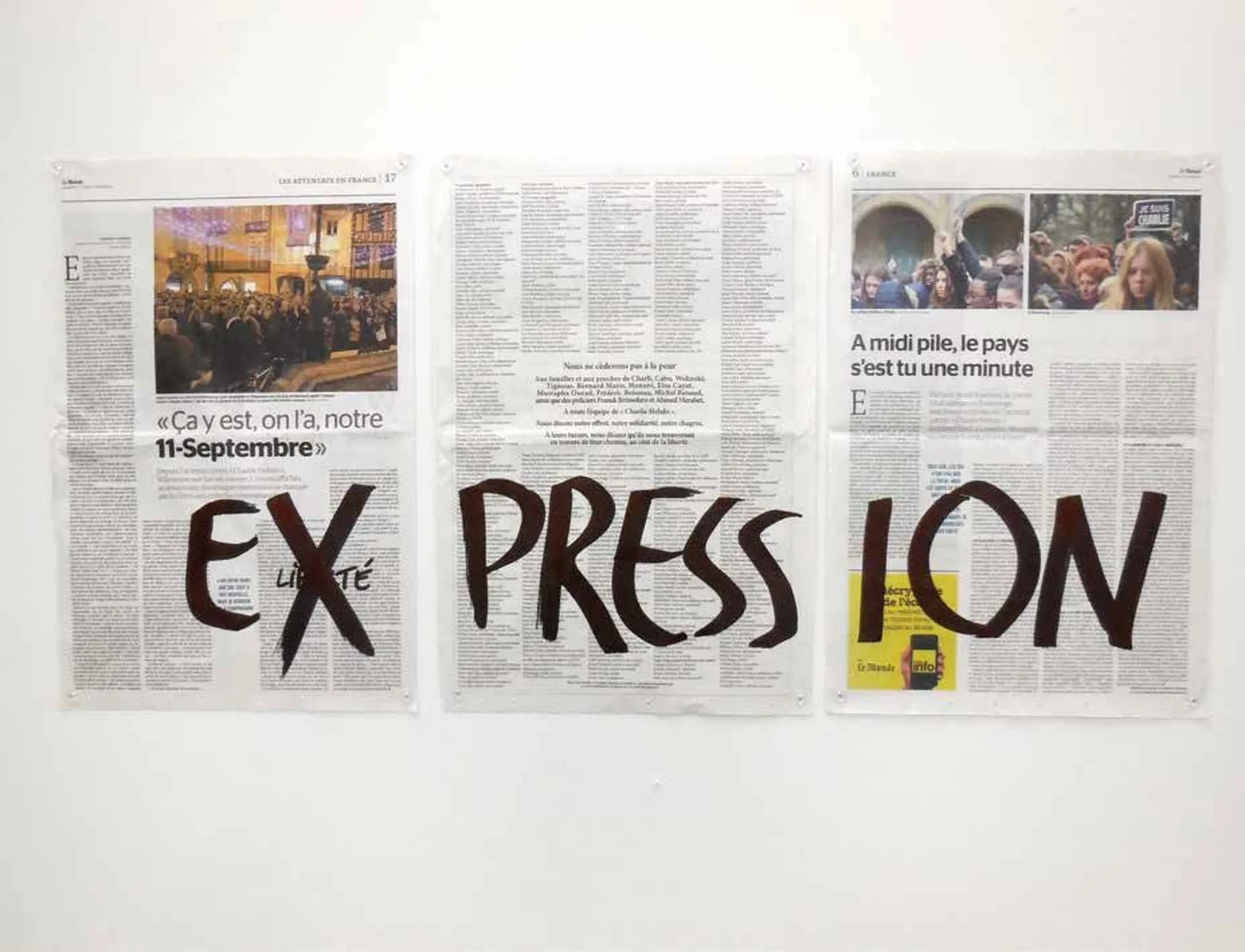
No, I don’t have any preferences. I drew (and I liked it more than doing in the museums) community libraries in Zagreb, a high school in Târgu Ocna, the worker`s canteen in Bristol etc. There isn’t an ideal „wall” for me, except maybe the one in Sibiu that I am continuously drawing and re-drawing since 2010. But, life always provides new situations. I made and I drew newspaper walls or the underneath of transparent glass floors. I got to the walls of the museums I was only dreaming about. It is very good. Caricature drawing and illustration are in fact a summary of messages and they hide an intelligent story, with irony and humor.
What did you get out of the long experience as illustrator working for Revista 22?
I started working for Contrapunct, the magazine of young writers. When the miners came to Bucharest, I was there. Drawing for the intellectual press has modified and simplified my expression. I had to create some images that “illustrate” the text or better said the subject of the text, which would also withstand without the surrounding text. This is a very difficult activity, particularly when the text is sophisticated. The more sophisticated it is, the simpler I am. I have balanced between the expression of the raw drawing and the caricature-comics convention and I have found a good synthesis. I do intellectual humour, not the trivial laughing type. I have drawn week after week since 1990 up to yesterday and of course this led to a graphic metabolism with a rapid reaction. In other words, I don`t make much effort to translate a text, a concept or a chance event into images. In the last few years I didn`t release images out of words, I just handled words as being images. I love language or better said languages (I manage in English and French and a bit in German an Italian) and right now I am working with letters and words, with cross-language and with the global language of companies. Since 1990 and up to the present time I have one meter and a half of drawings at magazine Revista 22. It is a sort of second Art Academy… and I am still studying for my master`s degree.
What are the values in which you strongly believe and make your artistic message so concrete and incisive?
Empathy… I don’t want to challenge or to break anything. I seek to understand the subject. I understand whatever I draw. If I understand, then I can share it with you as well. Humour is just like playdough… it can be moulded.
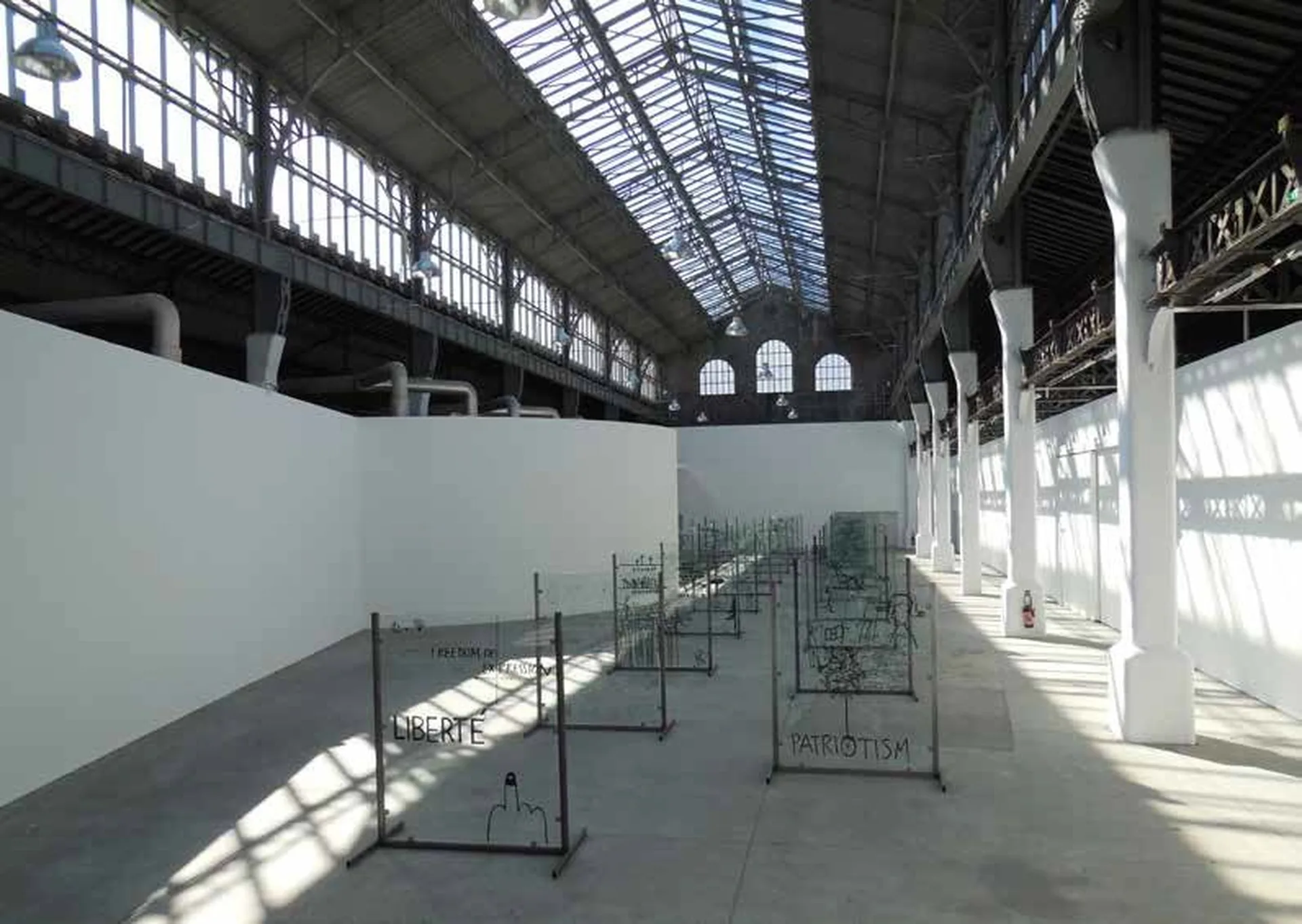
”You know, after 35 years of working, no matter how much ephemerality I desire, the system is fixing me. Once we make ourselves seen, we shall not fade away.”